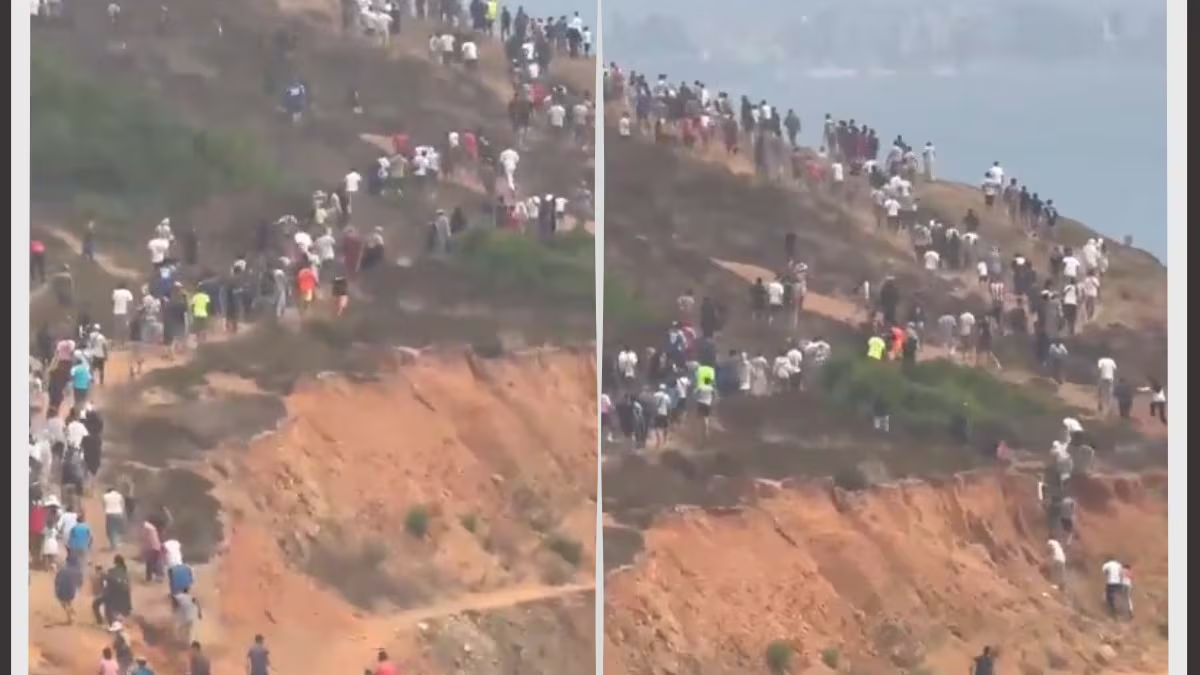
Situated on the Mediterranean coast in North Africa, Ceuta is small in size but holds immense strategic importance. Spanning approximately 18 square kilometers, this city is an autonomous region of Spain located on the African continent. This means the land belongs to Africa, but the administration belongs to Spain, making it a part of the European Union’s borders. Ceuta is bordered by Morocco on one side and the sea on the other. This geographical location has made it a crucial entry point for migrants trying to reach Europe from Africa. Ceuta has a population of approximately 84,000, so the sudden arrival of even a few thousand people poses a significant challenge for the local administration.
Why is Ceuta a dispute between Morocco and Spain?
Ceuta’s history dates back centuries. It was conquered by Portugal in 1415. After 1580, it came under Spanish control and later became a permanent part of Spain. Ceuta remained under Spanish control even after Morocco’s independence in 1956. Morocco still claims the Spanish North African territories of Ceuta and Melilla, while Spain considers them part of its sovereign territory. Therefore, the border here is not a typical international border. It is a highly sensitive political boundary between Europe and Africa.
Why do people choose the sea to reach here?
Ceuta’s land border is guarded by high security fences, surveillance cameras, police, and border security forces. Crossing the border by land is therefore difficult. Therefore, some migrants choose the sea route. They attempt to reach Ceuta from the Moroccan side by swimming or using small boats. Many attempt to swim entirely by sea. This is an extremely risky route, as currents, fatigue, cold water, and the crowds pose a risk of drowning. The sea has been the scene of several major migration incidents in Ceuta.
Where do people who come to Ceuta come from?
Not all people who come to Ceuta are citizens of the same country. The vast majority come from Morocco, but migrants from sub-Saharan African countries have also arrived. Many migrants from different parts of Africa first arrive in Morocco and then seek a path to Europe. These movements can be driven by a variety of factors, including economic opportunity, unemployment, poverty, insecurity, and the hope of a better life in Europe. Therefore, the story of Ceuta is not just about people traveling from Morocco to Spain, but is intertwined with the entire Western Mediterranean migration route.
What happened in Ceuta in 2021?
Ceuta’s most prominent migrant crisis erupted in May 2021. At that time, approximately 8,000 people entered Ceuta from Morocco in a matter of days. A large number of them swam across the sea, and a significant number of these were young people and minors. The sudden influx of such a large population put a tremendous strain on the city’s administrative system. Spain deployed troops and even military vehicles at the border. Thousands were later deported to Morocco. This crisis also compounded the ongoing diplomatic tensions between Spain and Morocco.
Does Morocco deliberately open its borders?
This is one of Ceuta’s most controversial layers. Whenever large numbers of people move toward the border simultaneously, questions arise about why Morocco’s security system suddenly weakened. Even during the 2021 crisis, there was debate in Spain about whether Morocco loosened border controls to exert political pressure. However, attributing every major migrant crisis to a government conspiracy to open the border is factually inaccurate. Border security arrangements, local conditions, migrant networks, and information spread on social media can also play a significant role.
Why is it so difficult for Spain to leave Ceuta?
Ceuta is not just a city for Spain. It is the African end of the European border. Weakening border control here could impact not just the local administration but the entire European migration system. Therefore, Spain has developed robust border fences, surveillance systems, police, and maritime security. Despite this, when thousands of people move toward the border simultaneously, the police system is put under extraordinary pressure.
Why does the army have to be deployed?
The primary reason for deploying the military is unusually large crowds at the border and increasing pressure on security. When the number of people exceeds the normal capacity of the police force, the military may be deployed for border security, patrols, and monitoring of critical areas. Spain also did this in 2021. The military was primarily used to control the situation and secure the border area, while legal and humanitarian processes related to migrants continued to be handled by the police and administration.
What is the real story of Ceuta?
The true story of Ceuta lies in its small geographical area and its extraordinary political significance. This city, located in Africa, borders the European Union. On the other side is Morocco, which does not recognize its territorial claim. Between them, thousands of people from Africa travel to Europe in search of economic opportunities. Therefore, every migrant crisis in Ceuta is not simply a matter of border congestion. Behind it are many layers: Morocco-Spain relations, European border policy, migration, human trafficking, economic inequality, and humanitarian crises.
This is why Ceuta, which appears small on the world map, is considered one of Europe’s most vulnerable borders. The distance between Africa and Europe is minimal, yet the attempt to cross it often results in fatalities.