
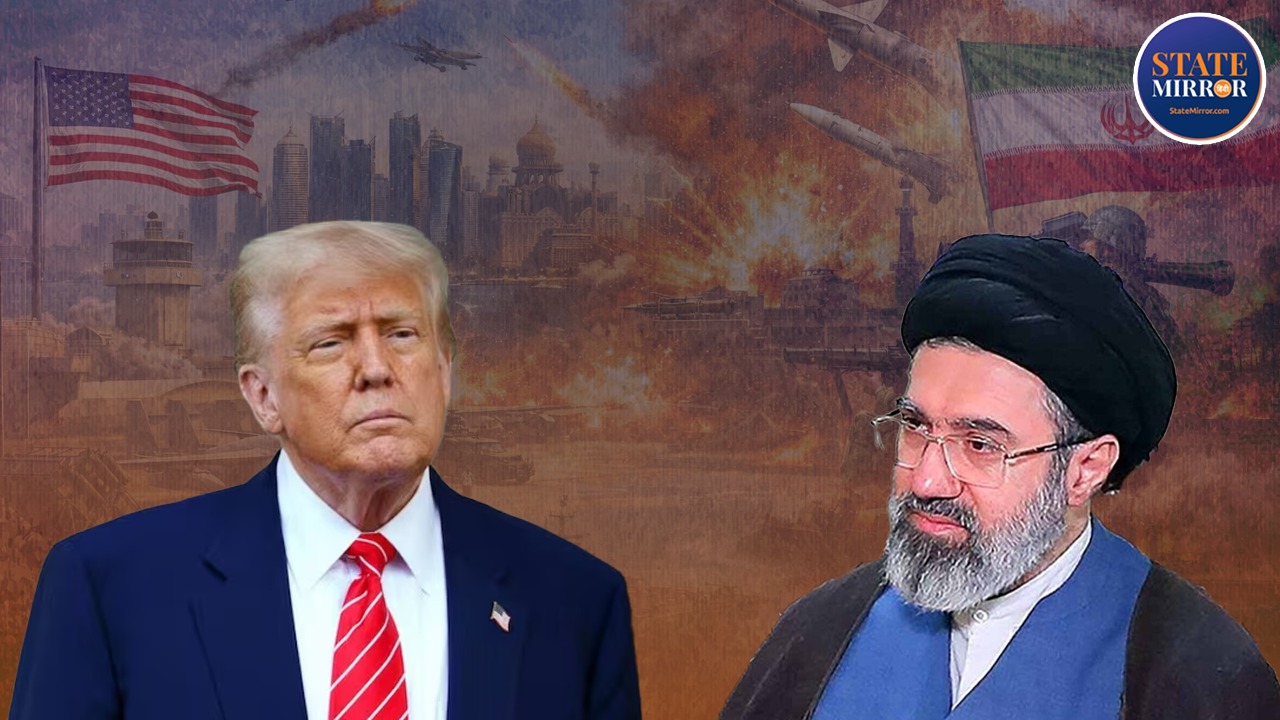

The tension between America and Iran that has been going on for 88 days has now gone far beyond the limits of traditional war. This is no longer a conflict limited only to missiles, soldiers or borders, but has now transformed into a global war, a model of instability operated through many connected networks. War Expert – This is called “network instability”. This means a conflict that cannot be completely ended by military force alone, as it is based on multiple interconnected mechanisms such as proxy organizations, cyber attacks, maritime pressure, ideological influence, oil supply routes and digital propaganda.
This is the reason why despite tensions between America and Iran reducing several times or a ceasefire-like situation being created, the conflict has not ended completely. Tension continues between the two. While retreating from the nuclear program is a question of Iran’s security, for Trump, unilateral retreat is not only a question of survival for him but also of American supremacy across the world. By doing this, the media around the world will say that Trump’s decision is a bigger defeat for America than the defeat in the Vietnam War.
Why isn’t Iran fighting just like a country?
Iran’s strategy is considered different from traditional military war. It does not fight only on the basis of its army, but it has a large structure of regional allies, proxy organizations, ideological groups and maritime pressure networks. Hezbollah in Lebanon, the Houthi group in Yemen, several armed militias in Iraq, and networks linked to the Islamic Revolutionary Guard maintain pressure on the US and its allies despite being away from the direct battlefield. Due to this, the conflict is not limited to any one border but spreads throughout West Asia.
How did the Strait of Hormuz become a strategic weapon?
In fact, the Strait of Hormuz is counted among the most important oil routes in the world. A large part of the world’s oil supply passes through this route. Iran can create instability even without shutting it down completely. It has the ability to impact the global economy through sea mines, drone activities, stopping oil tankers or naval pressure. Its direct impact is visible on oil prices, inflation, marine insurance and Asian economies. This is the reason why this conflict becomes a major cause of not only military but also economic instability. “Iran is now targeting global systems more than the battlefield.”
Why does the conflict continue even after the ceasefire?
Despite a formal armistice-like situation between the US and Iran, small-scale conflicts continue. Sometimes the American army attacks in the name of self-defense, and sometimes Iranian boats are accused of laying sea mines. Additionally, developments such as proxy counter-attacks, cyber attacks and maritime disruptions continue to maintain tensions. This is the reason that instead of ending, the conflict continues to survive in new forms.
How big a threat is cyber war?
Modern war is no longer fought only with missiles and weapons. Attacks on the banking system, hacking, disrupting digital networks and online propaganda have also become part of the war. Cyber networks and hacktivist groups associated with Iran are continuously active. Digital media has transformed conflict into a round-the-clock process, where attacks take place not only at the border but also within the Internet and information systems. “Digital networks have turned war into a 24/7 conflict.”
Why is the situation out of American control despite military advantage?
America has state-of-the-art military power. It can carry out air strikes, destroy military bases and show maritime dominance. But it is extremely difficult for it to completely eliminate regional ideological networks, proxy organizations, decentralized militias and pressure on oil routes. For this reason, many experts see this situation as an “endless war”, where military victory is possible but ensuring stability remains difficult. “The US can punish Iran militarily, but it is unable to completely end regional network-based instability.”
How is domestic politics affected by global unrest?
In today’s era, international conflicts are not limited to foreign policy only. Their impact is also visible on the internal politics and social polarization of countries. People do not just look at any global conflict from a strategic point of view, but start understanding it by linking it to their religious identity, ideological thinking, nationalism and political inclination. This strengthens the “us versus them” mentality.
Earlier the discussion used to be limited to foreign policy experts and governments, but now social media platforms turn every global event into a domestic political debate. Short videos, emotional messages and aggressive propaganda related to war reach people rapidly. Algorithms often push content that is emotional and divisive. Due to this, global conflicts start taking the form of local political disputes.
How do political parties use global issues?
In many countries, ruling parties present themselves as strong leaders through border security, military power and nationalist image. At the same time, the opposition tries to corner the government through economic crisis, diplomatic failure and democratic concerns. In this way foreign issues turn into domestic ideological conflicts.
Why does economic pressure increase polarization?
Global conflicts impact oil prices, inflation, employment and supply chains. When economic pressure increases, the tendency towards emotional politics, nationalism, conspiracy theories and blaming any one group also increases in the society. This is why prolonged conflicts further increase social tension.
The new generation understands global conflicts primarily through short videos, meme culture and influential Internet personalities. Sometimes symbolic reactions have more impact than historical background. Due to this, ideological polarization can increase rapidly.
Why does it affect India also?
In India, issues like Pakistan, China, Gaza and Russia-Ukraine are no longer limited to foreign policy only. They have reached election speeches, TV debates, online trolling, student politics and consumer nationalism. Global conflicts are now becoming a part of domestic political discourse.
Is polarization negative every time?
In fact, external threats sometimes strengthen national unity. Global conflicts increase people’s strategic understanding and interest in foreign policy also increases. Therefore, it is not necessary that every type of polarization brings only negative results. Today, as many global conflicts are being fought across borders as they are being fought within smartphones and domestic political discourse.

Comments are closed.