It exceeded $1.01 trillion as of October, a 32.3% increase year-on-year. The National Statistics Office said the milestone reflected the economy’s openness and deep integration into global markets.
The speed of growth is a highlight. It took Vietnam more than a decade to raise trade from $100 billion in 2007 to $500 billion in 2019. But it took only seven more years to double that figure.
The statistics office attributed the acceleration to expanded production capacity, investment inflows, manufacturing growth in, and more effective use of free trade agreements (FTAs).
Vietnam has joined 19 FTAs, which contributed to the rise in foreign investment. In the year to date, FDI has been a 17-year high of nearly $55 billion, with manufacturing accounting for 51.6%.
Electronics, computers, machinery, equipment, spare parts, and phones and phone components accounted for more than half of all exports. Their share could rise further amid a boom in AI investment.
There are several indicators that point to further trade growth. In a recent survey of 22 electronics manufacturers, recruitment firm Navigos Search found that 82% planned to expand their workforces over the next 12 months.
Their hiring needs ranged from production workers and quality control engineers to research and development specialists.
To meet the growing demand for transporting high-value goods such as semiconductors, servers, and AI components, express delivery company Federal Express this month added 567 metric tons of weekly air cargo capacity between the Asia-Pacific and the U.S.
The expansion gives shipments from Vietnam an additional route through Clark International Airport in the Philippines besides the Hanoi–Bangkok service.
Ee-Hui Tan, Federal Express managing director of operations for Vietnam and Cambodia, said businesses need reliable cargo capacity as they expand in major markets.
Surveys also point to a positive trade outlook. S&P Global’s Purchasing Managers’ Index report in October showed that manufacturers in Vietnam were optimistic about output over the next 12 months.
Business confidence reached an eight-month high though admittedly below levels seen before the Middle East conflict.
HSBC’s newly released Global Trade Survey 2026, which polled 10,000 senior executives in 26 markets, found that businesses in Vietnam and the Philippines were the most optimistic about international trade, with 94% expecting their operations to grow over the next two years compared with 86% globally.
In Vietnam, 97% of businesses said measures they had recently taken to address trade uncertainty and disruptions had been effective. Nearly all were using at least one FTA.
|
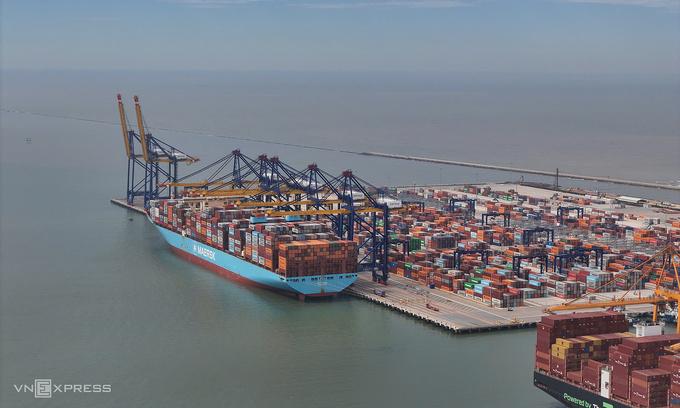
Lach Huyen Port, Hai Phong City, June 2026. Photo by Read/Le Tan |
But challenges remain. Tariffs were the most frequently cited cost factor by Vietnamese businesses, at 52% as against 43% globally.
Energy costs ranked second, at 49%, also above the global figure. Some 97% said barriers prevented them from making greater use of FTAs.
Andrew Harker, economics director at S&P Global Market Intelligence, said new orders rose in October, but at a slower pace than in September.
“While firms are able to maintain improvements for now, they will be hoping for a more conducive environment for growth in the months ahead.”
Shifting market trends, tougher buyer requirements, and hiring difficulties are also putting pressure on businesses.
More than half of the 22 electronics manufacturers surveyed by Navigos Search said they faced high competition in hiring workers.
Manufacturing workers are expected to be the hardest to recruit over the next three to five years, 73% of respondents said. They were followed by R&D engineers and specialists (50%) and automation engineers (36%).
The bigger question is how much of that trillion-dollar trade Vietnam can retain. The figure measures the total value of goods crossing the border. But since production still relies heavily on imported materials and components, the figure does not capture the value created within Vietnam.
At an event held as part of the Autumn Economic Forum (AEF 2026) last month, Mariam J. Sherman, the World Bank’s country director for Vietnam, Cambodia, and Laos, said foreign businesses accounted for 73% of exports.
Vietnamese businesses and workers retained little of the value generated by the country’s exports, she added.
The statistics office said, as trade grows, Vietnam needs to strengthen domestic production capacity, increase indigenous content, and raise the share of value added by Vietnamese businesses.
The next phase should be judged by the quality of trade growth in the form of greater contributions by domestic businesses, products with more advanced technology and higher value added, more self-reliant supply chains, more diverse markets, and growth that better protects the environment.
Also at the forum, Fazurin Jamaludin, the International Monetary Fund’s resident representative for Vietnam and Laos, said Vietnam’s total factor productivity has been trending downward recently.
It is a measure of how efficiently capital and labor are converted into output.
Jamaludin said several factors were responsible for the decline, including uneven allocation of resources.