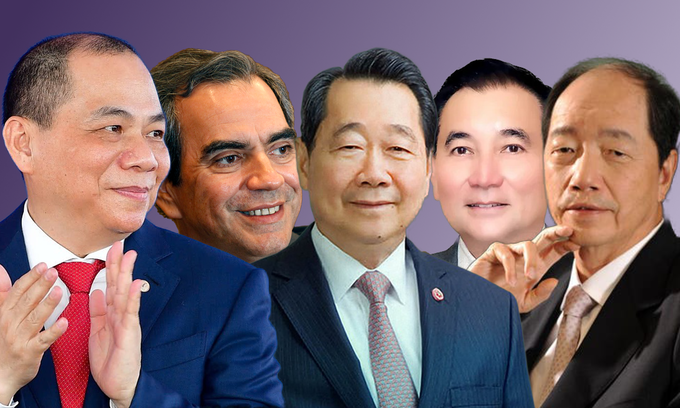
Pham Nhat Vuong (Vietnam)
Vingroup chairman Pham Nhat Vuong remains the richest man in the bloc with a net worth of $33.6 billion, up 19% from the start of the year, according to Forbes.
Shares of the largest listed company in Vietnam have risen around 29% year-to-date, while shares of its property arm Vinhomes have added 12.9%.
Vingroup’s revenue in the first quarter jumped 24% year-on-year, partly driven by the surge in sales of VinFast electric vehicles, which is now the best-selling auto brand in Vietnam.
Another Vingroup company, VinSpeed, began construction of the $5.7 billion Hanoi–Quang Ninh high-speed railway in April. The project is expected to cut travel time between the two localities from two hours to 23 minutes when it is completed in 2028.
|
From L: Pham Nhat Vuong, Vingroup chairman; Enrique Razon Jr, International Container Terminal Services chairman; Dhanin Chearavanont, CP Group senior chairman; Sarath Ratanavadi, Gulf Development CEO; Jason Chang, ASE Technology Holding chairman. Graphics designed by Read/Dat Nguyen. Photos by Read, Reuters, CP Group, Gulf Development, ASE Technology Holding |
Enrique Razon Jr. (Philippines)
The second person in Southeast Asia is Enrique Razon Jr, the Philippine ports tycoon, who has a net worth of $21.6 billion.
The 66-year-old chairman of International Container Terminal Services Inc., the country’s largest port operator, has seen his wealth ballooned by more than $10 billion within 12 months.
Shares of his company, ICTSI, have jumped 66% year-on-year, driven by resilient trade volumes, higher tariffs, cargo-service growth, and successful execution across its port network. Razon controls a 51% stake in the company through direct and indirect holdings.
The company saw revenue rise 29% year-on-year to $961 million in the first quarter, boosted by the inclusion of two new ports, Durban Gateway Terminal in South Africa and Batu Ampar Container Terminal in Batam, Indonesia.
The company this year plans to invest in expansions and equipment upgrades in its home country, the Philippines, along with overseas markets including Mexico, Brazil, the Democratic Republic of Congo, Honduras, Australia and Ecuador.
Sarath Ratanavadi (Thailand)
Sarath Ratanavadi is the third-richest individual in Southeast Asia with a net worth of $17.7 billion, up from $5.6 billion from last year, the biggest wealth gainer in Thailand.
He has emerged as a top fortune gainer as investors rewarded his company Gulf Development’s transformation from a conventional power producer into a broad infrastructure platform spanning electricity, Thailand’s dominant mobile operator, banking stakes and AI data centers.
Forbes’ data, however, shows that if family wealth is taken into account, Ratanavadi ranks third in wealth, behind Red Bull co-owner Chalerm Yoovidhya and the Chearavanont brothers, who jointly own agribusiness giant CP Group
Dhanin Chearavanont (Thailand)
In the fourth place is another Thai billionaire, Dhanin Chearavanont, with a net worth of $17.6 billion.
Dhanin and his brothers controls CP Group, the largest conglomerate in Thailand with businesses spanning agriculture, food production, retail, telecommunications, real estate, finance, and e-commerce across more than 20 countries.
The company this month announced plans to invest an additional $600 million to expand poultry and pork processing in Vietnam, including doubling capacity at its Binh Phuoc poultry complex, building a new poultry processing plant in Phu Tho Province, and expanding its pork processing network.
Jason Chang (Singapore)
The richest man in Singapore, Jason Chang, is the fifth wealthiest individual in Southeast Asia with a net worth of $17.4 billion.
His Taiwan-listed semiconductor company, ASE Technology Holding, has seen its share price jump 93% year to date, doubling Chang’s net worth from $9.1 billion at the end of last year.
In April, ASE broke ground on a new chip testing campus in the southern Taiwan city of Kaohsiung, with an investment of more than $3.4 billion, as demand for high-end chips grows. The first phase is scheduled to begin operations in April 2027.
ASE’s CEO Tien Wu said recently that the company will expand its capacity to meet AI demand, with 15 new production sites to be added to its ecosystem this year, according to Reuters.