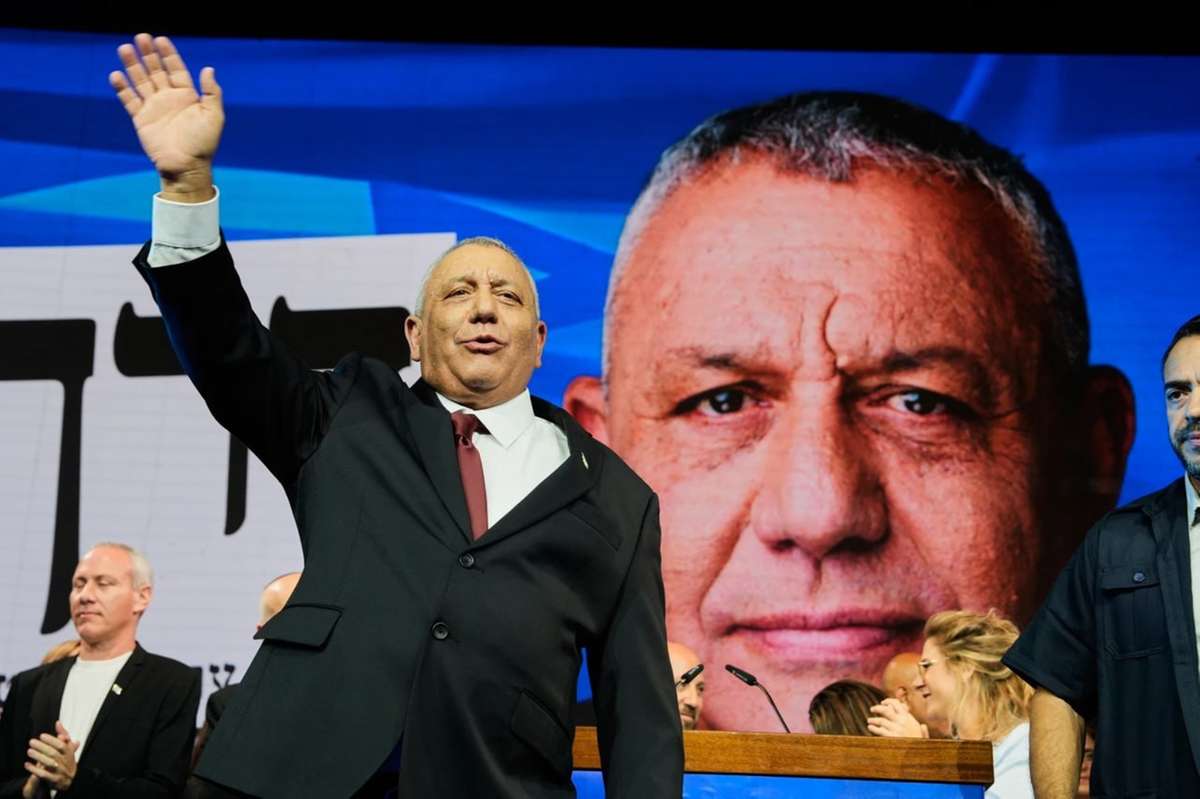
GAdi Eisenkot has spent much of his life in uniform, overseeing military operations and navigating some of Israel's most consequential security challenges. Now, the former Israeli military chief is facing a different test: forming a government that could end Benjamin Netanyahu's long tenure as prime minister.
Israeli President Isaac Herzog on Saturday gave Eisenkot the first opportunity to form the country's next government after the October 27 parliamentary election. The decision followed consultations in which 67 lawmakers recommended Eisenkot, compared with 46 who backed Netanyahu.
The mandate marks a significant moment in Eisenkot's political journey. A former chief of staff of the Israel Defense Forces (IDF), he entered politics in 2022 and has since emerged as one of Netanyahu's prominent challengers.
However, the appointment does not make him prime minister. Eisenkot has 28 days, with a possible 14-day extension, to assemble a coalition commanding the support of at least 61 members of the 120-seat Knesset.
From military service to Israel's top army post
Born on May 19, 1960, in Tiberias, northern Israel, Eisenkot grew up in Eilat in a family of Moroccan Jewish immigrants. He began his military career in 1978, joining the Golani Brigade, one of the IDF's prominent infantry formations.
Over the following decades, he rose through the military ranks, holding several senior positions, including head of the Operations Directorate and commander of the Northern Command.
His experience in the Northern Command came in the aftermath of the 2006 Lebanon war between Israel and Hezbollah. Eisenkot became associated with the controversial 'Dahiya Doctrine', a military approach advocating overwhelming force against infrastructure in areas used by armed groups. Named after a Hezbollah stronghold in Beirut's southern suburbs, the doctrine drew criticism over its implications for civilian populations and infrastructure.
In 2015, Eisenkot became chief of staff of the IDF, a position he held until January 2019. During his tenure, Israel conducted operations against Iranian-linked targets in Syria and faced continued tensions along its borders with Lebanon and Gaza.
October 7 attack changed his political trajectory
The Hamas-led October 7, 2023, attack on southern Israel, which killed around 1,200 people and saw 251 others taken hostage, marked another turning point in Eisenkot's career.
By then a retired general and opposition politician, he joined Netanyahu's emergency war cabinet in October 2023 alongside former defense minister Benny Gantz.
Eisenkot subsequently questioned the government's lack of a clear long-term strategy for Gaza and called for a broader political and security plan alongside military operations.
His involvement in the war was also deeply personal. His son, Master Sergeant Gal Meir Eisenkot, 25, was killed in December 2023 during military operations in Gaza. Two of his nephews also died while serving in the military.
In June 2024, Eisenkot and Gantz resigned from the emergency government, accusing Netanyahu of failing to make crucial strategic decisions about the war and the country's future.
From Netanyahu's wartime ally to political rival
Eisenkot entered electoral politics in 2022 by joining the National Unity alliance led by Gantz. The alliance positioned itself as a centrist alternative to Netanyahu's government.
Following their departure from the emergency government, Eisenkot gradually developed an independent political identity. He founded the Yashar party in September 2025, focusing on national security, government accountability and institutional reforms.
He has called for a state commission of inquiry into the October 7 security failures and criticized the influence of far-right ministers in Netanyahu's government.
His positions have also included criticism of settler violence against Palestinians in the occupied West Bank, an issue that has drawn international attention.
Election puts him in contention for power
The October 27, 2026, election gave Eisenkot an opportunity to challenge Netanyahu directly.
His four-party alliance won 48 seats in the 120-member Knesset, while Netanyahu's right-wing and religious-nationalist bloc secured 53. Neither crossed the 61-seat threshold required for a majority.
Eisenkot's Yashar party won 21 seats, while parties representing Israel's Arab minority secured 19 seats.
The parliamentary arithmetic, however, presents considerable challenges. Although Arab-led parties recommended Eisenkot, he has ruled out bringing them into his government under certain conditions. Support from ultra-Orthodox parties could also prove crucial, but disagreements over military service exemptions remain an obstacle.
A national unity arrangement involving Netanyahu is another possibility, although Eisenkot has previously ruled out serving alongside the incumbent prime minister.