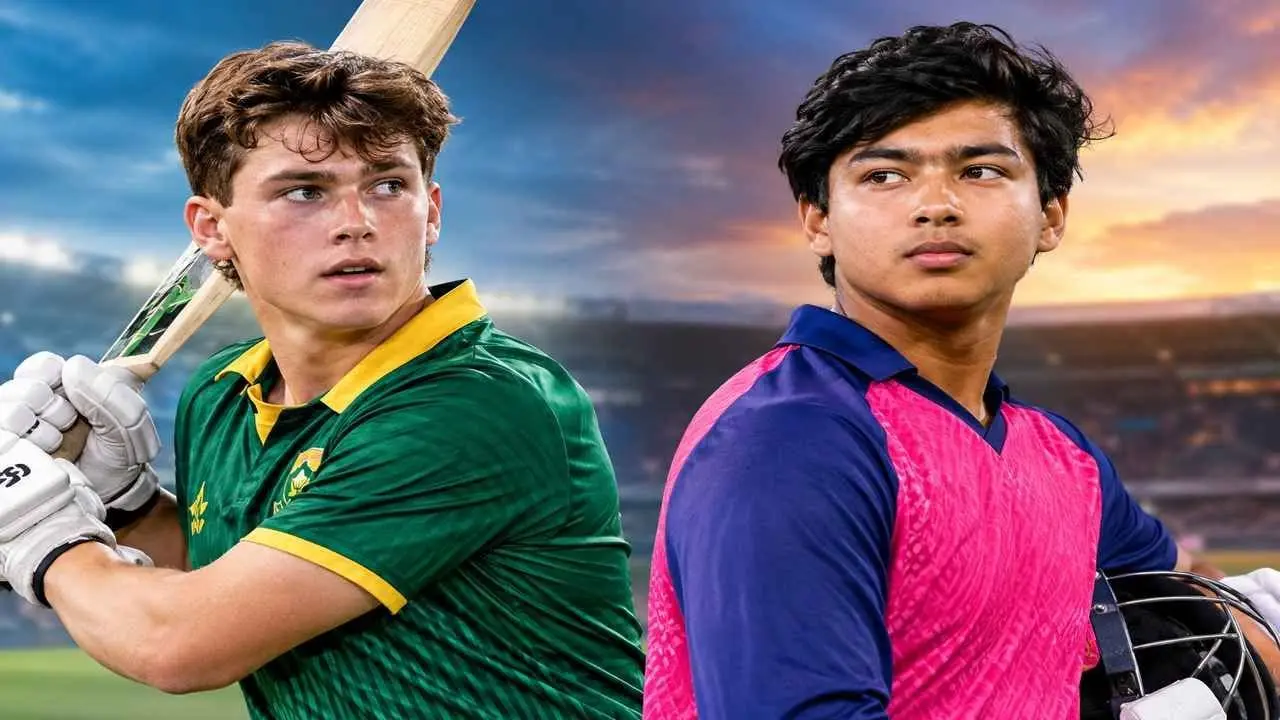
Everyone was left surprised at the SA20 auction when an 18-year-old youngster started attracting bigger bids than established international stars like Kieron Pollard, Faf du Plessis and Trent Boult.
The name was Jason Rowles.
Rowles entered the auction at a base price of just R200,000, but his price kept climbing before Joburg Super Kings finally secured him for a massive R2.9 million (approximately ₹1.68 crore)making him the most expensive player of the auction.
That raised an obvious question: what is so special about Jason Rowles that JSK were prepared to spend so heavily on an 18-year-old with very little senior cricket experience?
Interestingly, the answer becomes clearer when you look at another teenage sensation: Vaibhav Sooryavanshi.
Jason Rowles’ Domestic Numbers Don’t Explain R2.9 Million
If Rowles is judged only by his senior domestic record, his auction price looks surprising.
The young all-rounder has played five List A matches, scoring 109 runs at an average of 21.80. He also bowls left-arm orthodox spin and has taken three wickets in four innings.
His senior T20 experience is extremely limited as well. However, he offered an early glimpse of his ability by smashing an unbeaten 45 from 31 balls and contributing with the ball in his first senior T20 appearance.
These numbers alone aren’t enough to explain a R2.9 million investment.
But franchises scouting an 18-year-old aren’t necessarily buying him for what his senior record looks like today. They are trying to identify what that player could become with the right experience and development.
That is where the Vaibhav Sooryavanshi comparison starts making sense.
Jason Rowles Was Hyped Alongside Vaibhav Sooryavanshi at the U19 World Cup
The 2026 U19 World Cup provided a much better indication of Rowles’ potential.
Rowles scored 280 runs in five innings at an average of 70 and a strike rate of 112establishing himself as one of South Africa’s standout performers.
Interestingly, his batting average was even higher than Vaibhav Sooryavanshi’s in the same tournament. Vaibhav averaged 62.7compared with Rowles’ 70.
That doesn’t mean Rowles should automatically be considered better than Vaibhav. Their roles, innings and circumstances were different. But it provides important context to the hype surrounding Rowles.
At the same tournament where Vaibhav was attracting enormous attention as one of world cricket’s most exciting young players, Rowles was also being hyped as one of the standout talents of his generation.
And Rowles offered something extra with the ball. His left-arm orthodox spin produced four wickets during the tournament, adding another dimension to his game.
He has shown his immense potential even in the longer format, scoring a double century against England U19.
So when franchises evaluate Rowles, they aren’t simply seeing a batter with a List A average of 21.80. They are seeing an 18-year-old with the potential to develop into a genuine all-round cricketer.
The Vaibhav Sooryavanshi Formula Explains the Gamble
Vaibhav Sooryavanshi provides a useful example of why franchises sometimes look beyond early senior domestic numbers.
When an exceptional teenager first enters senior cricket, the sample size is usually tiny. His statistics may not immediately represent his actual ceiling.
The more important question for scouts is often: how far ahead is this player compared with others of the same age?
Vaibhav was identified extremely early because his natural ability was impossible to ignore. Rajasthan Royals invested in him before he became an established senior star and gave him exposure at the highest franchise level.
As experience caught up with his talent, the cricketing world began seeing why he had been rated so highly.
JSK’s investment in Rowles appears to follow a similar philosophy.
Rowles is not being bought as a finished product. He is being backed as an 18-year-old whose ceiling could be far higher than his current senior statistics suggest.
Sometimes a Young Player Becomes Part of a Franchise’s Brand
There is also a long-term factor that goes beyond immediate performances.
Sometimes a franchise discovers a youngster early enough that the player eventually becomes part of the identity of that team.
Virat Kohli and Royal Challengers Bengaluru are the ultimate example.
RCB picked Kohli when he was still a teenager coming out of India’s U19 system. He wasn’t the global superstar then that he later became. But as Kohli’s career and popularity grew, his association with RCB grew alongside it.
Eventually, Kohli didn’t just become their biggest player. He became deeply connected with the identity and global fan following of the franchise.
Rajasthan Royals’ early investment in Vaibhav Sooryavanshi shows the attraction of the same model with a new generation.
RR identified Vaibhav incredibly early and gave him a major platform before he was an established international player. His rapid rise has consequently created a strong connection between the youngster and the Royals.
When a franchise backs a teenager before he becomes a superstar, it potentially gains more than his future performances. Fans follow his development from the beginning, his popularity can grow alongside the team, and eventually that player can become one of the faces of the franchise.
Perhaps JSK see the possibility of building that relationship with Rowles.
There is no guarantee he will become JSK’s version of Kohli or Vaibhav. Predicting the career of any 18-year-old carries considerable risk.
But if Rowles eventually develops into one of South Africa’s biggest stars, Joburg Super Kings won’t need to chase that superstar later.
They will be the franchise that backed him before he became one.
Get cricket updates. Follow Tezzbuzz:
Download the Tezzbuzz app
Take Tezzbuzz with you. Get our app for cricket news and updates on your phone.