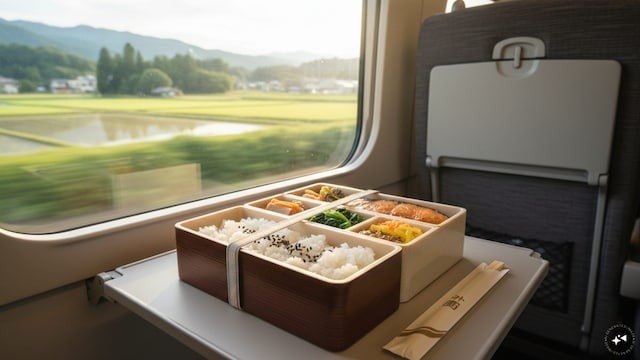
In Japan, famous all over the world for its punctuality, cleanliness and high-speed bullet trains i.e. Shinkansen, rail travel in Japan is not only a medium to reach from one place to another, but it is also a cultural and food related experience. When you travel in railway stations or trains in Japan, the colorful, artistic and balanced food boxes found there immediately catch your attention. This special railway food is called 'Ekiben'. The word is made up of two Japanese words—'eki' meaning railway station and 'ben' meaning 'bento' (packed food or lunchbox). Ekiben is not an ordinary sandwich or a typical packed snack, rather it presents to the travelers the local culture, season and taste of that region in a small box. How did the story of Ekiben begin in the 19th century? Ekiben's roots go back to the early days of rail transportation in Japan. After the opening of the first railway line in Japan between Shimbashi and Yokohama in Tokyo in the year 1872, rail travel gradually started becoming popular among the common people. In the early days, trains powered by steam engines were slow and long distance journeys took several hours. To satisfy the hunger of the passengers during the journey and to make better use of the time spent at the station, packed food boxes started being sold at the stations. The tradition of preparing lunchboxes combining local dishes and ingredients at different stations took hold in the late nineteenth century, especially from the mid-1880s. As the rail network expanded over time, each station and area developed its own ekiben. There was a time when Ekiben was challenged by the rise of high-speed trains and air travel, but Ekiben's popularity among passengers regained strength after dining car services on Shinkansen trains were discontinued in the 1990s. Each station has its own identity: why are different ekiben special? The biggest feature of Ekiben is its regional diversity. Traveling through different parts of Japan, travelers get the taste of local produce and traditional dishes in one container. At some places, seafood and squid-rice are specialties, while at others, pressed trout sushi (masu-zushi) wrapped in bamboo leaves or special rice-meat and vegetable dishes are available. Apart from this, Ekiben boxes and packaging are also a big center of attraction for the travelers. Many boxes are made of wood, paper, plastic or ceramic, some of which are even decorated with trains, popular characters or special shapes. In modern times, some special ekiben are also made in which when the attached string is pulled, the food becomes hot due to a chemical heat reaction without the use of microwave, whereas traditionally most of the ekiben are eaten at room temperature or cold. Larger stations offer a variety of ekiben from across the country, while smaller stations tend to have local specialty boxes more popular. Why is this railway tradition interesting for the travelers of India and Uttar Pradesh? In India too, local food—such as traditional dishes and snacks available at stations or en route in Uttar Pradesh's Lucknow, Kanpur, Varanasi, Prayagraj, Gorakhpur, Agra and Mathura—has its own special association with train travel. In this case, Japan's Ekiben culture shows how a simple travel meal can be transformed into a memorable experience by combining it with art, local geography and hospitality. Many large department stores in Japan even hold annual 'Ekiben Fairs', where famous lunchboxes from far-flung stations are made available under one roof. Overall, Ekiben is not just a means of filling the stomach, but it is a taste and history on the tracks that makes every journey special.