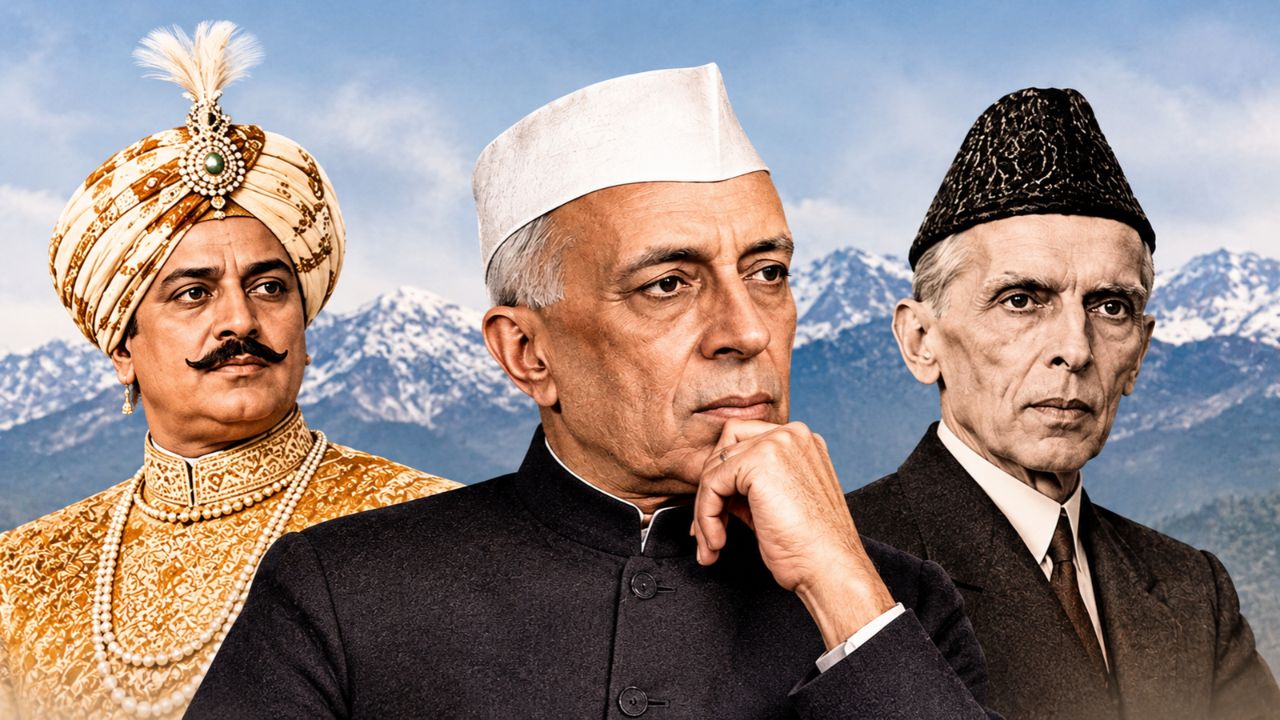
Today is the 137th birth anniversary of the country's first Prime Minister Jawaharlal Nehru. Nehru is often accused that due to his mistakes the whole of Kashmir could not become a part of India. Nehru is also accused that a part of Kashmir came under the control of Pakistan. Union Home Minister Amit Shah has many times held Nehru responsible on this issue. In December 2023, he had said in Parliament that Kashmir had to suffer losses due to two mistakes of Nehru. The first mistake among these was the announcement of ceasefire during the war and the second was taking the Kashmir issue to the United Nations. Prime Minister Narendra Modi has also raised questions on the decisions of Congress and Nehru era regarding Pakistan occupied Kashmir. In such a situation, the question is whether it was really Nehru's mistake to take the Kashmir issue to the UN or was it a decision taken in the circumstances of that time?
To know the answer to this question, it is important to understand the political and military situation of that time. There was fighting going on in Kashmir and there were allegations of help to the attackers from Pakistan's soil. India had the option of continuing the military campaign, but the mountainous terrain and winter weather were making it difficult. On the other hand, there was also a danger of direct war between India and Pakistan. Nehru had explained the difficulties of military operations in a letter written to Maharaja Hari Singh on 1 December 1947. Later, Sardar Patel also talked about the increasing pressure on military resources in a letter written to Gopalaswami Iyengar. These documents make it clear under what circumstances the decision to go to the UN was taken.
Hari Singh's bravery and tribal attack
VP Menon writes in his book 'The Story of the Integration of the Indian States' that Mountbatten went to Kashmir in the third week of June 1947. He spent four days with Maharaja Hari Singh and explained to him that it would not be practical for Kashmir to remain independent. According to Menon, Mountbatten had also said that India would not object if the Maharaja decided to merge with Pakistan. For this he had also talked about getting confidence from Sardar Patel.
Menon writes that despite Mountbatten's explanation, the Maharaja could not take any decision. He did not even adopt the option of calling a meeting of representatives to gather public opinion. According to Menon, even after August 15, at the behest of Mountbatten, Lord Hastings went to Kashmir, but his efforts also yielded no results. Meanwhile, the Maharaja talked about making a standstill agreement with both India and Pakistan. Pakistan signed the agreement, while India first sought time to understand its terms.
On 22 October 1947, tribal fighters attacked Kashmir. On October 24, Mahura Power House, which supplies electricity to Srinagar, was also captured by the attackers. According to VP Menon, on October 25, he reached Srinagar to see the situation on behalf of the Government of India. He advised the Maharaja to go to Jammu with his family. The Maharaja left Srinagar the same night and went to Jammu. On 26 October, Menon reached Jammu, where the Maharaja signed the Instrument of Accession with India. The Indian Army reached Srinagar on 27 October.
At the time of the partition of India in 1947, Maharaja Hari Singh of Jammu and Kashmir wanted to remain independent rather than joining any country. At the same time, Jawaharlal Nehru wanted Jammu and Kashmir to become a part of India. Nehru's family was originally from Kashmir and he had a close friendship with Sheikh Abdullah. Sheikh Abdullah was one of the influential leaders of the valley at that time. Meanwhile, border determination of Gurdaspur was also important for the future of Kashmir. The Radcliffe Boundary Commission included Gurdaspur, Batala and Pathankot tehsils into India. This gave India a way to reach Jammu and Kashmir by road. If these areas had gone to Pakistan, it would have become difficult for India to reach Jammu and Kashmir by road.
Also read: Why is the foundation day of 8 states only on 1 November? Know the story of formation
Kashmir war was not that easy
On December 1, 1947, Jawaharlal Nehru wrote a letter to Maharaja Hari Singh and talked in detail about the military situation in Kashmir. Nehru had written that there are two paths before India. Making any agreement with Pakistan or intensifying the military operation. He said that due to the hilly area, it is not easy for a big army to conduct operations here. As winter progresses, the problems of the Indian Army are increasing.
Nehru had clearly written in the letter that the problem was not the shortage of soldiers, but the geography and climate of the place. He told that in winter it is difficult to drive out the attackers from the entire area of Poonch. This may have to wait till spring. That is, continuing the military campaign meant that the war could have continued for several more months. Nehru also wrote that during this period the common people of Kashmir would have to suffer a lot.
Sardar Patel also later expressed concern over the military situation. In a letter written to Gopalaswami Iyengar on June 4, 1948, he had said, “The military position is none too good, and I am afraid our military resources are strained to the utmost.” This means that the military situation is not very good and India's military resources are being strained beyond their capacity. Patel further wrote that it is difficult to estimate for how long this struggle will have to continue.
Pakistan was also ready for UN
The suggestion to take the Kashmir issue to the UN did not come only from India. On 8 December 1947, a meeting was held in Lahore between Nehru, Pakistan Prime Minister Liaquat Ali Khan and Mountbatten. Complete details of the meeting are recorded in the 'Nehru Archive'. According to records, Mountbatten suggested that the United Nations be involved in the matter in some form. Liaquat Ali Khan also said that he could support the proposal to involve the UN.
On 21 December 1947, talks took place again between Mountbatten, Nehru and Liaquat Ali Khan. In the record of that meeting, Nehru clearly said that India will complain about the aggression by Pakistan in the UN. Nehru said that the attackers were getting help from Pakistan's soil and Pakistan should stop it.
Interestingly, when Mountbatten proposed to take the matter to the UN, Liaquat Ali Khan supported it. Liaquat Ali Khan said that he would accept the advice of the United Nations Organization (UNO) to ensure impartiality of administration before the referendum.
Also read: 61 lakh children of Tamil Nadu will get cake on Children's Day, CM Vijay gave ₹ 9.27 crore
Why did Nehru go to UN?
India lodged a complaint with the United Nations Security Council on 1 January 1948. Using Article 35 of the United Nations Charter, India said that the attackers in Jammu and Kashmir are getting help from Pakistan's soil. India demanded the Security Council to ask Pakistan to stop this aid.
In a letter written to the Chief Ministers of the country on January 5, 1948, Nehru himself said that India approached the UN so that a situation of war could be avoided between the two countries. He wrote that war cannot be taken lightly. This letter of Nehru gives the most direct answer to the question why he took the Kashmir issue to the UN. The main objective of India's initial complaint was to stop the help to the attackers from Pakistan.
Jawaharlal Nehru's decision should be understood according to the circumstances of that time. At that time, only one year had passed since India became independent and only three years had passed since the United Nations (UN) was formed. In such a situation, India did not want its decision to be viewed in a wrong way at the international level. Even if Pakistan had taken the matter to the UN first, questions would have been raised on Nehru's decision.
What conditions were laid down in the UN proposal?
On 21 April 1948, the United Nations Security Council passed Resolution 47. Three main things were said in this proposal. First, Pakistan should return its tribal fighters and Pakistani citizens who have come from outside. Second, India had to gradually reduce its army to the minimum number required to maintain law and order.
Later on 13 August 1948, the United Nations Commission made another proposal. In this, Pakistan was asked to withdraw its army from Jammu and Kashmir. After this, India had to withdraw a large part of its army in a phased manner. India was allowed to maintain the minimum number of troops necessary to maintain law and order. That means the next phase of reduction in the Indian Army was to begin only after the withdrawal of Pakistan's army.
However this process was never completed. No consensus could be reached between Pakistan and India regarding withdrawal of troops, security and administration. Therefore, the referendum could not be held as per the conditions laid down in the proposal.
So was it a mistake for Nehru to go to UN?
It was not easy to continue the war in Kashmir. Sardar Patel had also admitted that it would be difficult to fight there for a long time. Moreover, India was newly independent. In such a situation, being involved in war for a long time does not create a good image of the country even at the international level. On the other hand, Maharaja Hari Singh, Mohammad Ali Jinnah and Lord Mountbatten also had different views regarding the inclusion of Kashmir in India. In such difficult circumstances, Jawaharlal Nehru faced many challenges. Therefore, it is important to understand his decision keeping in mind the circumstances of that time. It would not be right to directly term it wrong.