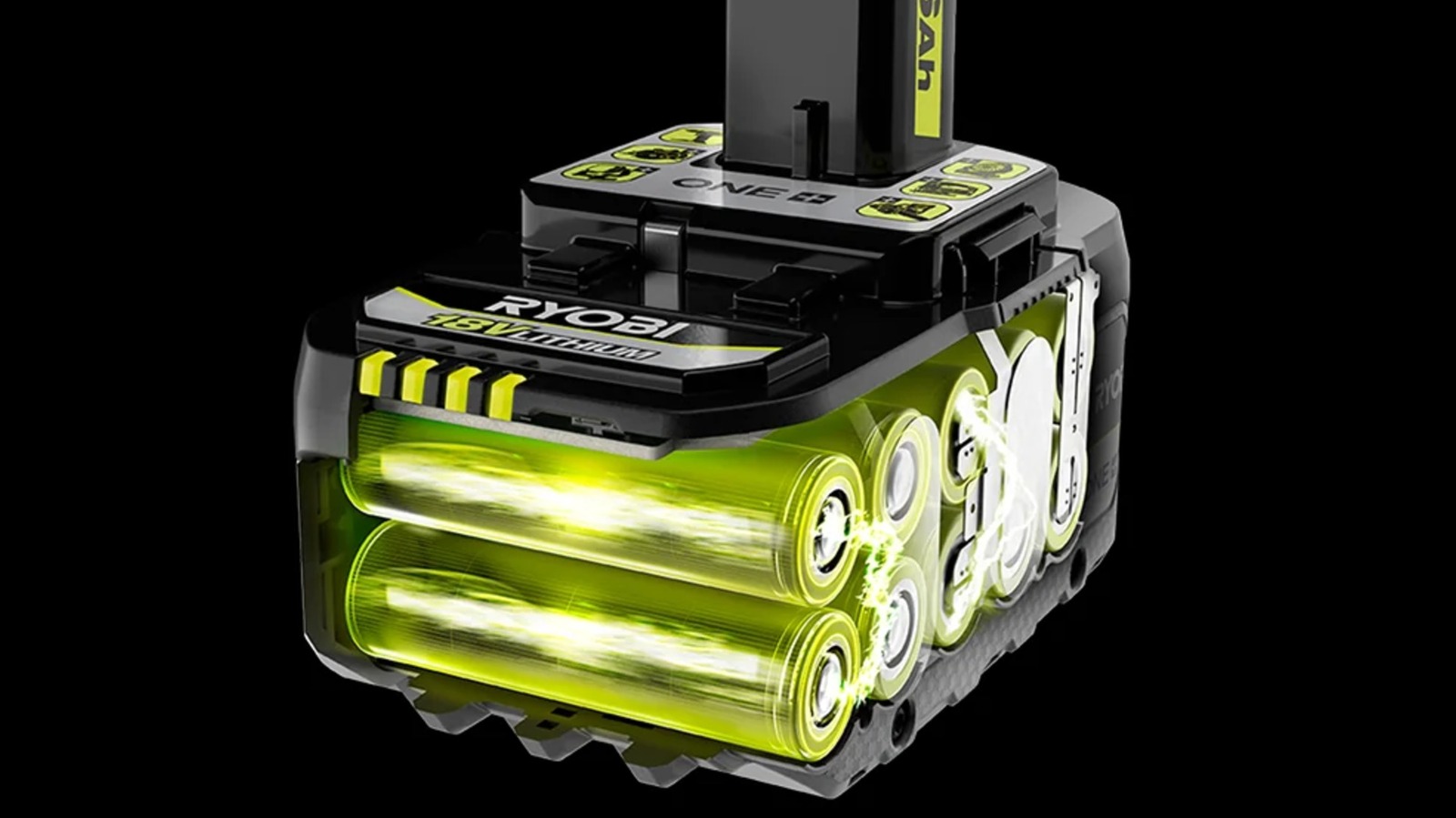
If you’ve spent enough time around battery-powered power tools, you’ve no doubt noticed a distinctive pattern: just about every major tool brand, from Ryobi to Makita to Milwaukee, uses 18V battery systems. Different brands like Ryobi may offer higher or lower voltage systems like 12V or 40V, but that 18V system seems to be an almost universal constant. There are some basic technical reasons for this consistency.
An 18V battery pack from pretty much any major power tool brand contains a small array of power cells, which is where the actual energy comes from. One pack consists of five power cells, each with a voltage rating of 3.6. 3.6 times 5 equals 18, and thus, we have our 18V battery. Five of these cells provide an optimal balance of power and portability, the best you can realistically get for your tools before moving up to heavier-duty ratings like 40V while still offering flexibility in the watt-hour and amperage-hour ratings. Some brands double up the five cells into ten to provide more ampere-hours, or the same amount of power for a longer time.
What’s important to clarify is that the 3.6V rating on those cells is their nominal rating, or the amount of energy they can store and output on average. Technically, though, the maximum rating on those cells is 4V. The actual tangible power output is the same, it’s just a technical difference, but it’s that tangible difference that sets the stage.
18V vs 20V is mostly a matter of branding and regulations
Here in the United States, many 18V battery packs are marketed instead as 20V packs, because they’re based on that 4V maximum instead of the 3.6V nominal. The reason for this is actually very simple: 20V sounds better to shoppers. However, in many countries, particularly in the EU, tool brands are only allowed to market their batteries and tools by their nominal voltage, not the maximum, which is why they use the 18V rating instead. Some brands, like DeWalt, switch to 20V for the U.S., but others, like Ryobi, maintain the 18V branding across all countries because, frankly, it’s easier and more consistent.
The broader fact of the matter is that it’s mostly just a matter of branding and, in the specific case of batteries sold around the world, advertising regulations. 18V is something of a sweet spot from both the power and the marketing perspectives, which is why all of the major brands largely stick to that voltage for its rank-and-file tools, opting instead to raise the amperage on newer and better models of tools and batteries.