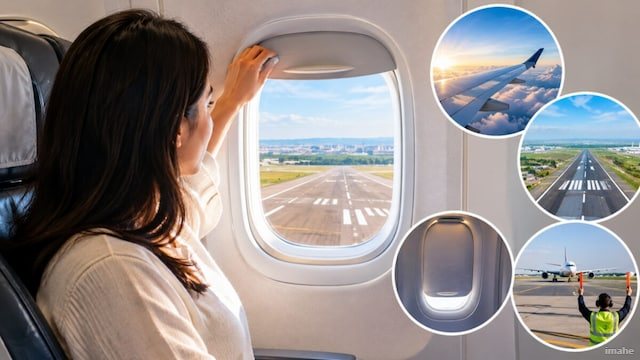
Whenever we travel by plane, the first choice of most of us is always window seat. The beautiful view of clouds floating above the clouds, small houses below and the pleasant sky can win anyone's heart. But have you ever noticed that whenever the plane is about to take off or land, the cabin crew members repeatedly instruct the passengers to keep their window curtains completely open? Many people think that this rule might have been made to show the passengers a beautiful view of the outside or to maintain light inside the plane. But the truth is completely different and it is directly related to your own life and the safety of the aircraft. 90 Second Game and Visibility in Emergency Situations According to aviation safety experts and regulations, the first and last few minutes of takeoff and landing are considered the most sensitive and risky during a flight. According to statistics, most emergency incidents or accidents involving aircraft occur during these two phases. In such a situation, if God forbid an emergency arises, the crew member has only 90 seconds to get the passengers out of the plane safely. With the window curtains open, natural light from outside comes inside the cabin, so that in case of sudden power failure or darkness, passengers and security personnel do not have to waste time in adjusting their eyes. Additionally, a clear view out allows the cabin crew to immediately know which part of the aircraft is on fire, whether the engines are OK, or whether there are any obstructions outside, allowing them to open the emergency exit in the right direction. Natural Light and Eye Harmony A very important scientific reason behind keeping window curtains open during flight is also related to the functioning of our eyes. Suppose an aircraft is taking off or landing at night, and suddenly the main lights of the cabin go off due to some technical fault. If the curtains of the windows are closed, there will be complete darkness inside and the eyes of the passengers will become accustomed to that darkness. In such a situation, due to sudden exposure to bright light or smoke while rushing out, the eyes may have trouble seeing things. On the contrary, if the curtains remain open, some outside light or moonlight comes in, so that in case of an emergency, the passengers' eyes are prepared for sudden changes and they can immediately run towards safe routes without any confusion. Visual coordination between the pilot and air traffic control Monitoring the condition of the aircraft's wings and engines is not only the responsibility of the pilots sitting in the cockpit, but the eyes of the passengers sitting near the window also act as an extra unit of the cabin crew. Many times it happens that passengers are the first to notice a spark coming out of the engine, ice accumulated on the wings or any other technical fault and immediately inform the air hostess or flight attendant. If the curtain remains closed, the passengers sitting inside will not be able to see any unusual activity going on outside. Apart from this, it is also important that there should not be any curtain on the glass in order to take stock of the outside weather, runway conditions and environment at the time of landing. So the next time you travel by air and the cabin crew asks you to lift the veil, do not consider it as just a rule, but understand that this is a very important and precautionary step taken for your own safety.