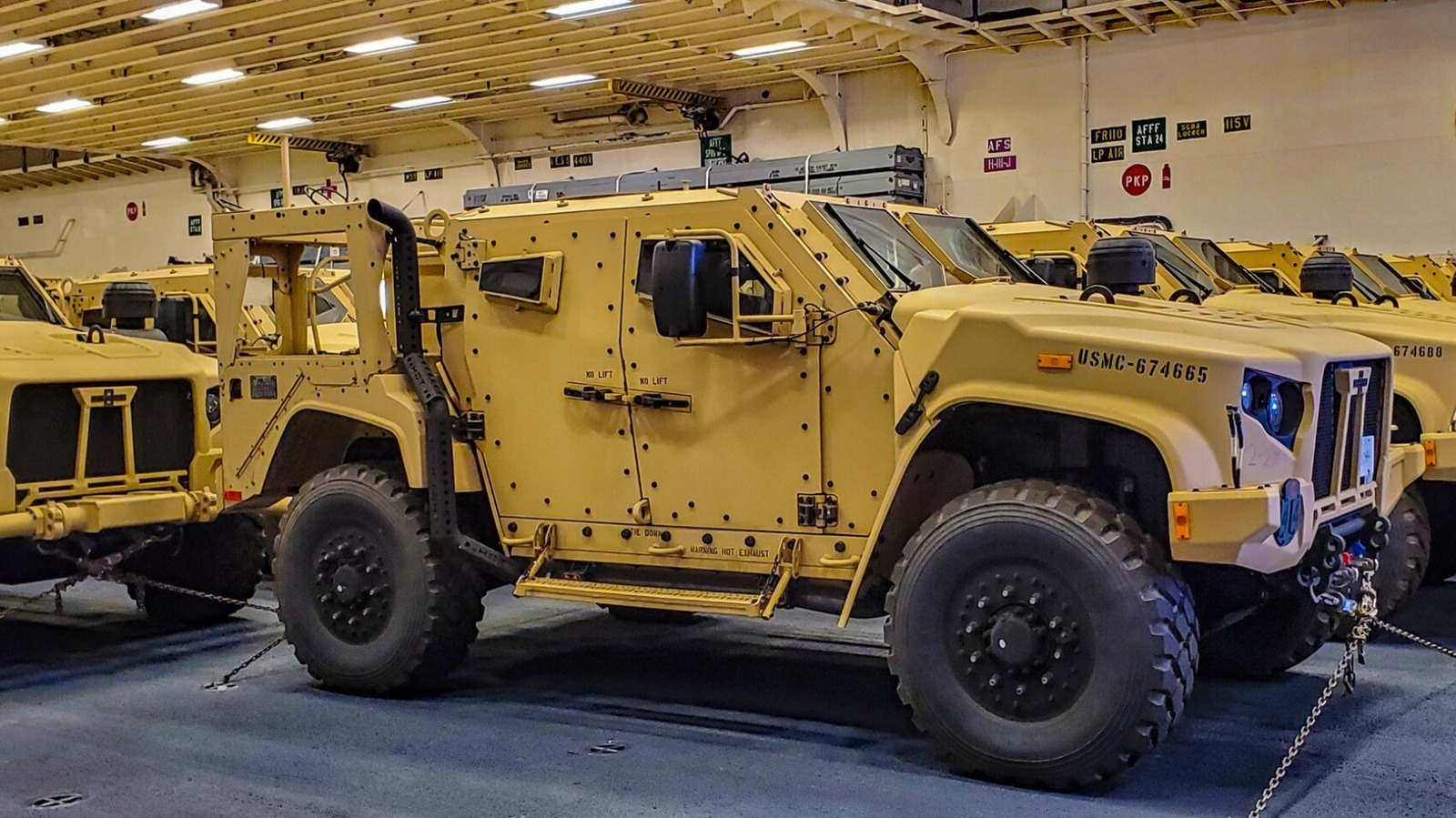
Some military vehicles look and function very much like their civilian counterparts. Others, of course, do not — sporting armor, weaponry, and advanced technology that civilian models don’t need. Along with these features can come a need for specialized experience and maintenance knowledge. After all, these vehicles help their occupants survive in the most hostile of environments and are means of transportation just as much as military tools. Typically, ground models have conventional transmissions to maintain.
Since there’s the logistical challenge of getting a replacement model to the front lines, it’s important to keep these vehicles in action, or at least try to ensure that servicing them is as fast, intuitive, and practical as possible. As such, you might think that a “lifetime” sealed transmission is a more practical choice, as it could reduce the amount of maintenance. However, there are some considerable downsides to this specific type of transmission for military models, including maintenance experience and the fact that they’re not as “lifetime” guaranteed as the name suggest. Because of this, military vehicles don’t tend to use sealed transmissions, unlike so many modern cars.
Potential downsides of lifetime sealed transmissions, particularly in a military context
Regular cars and trucks are tools for commuting, and so convenience is enormously important. To facilitate this, many have sealed transmissions that purport to be good for a “lifetime.” As such, you’d be forgiven for thinking that a sealed transmission doesn’t need to be serviced, but that’s not entirely the case. In fact, when these transmissions do require servicing, it can be more complicated because of how they are designed. Sealed transmissions don’t have a dipstick or any of the conventional means of access, and this can create a huge potential issue in military use.
Unfortunately, the reality of supplying, maintaining, and running a lot of sophisticated military technologies is that some of them will inevitably have issues that can take them out of action. To reduce pressure on servicepeople, the military must utilize systems that don’t require specialized knowledge to manage. This, then, can be a primary reason as to why sealed transmissions aren’t a focus on military vehicles.
When care for sealed transmissions is needed in the civilian world, it’s often the case that a mechanic with the required knowledge and tools is not far away. Meanwhile, militaries may be dispatched to more remote locations where the key to survival is self-reliance, and while there are some experienced mechanics, they cannot be everywhere. Using systems that are easy to service on the go reduces logistical issues, and a sealed transmission could compromise that.
Some different types of transmissions used by military vehicles
A lot of military vehicles are rugged powerhouses that are expected to transport personnel and certain equipment loads across what could be challenging terrain. Because of this, they’re built to be hard-wearing and versatile. They have to be designed with the practicality of maintenance in mind while remaining multi-purpose in terms of operation.
For example, the Humvee 4-CT was designed with a four-speed automatic transmission, but it is far from the only military model to be an automatic, though. For instance, in March 2023, Allison Transmission noted in a press release that its 2500 Specialty Series transmission had been chosen for the Joint Light Tactical Vehicle’s A2 variant, after eight years of supplying the transmission for the JLTV A1.
Automatic transmissions are also in a wide range of other prominent military ground vehicles. Take the ever-imposing tank, for instance. For some time, automatic transmissions have been essential components of tracked vehicles, including the Turkish Altay, Malaysian PT-91M, and Indian Arjun main battle tanks. Typically, though, these are not sealed transmissions. Neither are the specialized ones developed for military vehicles, such as Allison Transmission’s eGen Force electric hybrid system, which the manufacturer notes is “scalable to 75-ton tracked vehicles, making it capable of meeting future Main Battle Tank requirements.” The needs for these vehicles can be very different, so sealed transmissions do not broadly fit here.