

Charging to 100 Percent Isn’t Harmful, If Done at the Right Time
One of the biggest misconceptions surrounding electric vehicles is that charging to 100 percent will immediately damage the battery. That isn’t true. Modern EV batteries are designed to reach full charge safely. Automakers build multiple layers of protection into the battery pack, including advanced cooling systems, voltage monitoring, and sophisticated charging algorithms. These systems ensure the battery never operates outside safe limits, even when fully charged.
The real concern is not reaching 100 percent, but how often the battery stays there.
Lithium-ion batteries experience greater chemical stress when they remain fully charged for extended periods, particularly in hot weather. If an EV is charged to 100 percent every night and then sits unused for several hours or even days, the battery spends more time under high voltage, which gradually contributes to capacity loss over the years.
This is why many manufacturers recommend charging to around 80 percent for daily commuting and reserving a full charge for occasions when maximum driving range is genuinely needed. A long road trip, an early morning departure, or travelling through areas with limited charging infrastructure are all situations where charging to 100 percent makes perfect sense.
Several EVs now allow owners to schedule charging so the battery reaches 100 percent just before departure rather than hours in advance, reducing unnecessary stress while still providing maximum range.
Not Every EV Slows Down the Same Way
Although the 80 percent rule is widely recognised, every electric vehicle has its own charging personality. The speed at which charging tapers depends on several engineering factors, including battery chemistry, cell design, cooling technology, software calibration, and even the size of the battery pack itself.
Vehicles equipped with 800-volt electrical architecturessuch as those found in some premium electric models, can often sustain higher charging speeds for longer periods than conventional 400-volt systems. Improved thermal management and more advanced battery chemistry allow these vehicles to delay the charging slowdown without compromising battery health.
Battery size also plays an important role. Larger battery packs generally generate less heat per individual cell during charging because the incoming energy is distributed across more cells. As a result, larger batteries can sometimes maintain faster charging rates deeper into the charging session.
Ambient temperature is another factor that many drivers underestimate. On extremely cold days, lithium-ion batteries become less efficient at accepting electrical energy. Conversely, excessive summer heat can also reduce charging performance because the battery management system prioritises temperature control over charging speed.
To overcome these challenges, many manufacturers now include battery preconditioning. If the navigation system detects that the driver is heading towards a fast charger, the vehicle automatically warms or cools the battery to its ideal operating temperature before arrival. This allows the battery to accept higher charging power immediately after being plugged in, reducing overall charging time.
Why Cell Balancing Becomes Critical Near Full Charge
A modern EV battery is not one large battery cell. Instead, it consists of hundreds or even thousands of smaller lithium-ion cells connected together into modules and packs.
No two cells are perfectly identical. Even during manufacturing, tiny variations in capacity, internal resistance, and voltage exist. Over years of charging and discharging, these differences become slightly more pronounced. As the battery approaches full charge, the Battery Management System begins a process called cell balancing.
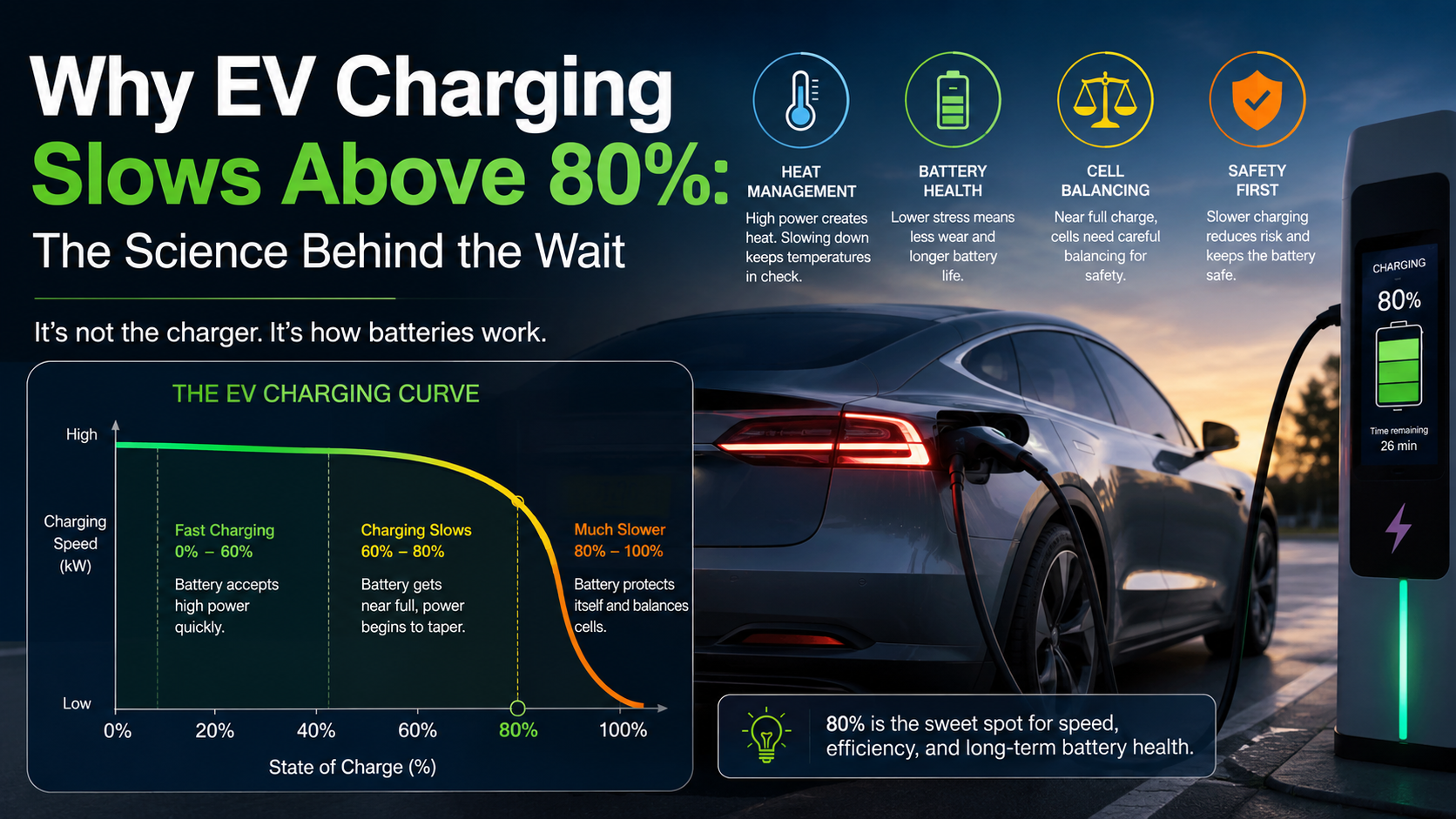
During cell balancing, the system ensures every cell reaches nearly the same voltage. If one cell charges significantly faster than the others, it could exceed its safe operating limit while neighbouring cells remain undercharged. To prevent this, the Battery Management System carefully reduces charging power and redistributes energy where necessary. This balancing process is another reason why the final few percentage points take considerably longer than earlier stages of charging.
Although drivers rarely notice it happening, cell balancing is essential for maintaining battery performance, preserving driving range, and ensuring long-term reliability.
Fast Charging Is Not the Enemy
Another common myth is that frequent DC fast charging permanently damages electric vehicle batteries. Research conducted over recent years suggests the picture is far more nuanced.
While repeated high-power charging does create additional heat compared with slower AC charging, modern EVs are specifically engineered to manage these conditions. Advanced liquid cooling systems, intelligent software, and improved battery chemistry significantly reduce the long-term impact of occasional fast charging.
For most drivers, the difference in battery degradation between responsible fast charging and everyday home charging is relatively small.
What has a much greater impact on battery longevity is consistently exposing the battery to extreme temperatures, leaving it fully charged for long periods, or allowing it to remain completely discharged.
In other words, how the battery is treated between charging sessions often matters more than whether a driver occasionally uses a high-speed charger.
The Future Could Make the 80 Percent Rule Less Noticeable
Battery technology continues to evolve at an extraordinary pace.
Researchers are developing next-generation lithium-ion batteries using silicon-rich anodes, improved electrolytes, and new cathode materials capable of accepting higher charging rates while producing less heat.
At the same time, solid-state batteries remain one of the industry’s most anticipated breakthroughs. Unlike today’s liquid-electrolyte batteries, solid-state designs promise higher energy density, faster charging, greater thermal stability, and significantly lower degradation. Several manufacturers are investing billions of dollars into bringing this technology to mass production before the end of the decade.
Charging infrastructure is also advancing.
Ultra-fast charging stations capable of delivering 350 kW or more are becoming increasingly common, while software updates continue improving charging efficiency in vehicles already on the road.
Artificial intelligence is beginning to play a role as well. Future battery management systems are expected to predict charging behaviour based on driving habits, weather conditions, battery health, and route planning, dynamically adjusting charging strategies to maximise both convenience and longevity.
While the charging curve is unlikely to disappear entirely, tomorrow’s electric vehicles are expected to spend much less time slowing down after 80 percent than today’s models.
The Bottom Line
The slowdown that occurs after an EV reaches around 80 percent charge is not a flaw, nor is it caused by an underperforming charging station. It is a deliberate engineering strategy designed to protect the battery, maintain safety, and preserve long-term performance.
As the battery fills, lithium-ion cells become increasingly sensitive to voltage, heat, and chemical stress. By gradually reducing charging power, the Battery Management System ensures each cell reaches a balanced and safe state without accelerating wear or shortening the battery’s lifespan.
For everyday driving, charging to around 80 percent offers the best combination of convenience, efficiency, and battery health. The final 20 percent remains available whenever drivers need maximum range, but understanding why it takes longer helps set realistic expectations.
As battery chemistry, charging infrastructure, and vehicle software continue to improve, charging times will become shorter and more predictable. Until then, the pause after 80 percent serves as a reminder that the smartest technologies are often those designed not to go faster, but to last longer.

Comments are closed.