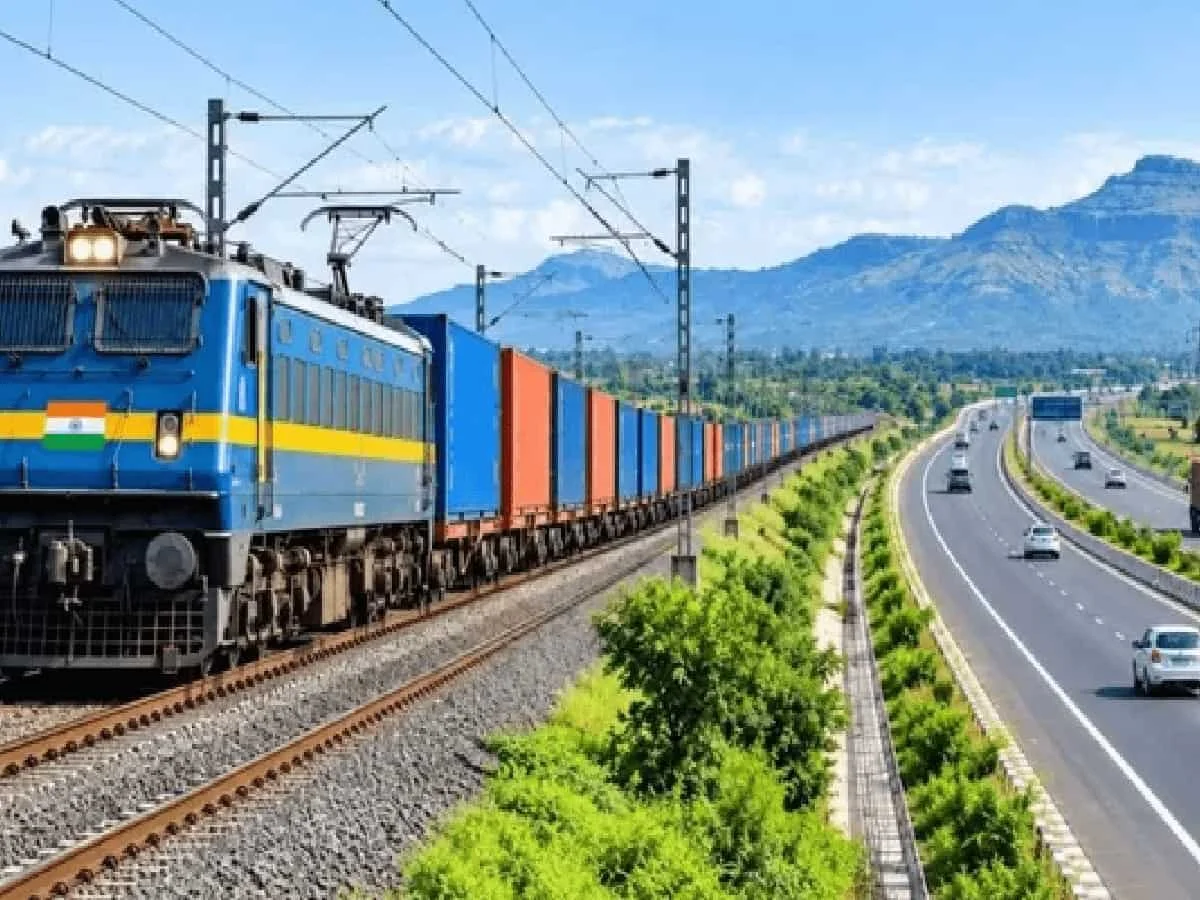
Indian Railways has officially entered a transformative new era of freight movement. With the Eastern and Western Dedicated Freight Corridors (DFCs) now fully operational, the national transporter has significantly boosted its carrying capacity, accelerated transit times, and improved reliability. Looking ahead, ambitious proposals like the upcoming East-West Corridor aim to strengthen national logistics connectivity even further. After decades of historical underinvestment, rail freight finally possesses the core heavy infrastructure required to compete on a national scale.
However, building tracks and laying down heavy infrastructure alone will not win back India’s booming road freight market. Despite record-breaking loading figures, the deeper structural reality of India’s logistics ecosystem reveals a complex commercial hurdle: convincing businesses that moving cargo by rail is superior to booking a fleet of trucks.
The Paradox of Growth: Rising Loading Numbers vs. Shrinking Market Share
At first glance, railway freight appears to be enjoying an unprecedented golden age. Freight loading statistics show a steady, impressive climb from 1,098 million tons in fiscal year 2015 to 1,617 million tons in FY2025, culminating in a record-breaking 1,670 million tons during the previous fiscal year.
Yet, when viewed through the lens of national trade, rail’s actual position in India’s logistics system is far weaker than raw tonnage suggests. A parliamentary committee recently estimated that rail’s share of national freight traffic hovered at a modest 27 percent in fiscal year 2025—falling well short of the ambitious National Rail Plan target of capturing 45 percent of freight traffic by 2030.
The underlying problem is not a shortage of goods or economic activity. India’s expanding industrial base produces more than enough cargo to meet these targets. The core challenge lies in the fact that road transport continues to provide a more flexible, customer-centric service. This competitive pressure is painfully evident even in legacy commodity sectors that have historically formed the bedrock of railway revenue.
The Shift in Traditional Commodities: Coal, Iron Ore, and Steel
Historically, bulk commodities like coal, iron ore, steel, and cement have served as the financial lifeblood of railway freight operations, with coal alone accounting for nearly half of total freight revenue. Despite this entrenched dominance, road transport has steadily chipped away at rail’s market share across multiple sectors.
The shifting dynamics are most visible in the transportation of raw coal. The market share of road transport in raw coal logistics surged from 24.4 percent in FY2021 to 33.8 percent in FY2024, before tapering slightly to 31.1 percent in FY2025. Concurrently, rail’s share dropped from 53.9 percent down to 47.4 percent before staging a partial recovery to 50.5 percent.
While railways have fought back to reclaim ground, road transport is now permanently entrenched as a formidable alternative. A comparable pattern defines other heavy industries. In FY2025, railways transported approximately 178 million tons of iron ore against an estimated total domestic production of 289 million tons, meaning rail managed just over 60 percent of the volume. For finished steel and cement, modal splits remain even more fractured, proving that a massive share of India’s industrial cargo continues to bypass the rail network entirely.
The Decentralization of India’s Consumption Landscape
The preference for road transport is not driven solely by freight pricing; it is a direct response to a fundamental restructuring of India’s economic geography. Rapid urbanization, rising disposable incomes, and the e-commerce boom have decentralized consumer demand, shifting production and consumption away from a few massive metropolitan centers to hundreds of thriving Tier-II and Tier-III cities.
Projections indicate India’s urban population will scale to 522 million, pushing toward nearly 600 million in the coming decade. Crucially, Tier-II and Tier-III cities generated nearly two-thirds of direct-to-consumer orders last fiscal year. Modern warehousing, distribution hubs, and secondary industrial clusters are dispersing across these non-metro regions, demanding an agile, decentralized logistics network.
Road transport has adapted to this decentralized reality with remarkable speed. Backed by a massive expansion of the national highway network—which grew by nearly 60 percent from 91,287 kilometers in 2014 to 146,204 kilometers by March 2025—trucks can navigate directly to remote warehouses, regional distributors, suburban factories, and urban construction sites.
The Last-Mile Dilemma and Multimodal Friction
In contrast to the seamless door-to-door capability of trucks, railways remain fundamentally a line-haul bulk transporter. Rail’s Achilles’ heel lies in its heavy, unavoidable dependence on road transport for first-mile and last-mile connectivity.
Modern supply chains rely entirely on efficient multimodal logistics. However, the physical and administrative transition between rail and road in India is frequently fragmented, introducing extra handling steps, unpredictable transit delays, and administrative uncertainty for enterprise customers. A cement manufacturer or steel producer evaluating logistics partners does not look at railway freight rates in isolation; they calculate the total cost, transit speed, and schedule reliability of the entire end-to-end journey.
If cargo requires multiple intermediate handlings, delivery windows remain unpredictable, or real-time shipment tracking is absent, low base rail tariffs become meaningless. Industrial clients ultimately buy the predictable outcome of a completed supply chain, not merely a mode of transportation.
Transforming Infrastructure Into a Service Model
To bridge this gap, the next frontier for Indian Railways is upgrading service quality. While Dedicated Freight Corridors successfully compress transit times, speed is only part of the equation. Customers demand guaranteed wagon availability, punctual departures, reliable arrival schedules, and real-time digital shipment visibility.
A modern steel manufacturing plant cannot absorb raw material supply chain disruptions caused by delayed freight rakes, nor can an export house afford missed port cut-off times. Consequently, railway management must measure success not just by gross loading volumes and revenue earnings, but by strict customer-centric parameters: on-time arrivals, terminal turnaround times, schedule adherence, and long-term customer retention.
Furthermore, the ongoing rollout of Gati Shakti cargo terminals must evolve past mere capacity expansion. These facilities need strategic integration into regional logistics hubs where cargo can be efficiently aggregated, stored, containerized, and swapped between rail and road. Rather than laying expensive private tracks to every single customer, the railways must forge strategic partnerships with trucking companies, 3rd-party logistics (3PL) providers, and warehouse operators to build unified door-to-door solutions.
Ultimately, the future of Indian freight transport will not belong to the entity that simply carries the heaviest tonnage, but to the system that delivers the smoothest, most reliable service experience. Indian Railways has successfully constructed the heavy infrastructure; the urgent task now is to build a responsive, customer-first service model that translates raw capacity into permanent market share.