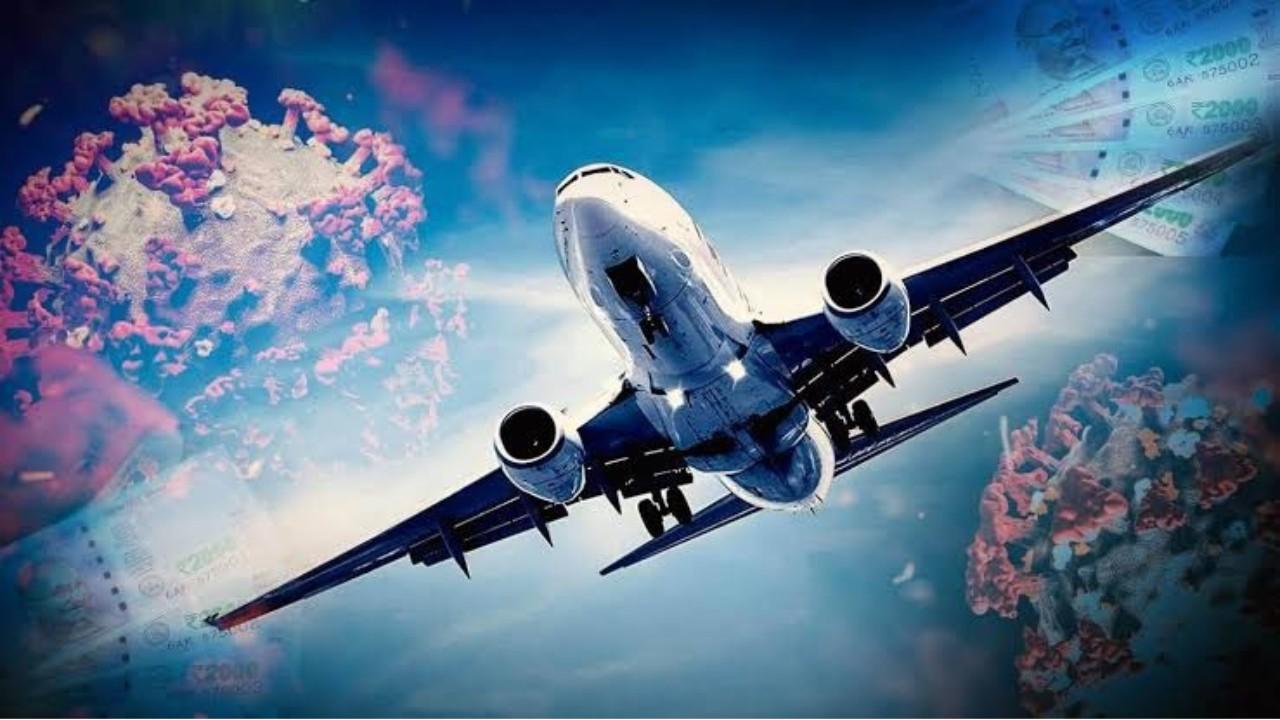
Air ticket prices suddenly skyrocket during festivals, holidays or any emergency in the country. Recently, a petition filed in the Supreme Court claimed that air fares on some main routes have increased by two to seven times (about 700%) as compared to normal days. Although the court refused to hear it immediately, this case has once again heated up the debate on government control and dynamic pricing of air fares in the country.
In India, after the 'Air Corporations Act' was repealed in March 1994, airlines have complete freedom to decide their own fares. Companies work on 'dynamic pricing' model. This means that as seats fill up or the date of travel gets closer, tickets become more expensive. At the same time, when this fare starts becoming beyond the reach of common people, then the question arises whether the government should intervene in it?
Also read: 'There were preparations to build a mall worth Rs 35 crore', what did ED tell on KPSC scam?
The government has already imposed restrictions
It would be wrong to say that the Government of India has no experience in controlling air fares. The government has already taken strict steps in emergency situations. Currently, during the Covid pandemic in the Corona period (May 2020 to August 2022), the government had fixed the minimum and maximum fare limits for domestic flights according to distance and time. The minimum limit was kept so that airlines could protect themselves from losses in an economic downturn and the maximum limit was to protect passengers from robbery.
How can we forget the Indigo crisis (December 2025 – March 2026). When IndiGo flights were canceled on a large scale in December 2025 and the financial pressure on passengers increased, the Civil Aviation Ministry immediately imposed a temporary maximum fare limit on 6 December 2025. This limit was removed on 23 March 2026 when the situation became normal. Both these examples prove that the government has every right to intervene in times of crisis.
New rules will come into effect from January 1, 2027
The Government of India has notified the 'Indian Aircraft Rules, 2026' on 31 October 2026 which will come into full force from 1 January 2027. Under its Rule 192:
- Airlines will have to clearly give complete information about base fare, taxes, cancellation charges and other charges at the time of booking.
- Companies will have to submit their fare structure to DGCA.
- Most importantly, if the government feels that an extraordinary situation has arisen, it can issue written instructions to airlines regarding fares in public interest.
What is the system in other countries of the world?
Even in foreign countries, airlines have the freedom to set fares but there are very strict rules on transparency and consumer rights. Like in America, under the 'Airline Deregulation Act' of 1978, there too the market decides the fares. But the 'US Department of Transportation' takes care that airlines do not give any kind of misleading advertising or cheat people by creating a monopoly.
In the European Union (EU), companies have the freedom to fix fares under Regulation 1008/2008. Additionally, it is illegal to conceal the total final price, mandatory taxes, baggage charges and airport fees at the time of booking. In Britain, the 'Civil Aviation Authority' (CAA) has wide powers to protect the interests of consumers and take strict action against companies providing misleading information.
How is surveillance done in India now?
At present, DGCA's Tariff Monitoring Unit (TMU) conducts random checks of fares on 78 main routes of the country. However, its function is only to see whether the airline is selling tickets within its fixed and declared fare range or not. Experts believe that India needs an independent 'aviation regulator' that can only keep an eye on the economic interests of passengers and transparency in fares, separate from the safety and competition monitoring body (CCI).
Also read: 'Stay away from the issue of foreign-indigenous', Brijbhushan Sharan Singh's advice to Rahul Gandhi
There are both advantages and disadvantages to permanently capping air fares. If we look at it as a benefit, there will be no loss in the pockets of passengers during festivals or times of crisis. Patients, students and those traveling suddenly will get great relief. If the government fixes very low fares, then it will become a loss-making deal for the airlines to operate flights amid expensive aviation fuel and operating expenses. Due to this, flights on many routes may also be stopped.
The solution does not lie in tying fares throughout the year but in a balanced policy. Whereas on normal days the market should be allowed to decide the fares, but during festivals, natural disasters or disturbances in flights, the government should immediately intervene and set the maximum limit.