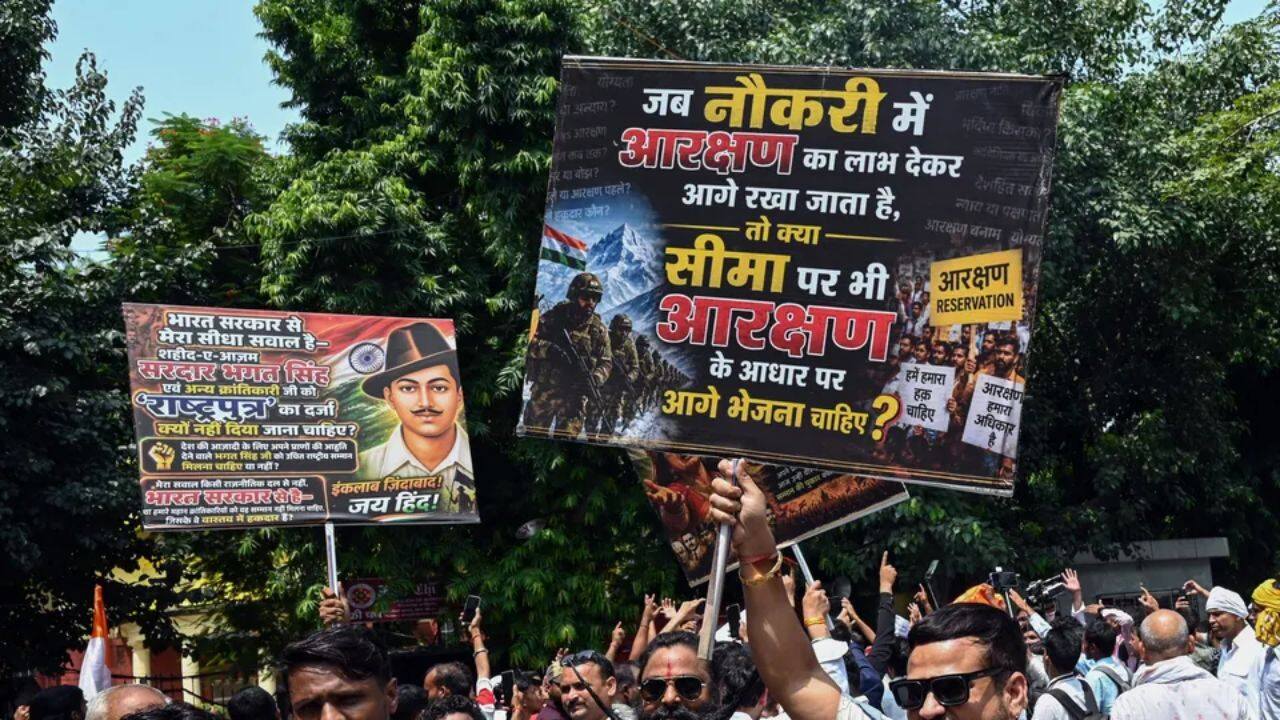
Supporters of 'Remove Reservation Movement' have surrounded Jantar Mantar in the country's capital Delhi. He claims that the government has agreed to discuss the removal of reservation. The agitation of just 2 days has forced the government. He says that the government has agreed to discuss the demands related to improvements in reservation. Union ministers from the ruling party will come to talk to the protesters.
The protesters say that the movement is not over yet. This movement is being run through a page on Instagram 'Remove Reservation Hatao Andolan', which has about 56 lakh followers. On Friday, hundreds of people gathered at Jantar Mantar in Delhi and demanded removal of reservation.
Police detained many people. The protesters say that the government has now agreed to talk about the demands. They want people like YouTuber Ajit Bharti, Anand Ranganathan to also participate in this discussion, so that people can agree on one issue.
Also read: 'Remove reservation' movement at Jantar Mantar, thousands of people gathered, many detained
What do the protesters want?
- While giving reservation, more importance should be given to economic condition
- A poor person should get the benefit of reservation irrespective of his caste.
- There should be quota-in-quota system even within reserved categories.
- Efforts should be made to provide benefits to the weakest people.
- The government should issue a white paper on the impact of reservations over the past several decades.
- Minimum marks level should be maintained for admission in higher education
- Economically weaker sections should get more facilities
Why do the protesters want this?
The protesters say that the situation has changed, so the old system should be reconsidered. After the coming of the Constitution in the country, the society has become equality oriented, hence the old system of reservation should be ended and emphasis should be given afresh on adding new classes.
Ajit Bharti, remove reservation agitator:-
'Reservation is a political solution to a social problem. This system has now extended beyond education and government jobs to promotion, due to which ability and efficiency is being affected. Instead of increasing the scope of reservation again and again, society should focus on real reforms and equal opportunities. The question is how long will this endless reservation continue?
Why is it difficult to remove caste based reservation in the country?
Nikhil Gupta, assistant professor in the law department of Dewan Law College, said, 'Reservation provisions were made in India to bring the Dalits, deprived and exploited sections to the level of equality. Centuries of exploitation, social neglect and marginalization have kept it relevant. Even today, caste discrimination is seen in many sections of the society. As long as this inequality exists, as long as oppression exists, the need for reservation will remain.
Assistant Professor Nikhil Gupta said, 'Caste-based reservation under Articles 15(4), 15(5) and 16(4) of the Indian Constitution allows the state to make special provisions for socially and educationally backward classes, scheduled castes and tribes. This is a valid exception to the fundamental right to equality. If it is removed, then under Article 368, majority is required in both the houses of the Parliament. The opinion of the leaders themselves on reservation is so divided that even the leaders of the same party may have different opinions. Some may agree with this, some may disagree. From Parliament to the streets, removal of reservation can lead to anarchy.
Nikhil Gupta said, 'The Supreme Court has upheld the constitutional validity of reservation in many decisions including Indra Sawhney. The Supreme Court argues that conditions like 50 percent limit and creamy layer should be followed. The courts also balance the goal of social justice while considering equality as a part of the basic structure. The reservation policy has been in place for decades and it is difficult to reach a unanimous opinion on abolishing reservations due to its incomplete goals of representation of beneficiaries and social justice. Any amendment may face legal challenges and judicial review.
Also read: '500 people, time only till 4 pm', now permission given for removal of reservation movement here
What are the arguments in favor of reservation?
Rajkumar Bhati, Spokesperson, Samajwadi Party:-
The recommendations of the Mandal Commission were not based only on religious texts, but were prepared on the basis of intensive socio-economic surveys across the country. This included assessment of concrete parameters such as housing conditions, level of education and income. Even today, incidents of discrimination and untouchability against Dalits and backward classes in the country are a bitter reality, which cannot be denied. In such a situation, reservation is a necessary and mandatory step to bring the deprived sections of the society into the mainstream.
How old is the debate on reservation?
Dr. Deepak Kumar, Assistant Professor at Bennett University and former research student of JNU, said, 'The debate on ending caste-based reservation is almost as old as the reservation system itself. In 1882, Jyotirao Phule had raised before the Hunter Commission the demand for proportional share and representation in government jobs and education for the deprived sections. But this was the ideological foundation of reservation, not a formal policy. Before independence, it was also implemented in some princely states, but as reservation became institutionalized, voices against it also kept being raised simultaneously.
Assistant Professor Deepak Kumar said, 'There was an intense debate on this in the Constituent Assembly during 1946-49. The recommendations of the Mandal Commission in 1980 and their implementation in 1990 were followed by nationwide protests. The Indra Sawhney decision of 1992 set the limit of reservation at 50 percent. This debate has not stopped. The movement to remove reservation in Delhi is not new. No matter how much political parties make statements on this issue, no matter how many demonstrations are held, it is true that removing reservation now is a difficult task. A slight change in this can invite a big uproar.
Also read: Will there be a movement to remove reservation at Jantar Mantar today? Delhi Police issued update
Reservation to whom and why?
There is a book by BR Ambedkar 'Who were The Shudras'. It has been told in this book that Shudra is the fourth varna of the Chaturvarnya system, which has been called the servant class. It comes under Brahmin (priests), Kshatriya (soldiers) and Vaishya (merchants). Ambedkar emphasized that Shudras were deprived of education, wealth and weapons so that they remained dependent on the upper three varnas. In such a situation, it was necessary to provide reservation to bring these classes to the level of equality.
What did Ambedkar think about reservation?
Assistant Professor Nikhil Gupta said, 'Dr. BR Ambedkar believed that reservation was not just a means of poverty alleviation or economic assistance, but it was the constitutional right to give adequate representation in the governance process to the classes who had been deprived of power and administration for centuries. While discussing Article 16(4) in the Constituent Assembly, he stressed the balance between the principle of equal opportunity and the actual situation of the backward classes.
Did Ambedkar want reservation to end in 10 years?
There is maximum confusion regarding this. Ambedkar had never said that reservation should be only for 10 years. Misleading claims are made regarding his statements.
Bhim Rao Ambedkar, in the Constituent Assembly on 25 August 1949:-
I was personally prepared to press for a longer period, because I feel that as far as the Scheduled Castes are concerned, they are not treated at par with other minorities. I believe that it would have been quite appropriate and generous on the part of this House to give a longer period to the Scheduled Castes in respect of these reservations. I am ready to give an even longer period for the Scheduled Tribes. Those who have talked about reservation for Scheduled Castes or Scheduled Tribes have been so cautious that this thing should end in 10 years. I want to tell them in the words of Edmund Burke that big empires and small minds do not go together.
Whose contribution is this reservation system?
Assistant Professor Nikhil Gupta said, 'The Poona Pact of 1932 laid the foundation of the current reservation system. After Mahatma Gandhi's fast in protest against Dalits getting a separate electorate under the Communal Award, Ambedkar agreed to the reserved seats along with the joint electorate. Dalit seats in provincial councils increased from 71 to 147. This agreement established the model of joint electorate and reserved candidacy in independent India. Ambedkar later expressed his dissatisfaction with this system that in this the Dalit leadership becomes dependent on the majority of voters and big parties.
Also read: 'Give reservation to Nishads, otherwise I will protest', Sanjay Nishad warns BJP
What is the status of Dalits in the country?
According to the 'Crime in India 2023' report of the National Crime Records Bureau (NCRB), 57,789 cases of crimes against Scheduled Caste people were registered, which is 0.4 percent more than 57,582 cases in 2022. Uttar Pradesh reported the highest number of cases at 15,130, followed by Rajasthan at 8,449, Madhya Pradesh at 8,232 and Bihar at 7,064. Most crimes against Dalits were of simple hurt. A total of 18,437 cases were reported. This was followed by cases of criminal intimidation and SC/ST Prevention of Atrocities Act. 2,835 cases of rape of Scheduled Caste women and 1,379 cases of rape of children were filed. The charge sheet filing rate was 81.2 percent.