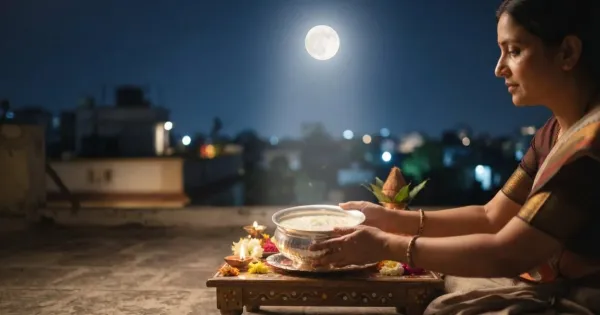
Religion Desk. Sharad Purnima is considered to have special religious significance in Sanatan Dharma. The tradition of worshiping the moon on this day, seeking the blessings of Goddess Lakshmi and keeping kheer under the open sky at night has been going on for centuries. It is believed that on the night of Sharad Purnima, the moon is filled with all its 16 phases and its cool moonlight causes nectar to rain. Due to this belief, people prepare kheer at night and keep it on the terrace, courtyard or balcony and accept it as prasad the next day.
But how did the tradition of keeping kheer on the night of Sharad Purnima start? Why is moonlight considered like nectar and what is the belief behind keeping kheer in a silver vessel? Let us know about the religious beliefs, cultural importance and scientific facts related to this tradition.
What is the religious belief behind keeping kheer on the night of Sharad Purnima?
According to religious beliefs, the rays of the moon on the night of Sharad Purnima are considered especially auspicious and cool. It is believed that on this night, nectar rains from the moon and when the moonlight falls on the kheer kept under the open sky, it acquires properties similar to nectar.
For this reason, many families prepare kheer made of milk, rice and sugar. At night it is kept at a clean place where moonlight can reach. The next morning, after offering the kheer to the Lord, it is distributed among the family members as Prasad.
However, this tradition is performed differently in different regions. At some places the kheer is kept in the moonlight for the whole night, while at some places there is a tradition of taking the prasad after puja and moon darshan. Its basic meaning is reverence for the moon, connection with nature and celebrating religious festivals with family.
What is the significance of the 16 phases of the Moon?
In Hindu religious traditions, the moon is considered a symbol of coolness, mind and gentleness. Sharad Purnima is associated with the fullness of the moon. There is a religious belief that on this night the moon is full of its 16 phases, hence its moonlight is considered especially auspicious.
Due to this belief, traditions like moon sighting, worship and night vigil are also prevalent on Sharad Purnima. In some religious beliefs, this night is also linked to Maharas Leela of Lord Krishna.
The point to be noted here is that the concept of 16 phases of the Moon and nectar rain is a part of religious and cultural beliefs. This should not be seen as evidence of any special scientific energy emanating from the Moon or actual nectar rain.
Why is Goddess Lakshmi worshiped on Sharad Purnima?
Sharad Purnima is also considered important for the worship of Goddess Lakshmi. According to folk beliefs, on this night Goddess Lakshmi roams the earth and blesses her devotees with happiness and prosperity.
For this reason, Goddess Lakshmi is worshiped at night in many homes. People clean their houses, light lamps and pray for wealth and prosperity. In some traditions, the importance of staying awake all night and worshiping has also been mentioned.
From a religious point of view, this occasion along with wishing for happiness, peace and prosperity in the family, also gives the message of charity, service and adopting positive life values.
Why is there a tradition of keeping kheer in a silver vessel?
The tradition of keeping kheer in a silver vessel on the night of Sharad Purnima is also prevalent in some families. In astrological beliefs, silver is associated with the Moon. For this reason, silver is given a special place in the worship of the Moon and the traditions related to it.
Antimicrobial properties are found in silver under certain circumstances, but this does not mean that keeping kheer in a silver vessel or moonlight falling on it automatically increases its medicinal properties. There is no solid scientific evidence confirming any additional health benefits from this particular religious tradition.
Therefore the use of silver vessels should be considered primarily associated with religious faith, tradition and symbolic importance.
Does kheer kept in moonlight really acquire the properties of nectar?
This question often comes in people's mind whether kheer kept in moonlight on the night of Sharad Purnima actually becomes medicinal. From a scientific point of view, moonlight is a reflection of sunlight. On the day of full moon, the illuminated part of the Moon is almost completely visible from the Earth, hence its light is relatively more visible.
But there is no reliable scientific evidence that the moon rains nectar on the night of Sharad Purnima or that its rays create special medicinal properties in the kheer. Similarly, the claim that the Moon is closest to the Earth every year on this night is also not scientifically established.
The taste and nutritional value of kheer mainly depends on the ingredients used in it, quality of milk, amount of sugar and method of preparation.
Relationship between changing weather and coolness of the moon
Sharad Purnima is celebrated on the full moon day of Ashwin month. During this period, the weather starts changing after the monsoon in many parts of India and the nights start becoming relatively cool. The moonlight may be more clearly visible in clear skies.
In Indian culture, moonlight is associated with coolness, mental peace and beauty of nature. In such a situation, spending time in the open environment on the full moon night and seeing the moon becomes a part of the religious experience.
However, associating moonlight with mental peace is a matter of culture and personal experiences. No specific medical benefit can be guaranteed.
Keep these things in mind while keeping kheer in the open
While following religious traditions, it is also important to take care of the hygiene and safety of food. Kheer made from milk can spoil quickly, especially if it is left at room temperature for a long time.
-
Always keep kheer in a clean vessel.
-
When storing it outdoors, use a clean mesh cover to protect it from dust, insects and animals.
-
Keep food safety in mind instead of leaving milk kheer outside all night. The safer option is to keep it covered in the refrigerator and take it out for a while at the time of puja.
-
If the kheer has unusual smell, taste or signs of spoilage, do not eat it.
It is important to give priority to food safety while still respecting religious traditions.
The festival of Sharad Purnima is associated with faith, tradition and nature.
The tradition of keeping kheer in the moonlight on Sharad Purnima is an important part of Indian religious and cultural life. Beliefs related to nectar rain, 16 phases of the moon and Goddess Lakshmi's visit to the earth make this festival special.
These beliefs have not been scientifically confirmed, but this tradition provides an opportunity to bring families together, perform rituals, and connect with nature. This is the reason why even in modern times many people celebrate Sharad Purnima with devotion and enthusiasm.