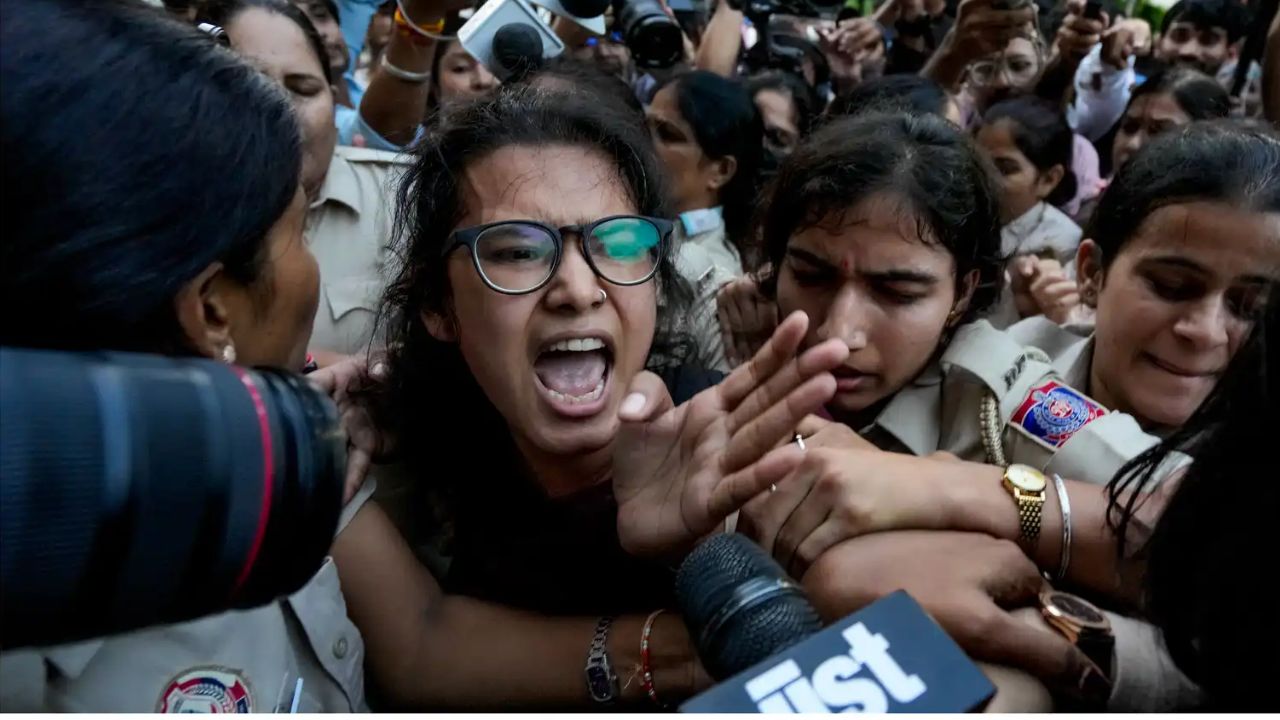
The country's capital Delhi has been at the center of protests for the last 5 months. On June 6, a huge public anger erupted in Delhi against Dharmendra Pradhan over the NEET paper leak and alleged rigging in CBSE results. This demonstration, which started under the leadership of Cockroach Janata Party founder Abhijit Deepke, turned into a mass movement. Dharmendra Pradhan had to resign. This protest lasted for more than 30 days; on July 25, Dharmendra Pradhan submitted his resignation.
Delhi is once again at the center of movements. This time anger has flared up against Gyanesh Kumar and the Election Commission. On October 2, Cockroach Janata Party held a public meeting in Shivaji Park, Mumbai. The opposition parties looked united. During the CJP protest in Delhi on 10 October, police detained several protesters. A day later, the court ordered the release of three leaders, including CJP founder Abhijit Dipke.
On October 12, Congress workers also marched towards the Supreme Court. More than 25,000 policemen were deployed to stop these demonstrations. Thousands of protesters were detained and allegations of police strictness were also made. On 16 October 2026, a 'Lehra Do Tiranga' march and demonstration was organized in the Central Park of Connaught Place, in which the police detained several protesters, including founder Abhijit Deepke.
Also read: 'Access to Internet is a fundamental right', why did the Supreme Court say this?
How were the journalists treated?
Many journalists were detained in Delhi. They were packed into buses, questions were asked about their press cards. The police looked at the cards of the journalists and raised questions on the card itself. Some journalists were asked to show the PIB card, even the cards of media institutions were questioned. Many independent journalists alleged that the police treated them badly. Police raised questions regarding media coverage. Police taught journalists how to report.
Why are police and government teaching journalists?
Now the government and police are prescribing the mode of covering protests for journalists covering demonstrations and law and order situations. Police say that journalists should stay away from police barricades and the protest site. Must show press jacket and card, do not obstruct police work.
Police are reminding journalists of the rule that journalists do not deliberately try to change or influence the situation while covering incidents. They violate a person's privacy only when there is genuine public interest, not just for curiosity's sake or sensationalism.
Journalists stay away from such political, social or commercial activities that raise questions about their impartiality. His work is completely free from any kind of bias.
Also read: Notice to ECI and government, rebuke to Rahul Gandhi; Supreme Court took news of everything
What rules has PCI set for journalists?
The Press Council of India (PCI) has issued detailed guidelines for journalists for coverage of protests and demonstrations. Their objective is to ensure safety of media personnel, responsible reporting and better coordination between journalists, media organizations and police. The guidelines have been adopted days after protests broke out in Delhi on October 10, in which several journalists were detained or injured.
What have the journalists been instructed to do?
PCI has said that journalists should clearly show their valid press identity card. This card can be from media organization, Press Information Bureau (PIB) or Directorate of Information and Publicity of the state government. When wearing an ID card, it should be kept secure so that the risk of getting entangled in a crowd or confrontation is reduced.
PCI says that when confronted by the police, one should identify oneself as a journalist in a calm and clear manner. Journalists should remain impartial. They should not participate in demonstrations, support any party, instigate confrontations, or interfere with protesters, counter-protesters or police.
Also read: Insurance will be available even if you buy tickets from railway counter, Supreme Court gave instructions
What instructions did journalists receive on conduct?
PCI has said that journalists should behave respectfully, follow police orders and avoid arguments in tense situations. Follow immediate instructions given for safety, and calmly communicate your press status if necessary.
PCI advises that journalists maintain an appropriate and safe distance from confrontations, especially when tensions rise or there is a possibility of police action. Cameras or recording equipment must not be attached to police barricades, vehicles or other equipment in a manner that obstructs movement or causes damage to property.
What should journalists do if there is a crowd?
One should walk carefully in a crowd and take small steps to reduce the risk of falling or being crushed. One must constantly assess one's situation and keep an eye on the surrounding environment, crowd behaviour, noise and potential hazards.
Escape routes and safe locations should always be memorized and updated as the situation changes. In case of smoke or tear gas, one should move out of the affected area using visible signs and safe routes, and should not go deeper into the crowd.
Also read: Is there going to be a ban on firecrackers in Delhi NCR? Hearing in Supreme Court
What instructions have been received for police coverage?
PCI has stated that reporting of incidents must be accurate, objective and unbiased. Verified facts must be separated from allegations, opinions and unverified claims. Information should be verified from multiple sources. Witnesses should be asked how they obtained the information and their credibility and potential for bias assessed. Statements by protesters, organizers, police and government should be covered carefully. Police real-time positions, movements or escape routes should not be broadcast unless it would affect security or operations. The truth should be shown instead of people's intentions or feelings.