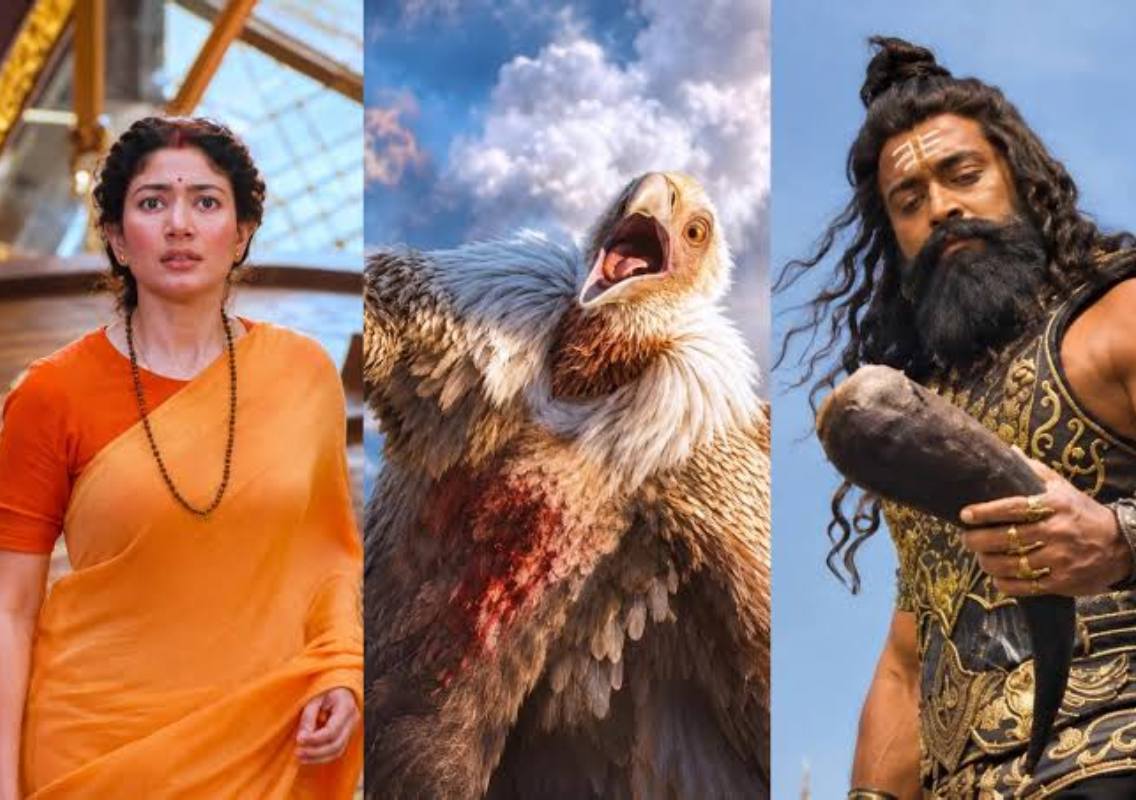
Mumbai: A brief but intriguing moment in Nitesh Tiwari’s Ramayana: Rise of a Legend has drawn attention to the character of Ravana, played by Yash. During the fierce battle between the Lanka king and Jatayu, voiced by Anupam Kher, Ravana breaks one of the injured bird’s nails and keeps it with himself. The seemingly small gesture has prompted viewers to wonder why a powerful ruler would preserve a part of an opponent he has just defeated.
The answer may lie in Ravana’s wounded pride. Jatayu, despite being old, puts up a determined fight when he sees Ravana abducting Goddess Sita. He manages to injure the Lanka king and even beheads him with his sharp claw. Although Ravana’s ability to regenerate allows him to recover, the encounter challenges his sense of invincibility.
By keeping Jatayu’s nail, Ravana appears to be preserving a reminder of the moment when an opponent he may have underestimated managed to hurt him. The gesture adds another dimension to the film’s portrayal of his ego, arrogance and desire to assert control.
However, there is an important distinction between the film’s interpretation and the original epic. The detail involving Jatayu’s nail is a cinematic addition and is not described in Valmiki’s Ramayana.
How Jatayu challenged Ravana
The confrontation takes place when Ravana is carrying Sita away after abducting her from the forest. Jatayu, the elderly king of vultures and a friend of King Dasharatha, witnesses the abduction and decides to intervene.
Although he is aware of Ravana’s immense strength, Jatayu refuses to remain a silent spectator. He confronts the Lanka king and reminds him that abducting another man’s wife is an unrighteous act.
Ravana does not heed his warning, and the disagreement turns into a fierce aerial battle. Jatayu uses his beak, talons and powerful wings to attack the demon king. His determination makes him a formidable opponent despite his age.
In the film, the fight is depicted as an intense exchange in which Jatayu manages to inflict a significant injury on Ravana. The bird’s sharp claw cuts off Ravana’s head. However, Ravana possesses the ability to regenerate, allowing him to recover and continue fighting.
The setback appears to intensify Ravana’s anger. He launches another attack, eventually cutting off one of Jatayu’s wings. The injured bird loses his ability to fly and falls to the ground.
It is towards the end of this encounter that Ravana breaks one of Jatayu’s nails and keeps it.
What does Ravana keeping the nail symbolise?
The gesture can be interpreted as an expression of Ravana’s wounded ego. The Lanka king is accustomed to being feared and obeyed. His reputation, power and conquests have made him believe that very few opponents can challenge him.
Jatayu’s resistance disrupts that sense of superiority. The bird is not a powerful warrior or a ruler commanding a large army. He is an ageing creature who chooses to fight because he believes Sita must be protected.
Yet, he manages to inflict an injury on Ravana. Even though the king eventually wins the physical battle, the encounter exposes a moment of vulnerability.
Keeping the nail could therefore be understood as Ravana’s attempt to possess a reminder of that humiliation. Rather than simply leaving the defeated bird behind, he takes something belonging to the opponent who managed to hurt him.
The action may also suggest a desire to turn an embarrassing encounter into a trophy. By taking the nail, Ravana could be asserting control over the very opponent who challenged him.
The film does not need an elaborate explanation to communicate this idea. The small gesture allows viewers to interpret Ravana’s psychological response to the confrontation.
It is important, however, to treat this as an interpretation of the cinematic scene rather than an established explanation from the original epic.
Did Ravana keep Jatayu’s nail in Valmiki’s Ramayana?
No. The episode in which Ravana breaks Jatayu’s nail and preserves it is not part of the original Valmiki Ramayana. It is a creative addition in Nitesh Tiwari’s film.
In the Aranya Kanda, Jatayu attempts to stop Ravana from abducting Sita. He challenges the Lanka king and tries to make him understand that his actions are wrong.
When Ravana refuses to listen, Jatayu attacks him. The bird damages Ravana’s chariot and kills his charioteer. He also manages to overpower the king for a while, demonstrating that his courage and strength should not be underestimated.
View this post on Instagram
Ravana eventually retaliates with his sword and cuts off Jatayu’s wings. The severely injured bird falls to the ground.
Later, when Rama and Lakshman search for Sita, they encounter the wounded Jatayu. Despite his injuries, the bird tells them that Ravana abducted Sita and carried her away towards Lanka.
This information becomes an important clue in Rama’s search. Jatayu’s account helps the brothers understand what happened and gives them a direction to pursue.
The original narrative does not describe Ravana collecting a nail from Jatayu after the battle. The film’s decision to introduce this detail gives the confrontation an additional psychological dimension.
Ravana’s history of conquests and trophies
Although the nail is a cinematic invention, Ravana’s association with conquest and displays of power has a broader basis in the epic tradition.
In the Valmiki Ramayana, Ravana is portrayed as a formidable ruler who expands his influence through battles and conquests. His victories are often associated with the acquisition of wealth, weapons, vehicles and other symbols of power.
One prominent example is the Pushpaka Vimana. The celestial vehicle originally belonged to Ravana’s half-brother Kubera. Ravana seized it after defeating him and took possession of the magnificent aircraft.
The Uttara Kanda also describes Ravana’s campaigns against celestial beings and other powerful opponents. His ambition extends beyond ruling Lanka, as he seeks to establish his dominance over different realms.
The epic also refers to marks on Ravana’s chest associated with his encounters with powerful adversaries. These include accounts connected to Indra and his white elephant Airavata. Such details reinforce his image as a warrior who has challenged formidable opponents.
However, these episodes should not be confused with the specific idea of Ravana collecting personal trophies from defeated enemies. The nail in Tiwari’s film is a separate creative choice.
Within the film’s interpretation, it can be viewed as a more personal reminder of a confrontation in which Ravana’s pride was challenged.
Why Jatayu’s sacrifice is important
Jatayu’s defeat is one of the emotionally significant episodes in the Ramayana because it highlights the bird’s willingness to sacrifice himself for what he believes is right.
He understands that Ravana is far more powerful, but that knowledge does not stop him from intervening. His decision is driven by his sense of duty and his determination to protect Sita.
Even after losing his wings, Jatayu does not give up completely. He remains alive long enough to inform Rama and Lakshman about the abduction. His final act helps the brothers continue their search for Sita.
The episode also establishes an important contrast between Ravana and Jatayu. Ravana uses his immense power to commit an unjust act, while Jatayu risks his life to oppose it.
In this sense, the nail detail adds an interesting layer to the film’s presentation of their battle. Ravana may emerge victorious in physical terms, but Jatayu manages to leave a mark on the king’s pride.
The scene ultimately underlines a central idea in the epic: courage and righteousness are not determined by physical strength or the certainty of victory. Jatayu loses the battle, but his decision to stand against injustice makes his sacrifice memorable.