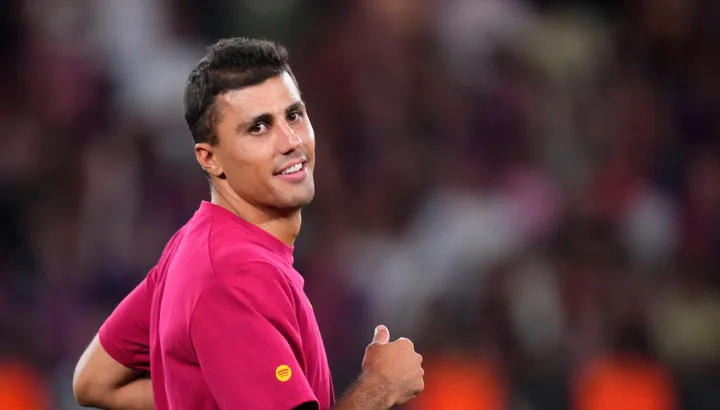
Barcelona’s signing of Rodri looks like the perfect marriage. The club, historically associated with passing, game control and an attacking philosophy, has secured the world’s best defensive midfielder in terms of game organisation.
It is an elite-level signing, without question. The 30-year-old Spaniard showed at the 2026 World Cup, where he was named the best player of the tournament, that he still delivers at an extremely high technical level.
That is despite a serious knee injury suffered in September 2024, which practically ruled out any sustained run of fitness for him right up until the World Cup.
The price, it is fair to say, is questionable. €60m (£51m) fixed, with a further €11m (£9.4m) in possible bonuses, is considerably high given his age. On top of that, there is a significant recent history of physical issues: after the ligament rupture, there were six further injuries.
There is also another, less discussed, factor: certain tactical fits. Rodri will obviously start, taking the place of Frenkie de Jong, who is injured until at least November.
However, there are arguably two issues Hansi Flick will need to resolve: how the midfielder’s dynamic with Pedri will work, and the team’s approach once possession is lost.
Rodri and Pedri did not click at the World Cup
© Imago / Sergio Ruiz / PRESSINPHOTO
Spain conquered the world without their second-best midfielder. With Rodri starting, Pedri was left on the bench and was not decisive in the triumph. Manager Luis de la Fuente stuck with the same midfield that had won Euro 2024, with Fabian Ruiz and Dani Olmo completing the trio.
The Barcelona midfielder could only have taken Ruiz’s spot, and, given the Spanish manager’s tactical approach, Ruiz’s profile simply made more sense for the system than Pedri’s.
In possession, the Spanish national team operated with only Rodri sitting in front of, or between, the centre-backs. The second midfielder needed to push further up the pitch, operate more between the opposition’s lines to receive the ball, carry it forward and even get into the box to score.
That was the perfect scenario for Ruiz. For Pedri, it was the worst.
The 23-year-old is the organiser at Barcelona, dictating attacks in a pairing with De Jong, who often pushed further forward himself. As with Rodri for Spain, there was simply no room for him in that structure. That will be something for Flick to find a solution for.
The German manager’s Barcelona side has a different structure to the Spain national team, typically operating with a more fixed midfield pairing in front of a back three.
Even so, this will not be straightforward, and Pedri could end up “paying the price” for Rodri’s arrival. The more experienced player will naturally become the primary outlet for the first pass, monopolising a large share of the team’s offensive actions.
At his peak with Manchester City, he averaged around 120 touches per match.
Over the last two LaLiga seasons, the Barcelona midfielder averaged more than 80 actions in possession per match, a number likely to drop. The youngster will probably continue to operate close to the build-up phase, supporting the centre-backs and his new teammate, but with the freedom to carry the ball through the middle, in a role closer to the one previously occupied by Frenkie de Jong.
Rodri could transform Barcelona, or expose them
© Imago / Every Second Media
The defining feature of Hansi Flick’s Barcelona has been their intensity when pressing opponents. That approach, however, has proven to be a double-edged sword. It has been key to both LaLiga titles won under Flick, while also arguably contributing to Champions League exits.
That high-energy rhythm has, at times, also shaped the way the team attacks. Barcelona, for example, tried to play too directly in the historic 13-goal Champions League semi-final against Inter Milan in 2025, across both legs. A chaotic match, end to end, with little control, is far from ideal conditions for Rodri.
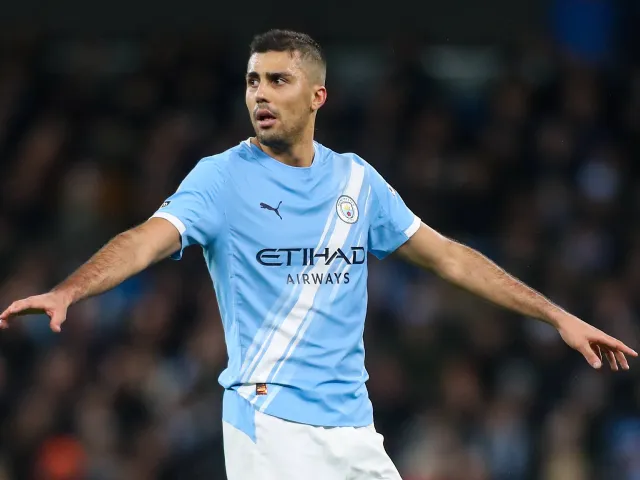
The less mobile midfielder stands out for his positioning and reading of the game, allowing him to cover large areas of the pitch. He did exactly that at Manchester City, winning three Premier League titles with the division’s best defence.
The issue is that the City side he played in under Pep Guardiola was tactically closer to Luis de la Fuente’s Spain than to the current Barcelona side under Flick.
To avoid leaving him exposed, the Blaugrana will need to take even greater care of the ball, circulate it in search of space, and, when losing possession, press quickly to win the ball back rather than allowing a long transition back towards the centre-backs and the number 16.
‘I think he might be the best number 6. He can control the game, but he also helps out in defence. He can win aerial duels, which is very important for us, and of course he raises the standard of every player’ – the German manager said in praise of his new signing.
There are questions over the tactical fit, but the expectation is that the new signing will become the face of Barcelona’s midfield and boost the team’s status as favourites in both LaLiga and the Champions League, which remains the great dream of the project under Flick.