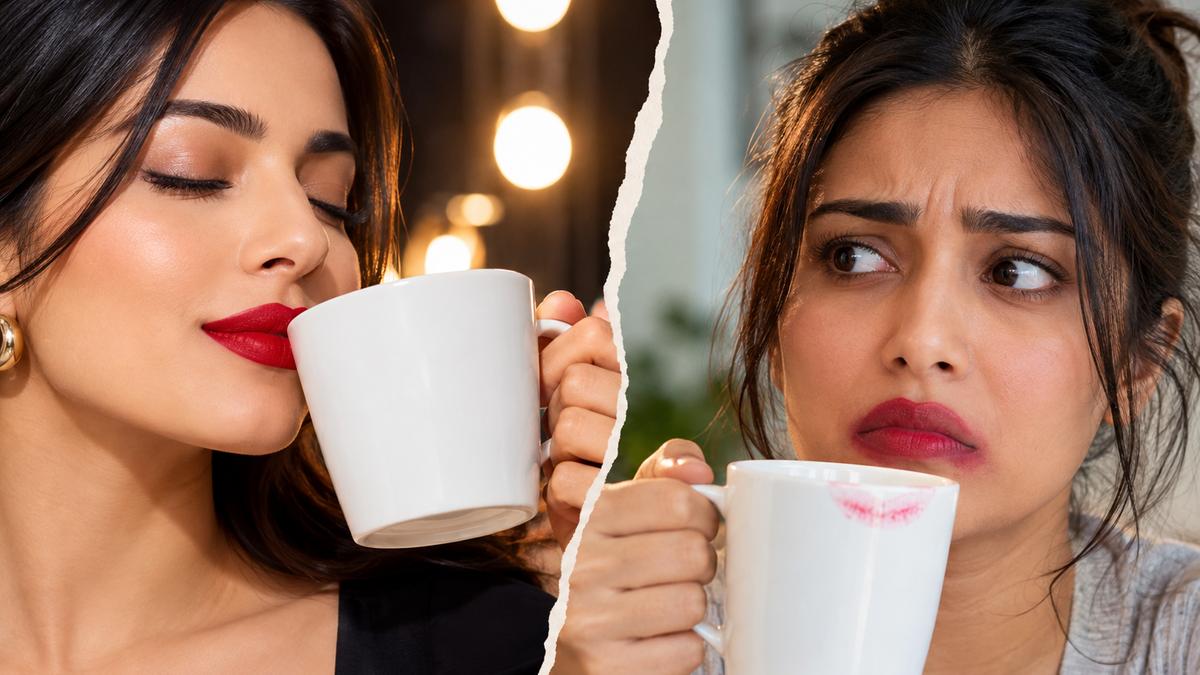
There are few relationships more complicated than the one between a woman and her favorite lipstick.
The lipstick promises to stay put all day; the advertisement proves it by surviving a coffee mug, and then real life happens. One sip later, there it is, proudly stamped on the cup.
So, why does the lipstick in the advertisement appear practically indestructible while the one in your handbag starts fading, cracking, or transferring within hours?
The answer is not necessarily that the product is fake. Modern long-wear lipsticks are genuinely engineered to resist transfer. But the dramatic demonstrations seen in beauty advertisements often take place under carefully controlled conditions that are very different from everyday life.
Why does transfer-proof lipstick work so well in ads?
1. The formula is designed to form a film
Many long-wear liquid lipsticks use volatile ingredients such as isododecane along with film-forming polymers.
After application, the volatile component evaporates, leaving behind a thin film that holds pigments against the lips.
Ingredients such as trimethylsiloxysilicate can help create a flexible, water-resistant layer, which is one reason some long-wear formulas can withstand considerably more rubbing, drinking and eating than conventional lipsticks.
2. Your lips are not a perfectly smooth surface
Real lips have fine lines, dry patches, and constantly changing moisture levels. When lipstick settles unevenly across that surface, it can break down or flake more easily.
That is why preparation matters. Smooth, well-prepped lips generally provide a better surface for long-wear products than lips covered with loose flakes or excess balm.
3. Too much product can actually work against you
Applying several thick layers may seem like the obvious way to make lipstick last longer. But an excessively thick layer can take longer to set and may remain more prone to movement or cracking.
For long-wear formulas, a thinner and more even application can often produce a better result than repeatedly swiping on more product.
4. Lip balm can change the equation
That comforting layer of moisturizer underneath your lipstick can also affect how firmly a film-forming formula sets.
Heavy oils or emollients on the lips can interfere with the way some long-wear products dry down. This is why makeup artists may carefully prepare and blot the lips before applying a highly durable formula.
5. Advertisements control the conditions
This is perhaps the biggest difference between an advertisement and your morning routine.
A commercial shoot can control lighting, application, timing, camera angles and the surface being tested.
The model may also have carefully prepared lips and time for the product to set before the dramatic transfer test is filmed.
At home, meanwhile, you are talking, eating, drinking, touching your lips, applying balm and generally doing everything a beauty commercial politely leaves out.
6. 'Transfer-proof' does not mean 'indestructible'
Even a genuinely long-wearing lipstick can eventually break down. Oil is particularly challenging because many film-forming formulas are more resistant to water than to oily foods.
So a lipstick that survives a glass of water may behave very differently after a greasy meal.
7. There is also the magic of production
Beauty advertisements are designed to make products look their best. If a shot does not work, it can be repeated.
Makeup can be reapplied between takes, and commercial footage can be edited before it reaches the audience.
That does not automatically mean that every lipstick advertisement is deceptive.
It simply means that the spotless mug, perfect lips and dramatic transfer test are being presented under conditions designed specifically for advertising.
The next time your supposedly transfer-proof lipstick leaves a mark on your coffee cup, therefore, you may not have discovered a beauty industry conspiracy.
You may simply have discovered the difference between cosmetic chemistry and real life.
Because in an advertisement, the lipstick has one job: look perfect for the camera. In real life, it has to survive breakfast.