
Will ethanol become India’s new energy revolution? Big picture of future between farmers’ income, employment and environment

Ethanol is emerging with huge potential not only for the state but for the entire country. In sugar mills, now a lot of emphasis is being laid not only on sugar production from sugarcane juice but also on ethanol production. The reason is that due to being cheaper, the use of ethanol has now emerged as an alternative to petrol. Currently 20 percent ethanol is being used in petrol. The central government has launched ethanol-based fuel E-85 and flex fuel vehicles to protect the environment and reduce dependence on crude oil imports. In such a situation, the market of ethanol based two-wheelers and four-wheelers is likely to increase in the entire country including Uttar Pradesh in the coming time. While the use of ethanol will promote environmental protection and energy security, it will also significantly increase the income of farmers. Apart from this, new employment opportunities will be available for the youth in the ethanol industry. Also, dependence on crude oil imports will reduce. Along with this, it also has a dark side that due to excessive exploitation of groundwater in sugarcane, questions are also being raised about water crisis in future.
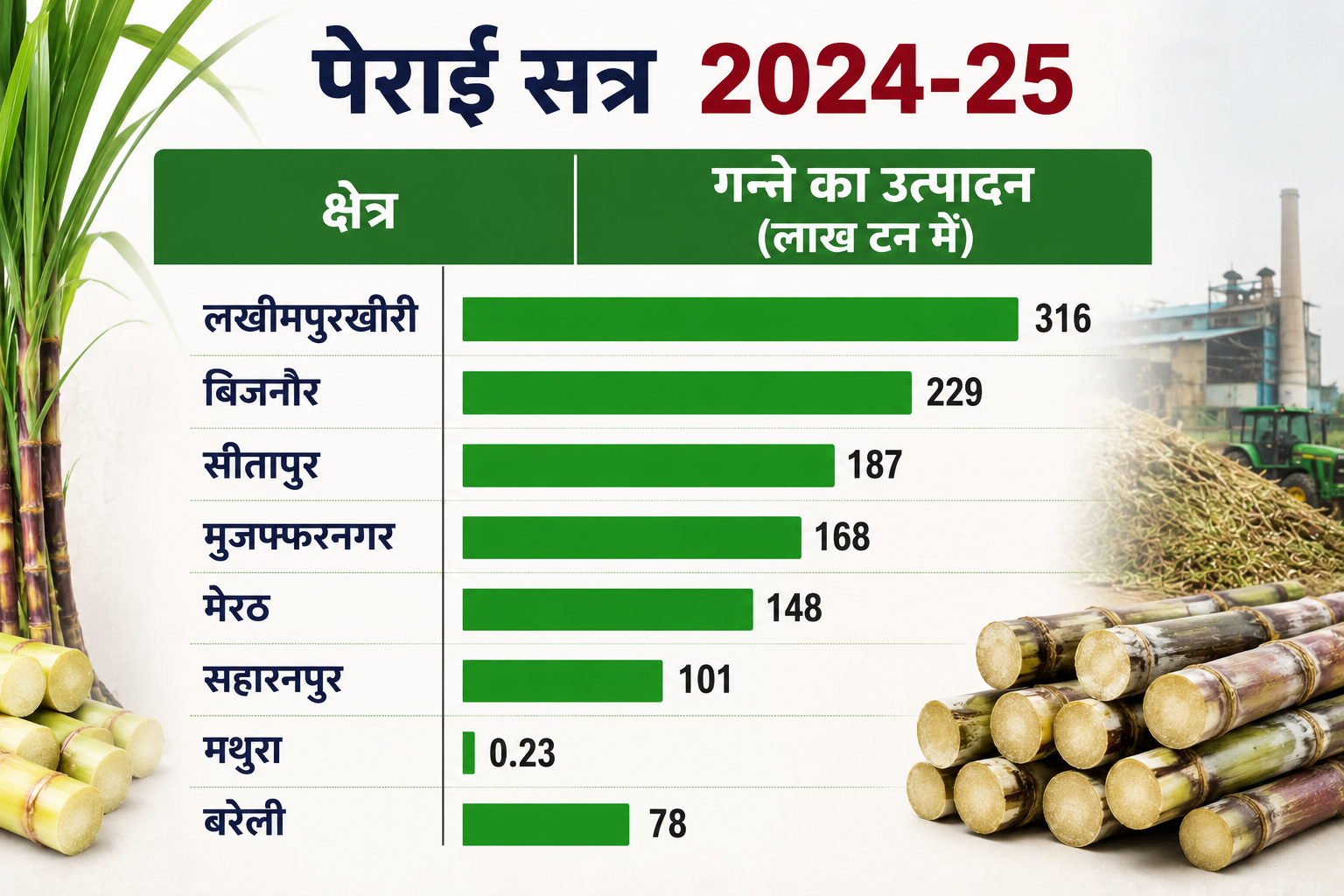
Traditionally, sugarcane is mainly produced in 45 out of 75 districts of the state. Sugarcane production is the backbone of the rural system. Due to this, about 45 lakh farmers have got direct employment, which is a means of their livelihood. The highest sugarcane production is in western Uttar Pradesh, while the highest production among the districts is in Lakhimpur Kheri in the central region.
Experts related to sugarcane production say that now sugar mills are focusing on ethanol production along with sugar production. Ethanol production will improve the standard of living of farmers as they will be able to get timely payment of sugarcane dues. At present sugar mills are not making timely payments to sugarcane farmers. Strictness is taken at the government level regarding this. On the instructions of the government, the district administration issues recovery certificates to them, only then the payment becomes possible. Due to the strictness of the government, till now almost ninety percent of the dues amounting to Rs 31,226 crore has been paid. Experts say that if the use of ethanol increases in future, sugar mills will benefit greatly. In such a situation, sugar mills will be able to pay the price of sugarcane to the farmers on time.
production of ethanol
In the year 2025-26, 229 crore liters of ethanol was produced in the state, whereas in the current year 15 crore liters of ethanol has been produced. Ethanol production in the year 2016-17 was 42 crore litres. It is clear from this that ethanol production in sugar mills is increasing rapidly. According to experts, due to good quality sugarcane being planted in the fields, more juice is coming out of it. It is proving better for both sugar production and ethanol production. Due to the schemes run by the government, farmers are now becoming increasingly aware of sowing good quality sugarcane. Due to this, the possibility of increasing their income is increasing.
The country will need 1016 crore liters of ethanol annually
To meet the Central Government’s target of ethanol blending (E-20), 1016 crore liters of ethanol will be required annually in the country, because a big market is being prepared for the new industry. The possibilities of employment opportunities for the youth are also increasing. The government is providing loans and other financial assistance at cheap interest rates for setting up ethanol plants. In future, ethanol will also be used in manufacturing bio-plastic, which will give people an alternative to single-use plastic.
Ethanol is also being made from broken rice
Apart from sugarcane, now ethanol is also being produced from agricultural residues (straw), maize, spoiled and broken rice etc. Farmers have also started getting the price for their waste. Due to this the income of farmers is increasing. With the establishment of new distillery plants in rural areas, the possibilities of providing employment at the local level have increased in the future. A debate has erupted over the policy of the Central Government to make ethanol from broken rice. By making changes in the public distribution system, the central government has reduced the share of rice in free ration from 25 percent to 10 percent. Arrangements for auction and purchase of broken rice at concessional rates have been made for ethanol producers through the Food Corporation of India. Due to this, there is a possibility that the food security program of the poor who get free ration will be affected.
Juice is increasing due to better varieties, income is increasing
The effect of the efforts of the Sugarcane Development Department and agricultural scientists is now visible in the fields also. Farmers are now adopting varieties with higher yield and better recovery. These varieties of sugarcane have high juice content, which increases the production of both sugar and ethanol. The sugar present in sugarcane is the basis for ethanol production. The better quality the sugarcane, the greater the quantity of ethanol that can be produced. This is the reason why now sugar mills are also encouraging farmers to cultivate improved varieties. Lakhimpur-Kheri remains the largest center of sugarcane production in the state, where more than 316 lakh tonnes of sugarcane was produced in the last crushing season. Bijnor, Sitapur, Muzaffarnagar, Meerut and Saharanpur are also among the top producing districts. Plans are underway for new distilleries and expansion of ethanol units in these areas. If this expansion gains momentum, a new network of agro-based industries may develop in the sugarcane producing districts.
New employment opportunity in villages
The impact of the expansion of the ethanol industry will not be limited to farmers only. The need for new distilleries, storage centers, transportation and technical services could increase employment opportunities in rural areas. State government officials say that if ethanol-based industries are developed in sugarcane producing districts, a large number of local youth will be able to get employment in their own districts.
Also beneficial for the environment
Ethanol is considered a biofuel. Its use in petrol helps in reducing carbon emissions. It is not a completely pollution-free fuel, but is considered a relatively clean alternative to conventional petrol. This is the reason why the Central Government is continuously working towards increasing the blending of ethanol in petrol.
Crushing session 2024-25
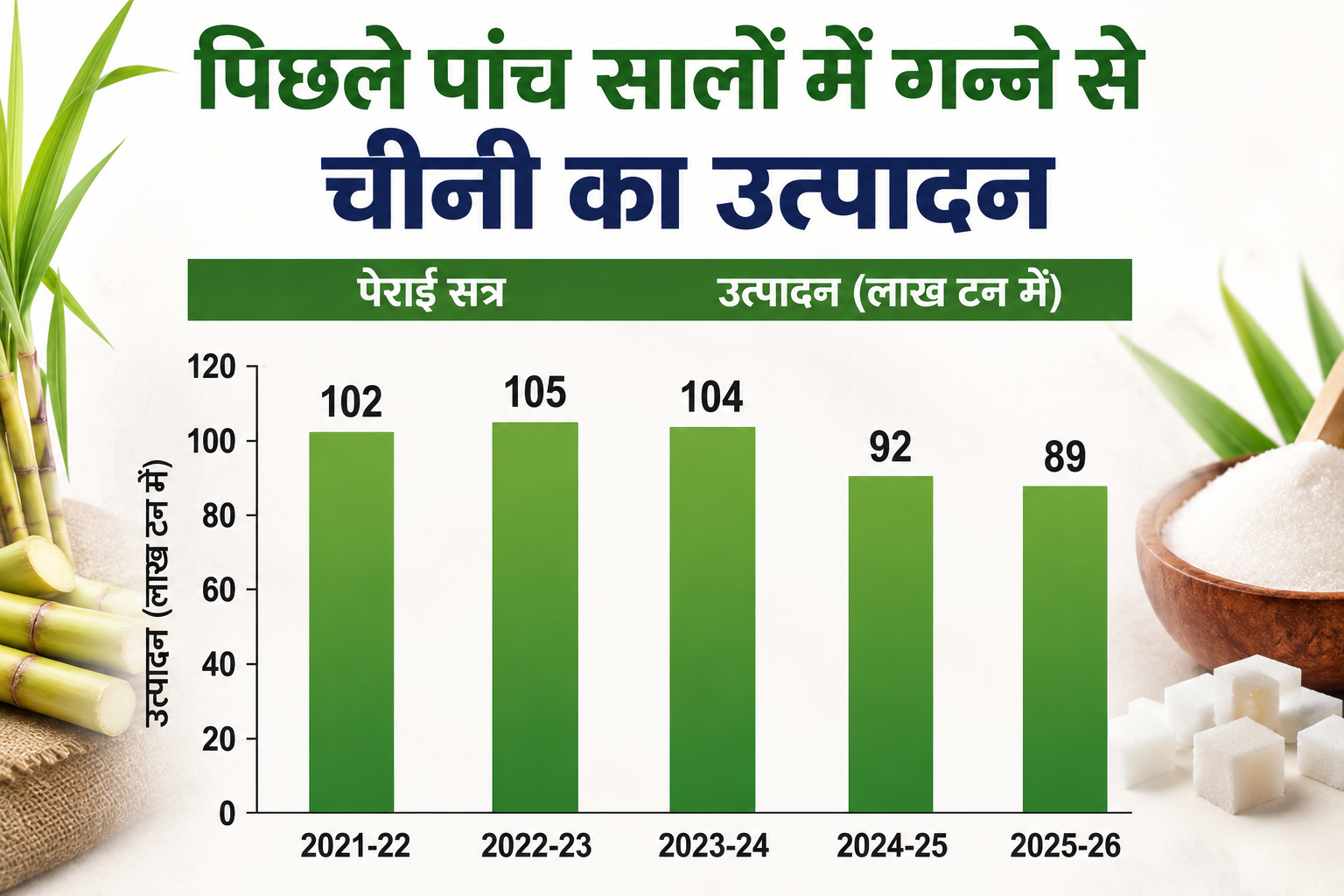
Sugar production from sugarcane in the last five years
Automobile representative said
At present, vehicles running on ethanol have come into the market in big cities like Delhi, Mumbai etc. Engines running on ethanol instead of petrol are being installed separately. In the coming months, the possibility of such vehicles coming even in small cities has increased, because due to the cost of petrol, people are now preferring vehicles with cheaper fuel.
– Pankaj Aggarwal, Banke Bihari Auto Private Limited, Bareilly
Vehicles are still facing problems due to ethanol. Vehicles are still facing problems due to mixing of ethanol in petrol. Vehicles are ‘missing’ in starting. Earlier vehicles were equipped with ‘carburetors’. During this period, if there was garbage in the petrol, it would stay there. At present, due to lack of carburettor in vehicles, fuel is going directly into the engine. This is causing problems in vehicles. But it will prove effective if there is an ethanol compatible engine.
-Saddam Hussain, TVS Hindustan Auto Sales, Bareilly
Opinion of sugar mill representatives
Local youth will get employment by setting up a new distillery plant: The possibilities in this area have increased due to the use of ethanol as petrol. The process of setting up a plant for ethanol production has also started in Pipraich Sugar Mill. The construction of the ethanol plant will definitely provide employment opportunities to the local youth. With this, farmers will be able to get their sugarcane price paid on time.
-Jagat Rajput, Principal Manager, Pipraich Sugar Mill, Gorakhpur.
There are vast possibilities in the future on ethanol: There are vast possibilities in the market regarding ethanol in the state. Its demand is likely to increase further due to its use as petrol. If demand increases, ethanol industry will develop. With this the youth will be able to get more employment. Farmers will also be able to get payment of sugarcane price on time.
-Jai Prakash, General Manager, Nanauta Cooperative Sugar Mill, Saharanpur
Government needs to make more efforts: Bajaj Group’s sugar mills are producing maximum ethanol, but the demand is not much yet. If the government makes more efforts to promote ethanol based vehicles, the ethanol business will increase in future.
-PN Singh, Unit Head, Bajaj Sugar Mill Kundarkhi, Gonda
There is a lot of potential in the ethanol industry: currently 20 percent ethanol is being used in vehicles. As technology advances, its percentage will increase. In such a situation, there is full potential for the ethanol industry to grow. This will increase employment opportunities and farmers will also benefit.
– Dr. HK Tripathi, DCM Shriram Sugar Mill, Lakhimpur Kheri
Underground water exploitation will be a big problem
Ethanol production has become a very good way for the prosperity of the country, because it allows sugar mills to produce ethanol throughout the year, but it also brings with it problems regarding environment and ground water. Sugarcane is a highly water-requiring crop, which is grown for sugar production, but due to ethanol production, the cultivation of sugarcane has increased in new areas and is likely to increase further in the future. Due to this there is a possibility of ecological imbalance. In such a situation, ethanol production should not be limited to sugarcane based crops only. For this, ethanol should be produced from sweet maize and sorghum. Along with soil water conservation and controlling groundwater exploitation, efforts should be made to grow sugarcane, sweet sorghum and sweet maize only in those areas for which these crops are approved by the Indian Council of Agricultural Research. Due to their more expansion in new areas, underground water exploitation will affect agricultural production with great problems.
-Kuldeep Bishnoi, Agriculture Expert Bareilly
– Ramesh Chandra, senior journalist

Comments are closed.