
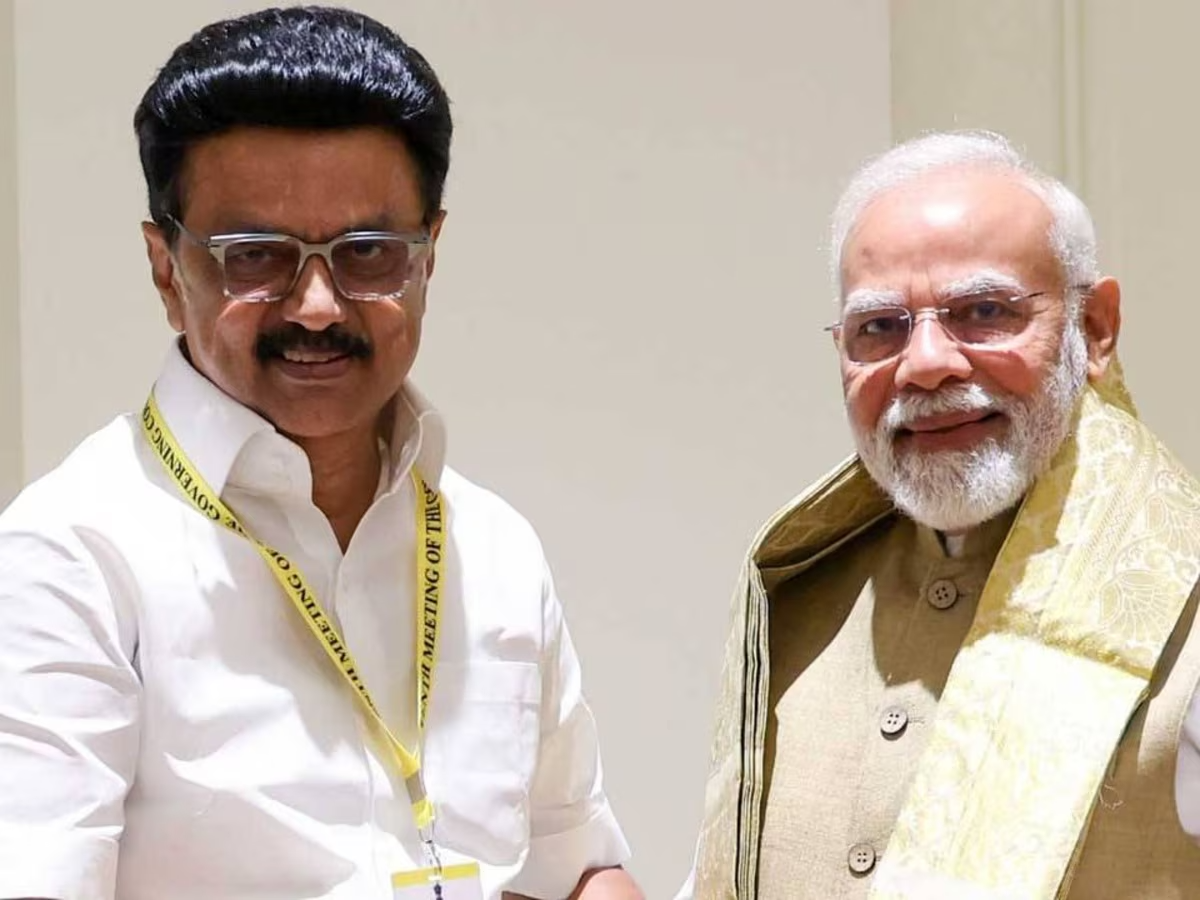
Will the DMK move closer to the BJP following its defeat in Tamil Nadu? Speculation intensifies amid a request to change seats in Parliament. Will DMK come closer to BJP after Tamil Nadu’s defeat? Speculation intensified due to petition for change of seat in Parliament – ..

The shocking results of Tamil Nadu Assembly elections have not only completely turned the politics of South India upside down, but its heat is now being felt in the country’s capital Delhi and within the Parliament as well. After losing power in the state, the old alliance of the ruling Dravida Munnetra Kazhagam (DMK) and Congress has completely broken. The Bharatiya Janata Party (BJP), which has clever political strategists, is finding big possibilities for itself at the national level in this disintegration of the opposition. Sources claim that the BJP is seriously considering the option of coming closer to the DMK to strengthen its legislative numbers within the Parliament. The BJP hopes that DMK’s support can be obtained ‘on the basis of issues’ on major issues of national importance, which can ease the path of the central government in the coming days.
Huge displeasure with Congress: Talk reached the point of demanding change of seat in Parliament
In the election season of Tamil Nadu, Stalin’s party is very angry with the Congress suddenly leaving the DMK and joining superstar Vijay’s new party Tamizhaga Vetri Kazhagam (TVK). Top DMK leaders have publicly accused Congress of ‘stabbing in the back’. The bitterness between the two parties has increased to such an extent that DMK has written a letter to Lok Sabha Speaker Om Birla requesting him to change the seating arrangement of its MPs in the Parliament House, because their MPs are no longer ready to sit with the Congress in the opposition camp.
Politically weak position and support of history
Actor-turned-politician Vijay’s party TVK has registered a historic victory, uprooting the six-decade-old traditional dominance of DMK and AIADMK in the state. After this crushing defeat, DMK is on the back foot politically. Political analysts believe that it is very difficult for any strong regional party to remain in opposition simultaneously at both the Center and the state after losing power in the state. In such a situation, to save its political ground and for administrative help, DMK may have to form a working relationship with the Central Government. Anyway, BJP is not an untouchable party for DMK; DMK has once been an important partner in the NDA government led by former Prime Minister Atal Bihari Vajpayee.
Ideological differences: delimitation and the big wall of Sanatan Dharma
Even though the political equations are pointing towards the two parties coming closer, there are two big issues at the ideological and policy level on which MK is unable to compromise. It will be no less than a litmus test for Stalin:
Opposition to delimitation: DMK has been a staunch opponent of the Delimitation Plan of the Central Government since the beginning. He fought the entire assembly elections on the same narrative that BJP wants to reduce the parliamentary representation of South India. Backing down from the stand of burning copies of the bill in Parliament can become a big political problem for DMK.
Sanatan Dharma controversy: The controversial statements made by former Deputy Chief Minister Udhayanidhi Stalin regarding Sanatan Dharma have created a deep ideological gap between the BJP and the DMK. It will be very difficult for both the parties to find a middle path on this very sensitive issue.
Path to two-thirds majority: Why are DMK’s 22 MPs important for BJP?
The BJP mainly wants to improve its legislative numbers within Parliament. During the recent voting on the important delimitation bill, the BJP-led NDA had failed to garner two-thirds majority. For any major constitutional amendment or two-third majority in Parliament, the magic figure of 362 is required, from which the NDA is still 70 seats away. During the last voting, 528 MPs were present in the House, where NDA got 298 votes, while 230 votes were cast in opposition. NDA was 54 votes short of the two-thirds mark. Then 22 DMK MPs along with the opposition voted against it. If in future these 22 DMK MPs come together or even walk out during voting, then the path will become very easy for BJP.
Eye on Odisha’s ‘Naveen Patnaik Model’ and preparation for Presidential elections
Instead of including DMK directly in its alliance (NDA), BJP wants to follow the old model of Naveen Patnaik (BJD) of Odisha, Jagan Mohan Reddy (YSRCP) of Andhra or KCR (BRS). The strategy is that DMK, despite staying out of the alliance, should support the Center from outside or on the basis of issues on important bills in Parliament. Apart from this, AIADMK, a traditional ally of BJP in Tamil Nadu, is struggling with internal rebellion after this defeat and is on the verge of disintegration. When AIADMK itself is weakening, it has become a practical necessity for BJP to extend its hand towards DMK. Along with this, the BJP, which has become stronger after the big victory in West Bengal and Assam, does not want to take any risk for the Presidential elections to be held next year. Strategists will try their best to ensure that DMK’s valuable votes come to their side in the Presidential elections.

Comments are closed.