
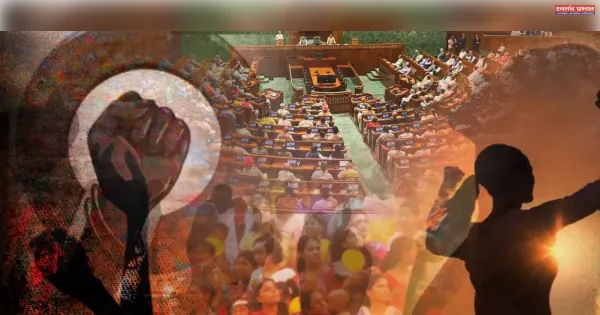
Will the Women’s Reservation Bill be implemented in 2029 or will it be applicable only in Panchayat elections?

Bureau Prayagraj. A new chapter will begin in Indian democracy after 16th April. In India, women were given reservation at all three levels of Panchayati Raj institutions by the 73rd and 75th constitutional amendments. But the issue of reservation for women in Parliament and Legislative Assemblies could not be fulfilled. The reason was that the male MPs were afraid of their numbers being reduced and due to the demands of SC, ST, ST, Muslim and backward classes for women’s reservation, the Women’s Reservation Bill could not be passed. At that time there was a coalition government, two-thirds majority was not enough to pass the bill in the Lok Sabha. BJP was opposing the bill. She was not in favor of caste based reservation in women’s reservation.
The opposition wanted caste based reservation. Women could not reach a consensus on how reservation should be implemented. Congress brought a bill in the Lok Sabha for women’s reservation during the Manmohan Singh government, but due to the opposition of the BJP and its alliance partners in power, the bill was not passed and then it was kept in abeyance. At that time, there was no talk of increasing the number of MPs in the Parliament because the number of male MPs would not be reduced. Yet, for the second time, the Congress got the women’s reservation bill passed not in the Lok Sabha but in the Rajya Sabha where it was in the majority. With this hope and belief, if there is enough support in the Lok Sabha in 2014, then the bill will be passed and for women. Reservation will extend from Assembly to MP.
But in 2014, BJP government was formed. Still, despite the repeated requests of the opposition, the bill was not passed. BJP did not want the Congress bill to be passed. Then in 2022, when BJP came back to government, the Women’s Bill was made in a new way and the bill was named Nari Vandan Bill. There was a meaningful debate in the Lok Sabha, Rajya Sabha, suggestions and some amendments were also made, then the bill was passed with majority in both the houses in 2023. Which has now become a legal bill. But there was a lot of dispute between the government and the opposition on the time limit for implementation. The opposition wanted it to be implemented in the 2024 elections but the ruling party did not agree and said that once the census is conducted, every seat will be delimited. And the number of Parliaments and Assemblies will increase by thirty-three percent. The number of seats in Parliament will be determined according to the population of the state. Only then Nari Vandan reservation will be implemented.
The number of Parliaments will be 816, of which 273 will be women MPs. This will be applicable only for the first fifteen years and then consideration will be given to extending it further. The talk of increasing the seats in Parliament and Assemblies according to population has also become a complex problem. The present government says that it is a state which has less population. The state which has reduced the population growth rate will have less number of MPs in that state. The number of MPs will increase in the state which has more population. With this policy, the number of Parliament seats in the Parliament seats in the South will increase much less than the present, which will be harmful for them. They want more number of Parliaments in their states. They say that they have not committed any crime by stopping the population growth rate. The number of Parliaments in our state should be reduced as per North India, the number of Parliaments in the Southern states should increase in the same proportion.
To put it as a rule, the number of MPs in the states of North India will be more than that of South India and the current dominance of South India will be reduced. This will also be discussed in the special session and there will be less representation of women in the Parliament as compared to South India. It has to be implemented in the Parliament elections to be held in 2029 but there is still doubt. Now it will be resolved in the special Parliament session to be held on 16th April itself that when and how women’s reservation will be implemented in the country, how will the reservation be implemented in parliamentary seats and assembly. Will there be caste-based reservation for women like Panchayati Raj or what will happen to reservation in reservation and how will it happen. The opposition has been demanding reservation for women on caste basis since the beginning. Muslim MPs are also demanding separate reservation for Muslim women.
Right now, the census is starting in India. For the first time in this census, castes will also be counted which will be beneficial for caste based reservation for women. This will be known correctly only after the census is conducted. Right now everyone’s eyes are on the special session of the Parliament. Well, this is a new trick of BJP, they have called a special session for this Nari Vandan Bill keeping in mind the Bengal elections. He wants power in Bengal. If he was really honest in giving reservation to women, then the bill would have been passed in 2023 but why it was not implemented in 2024 is a question among the public. Now whether it will be implemented in 2029 or after that is not clear yet.
Thirty-three percent reservation has been given to women by the 128th amendment in the Constitution. There is a provision to give reservation to Scheduled Castes and Scheduled Tribes in the reservation itself, but in this reservation, reservation has not been given for backward class women like Panchayati Raj. It is not yet known whether the issue will be raised in the special session on this, but the opposition has been demanding equal reservation for backward class women. And Muslims are also demanding.
The common woman will not get much benefit from the Nari Vandan Bill because very few common women win the Panchayati Raj elections or it seems that only women from families already established in politics win on most of the reserved seats. This will happen after the implementation of reservation in the elections of Parliament and Legislative Assemblies. Do common women become Parliament MLAs with the help of reservation or will only the wives, daughters and daughters-in-law of already established politicians come under reservation. Right now people will move with husband as head and then MLA will write ‘Husband’ on the car. The woman will be behind, the husband will be in the front and the MLA will be in Parliament.
Comments are closed.