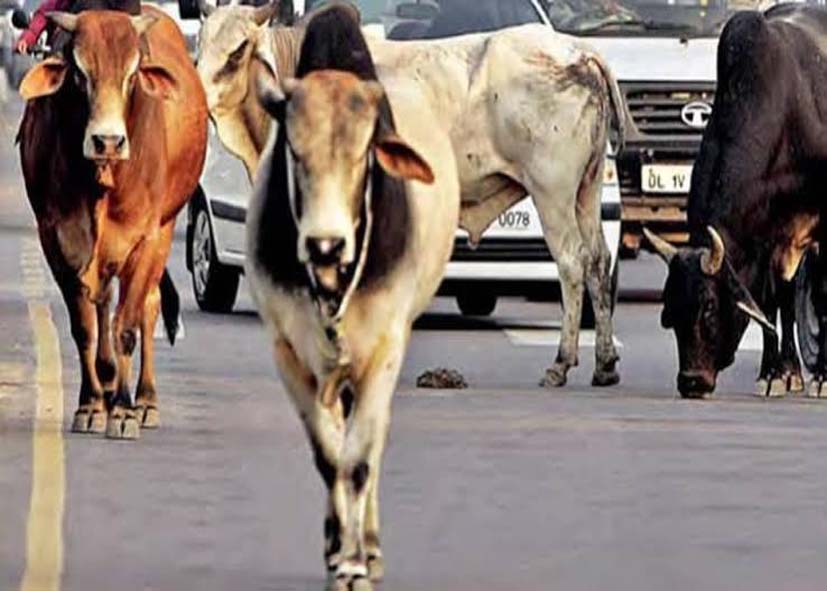
The Delhi government is working on a new plan to solve the problem of stray and destitute cows roaming freely on the streets of the capital. This issue was discussed in detail during the monsoon session of Delhi Assembly, where public representatives called it a serious issue related to public safety and traffic system. Raising this issue under Rule 280 in the Assembly, MLA Shyam Sharma said that the number of stray and destitute cows is continuously increasing in the capital, due to which people are facing many problems.
According to officials, to deal with this problem, MCD has identified land in Kirari, Ghogha and Bhalswa areas. In future these sites can be used for rehabilitation, maintenance or development of related facilities for stray and destitute cows. Work related to processing plants at Ghogha and Bhalswa is already in progress. Officials believe that these projects and available land can also be used for schemes related to animal management. However, no final or formal plan has been prepared in this regard yet. The concerned departments are considering various options and possible models.
Committee meeting expected next week
According to officials, after the issue was raised in the Assembly, it will now be discussed at the MCD committee level to take it forward. Various options including identification of stray cows, their safe rehabilitation and utilization of available land can be considered in the meeting. To deal with this problem, MCD has identified land in Kirari, Ghogha and Bhalswa. However, the final plan regarding the use of these places has not been prepared yet. Work related to processing plants is already going on in Ghogha and Bhalswa.
CM Rekha Gupta had already announced
Delhi government has already made budget provisions towards taking care of stray cows and developing better facilities for them. Chief Minister Rekha Gupta in March had approved a budget of Rs 20 crore for the care of cows and construction of 10 modern cow shelters. The objective of the government is to develop cow sheds with modern facilities, so that safe shelter can be provided to the animals wandering on the streets and the problems caused by their presence in public places can be reduced.
According to official data, the Development Department of Delhi Government, through the Directorate of Animal Husbandry, monitors the care of cows and recognized Gaushalas i.e. Gausadanas. At present the government is maintaining five Gosadans spread over an area of 110 acres. These cow shelters are said to have the capacity to take care of more than 23 thousand stray animals. According to MCD data, about 1,500 tonnes of unprocessed cattle waste is generated every day in the capital, while only 200 tonnes of this waste is being processed. According to officials, there is a need to strengthen the system regarding disposal of remaining waste also.
Currently one plant in Nangli Dairy
Currently, the facility to process cattle waste is available at Nangli Dairy in South-West Delhi. According to officials, about 200 tonnes of waste is being processed every day through this facility. Considering the number of cattle and the waste generated from them, MCD is now planning to set up new processing plants in different areas and dairy colonies of Delhi. Garbage processing plants with 200 tonne per day capacity are proposed at Ghogha, Goyla and Indira Park. There is a plan to set up a plant of 300 tonne per day capacity in Ghazipur Dairy and 125 tonne per day capacity plant in Bhalswa Dairy. Apart from this, there is a proposal to set up processing plants in Masoodpur Dairy, Indira Camp of Rohini, Shriram Colony in Khajuri and Sarita Vihar. The capacity of these plants will be kept between 50 to 100 tonnes per day.
According to officials, there are estimated to be around 1.27 lakh cattle in Delhi. Of these, about 84 thousand cattle are kept in legally recognized dairy colonies. According to government data, about 23,980 cattle are kept in government gaushalas, while about 21 thousand cattle are kept in private gaushalas. In such a situation, it is considered necessary to develop adequate processing capacity for scientific disposal of large number of cattle wastes.
Follow the LALLURAM.COM MP channel on WhatsApp