
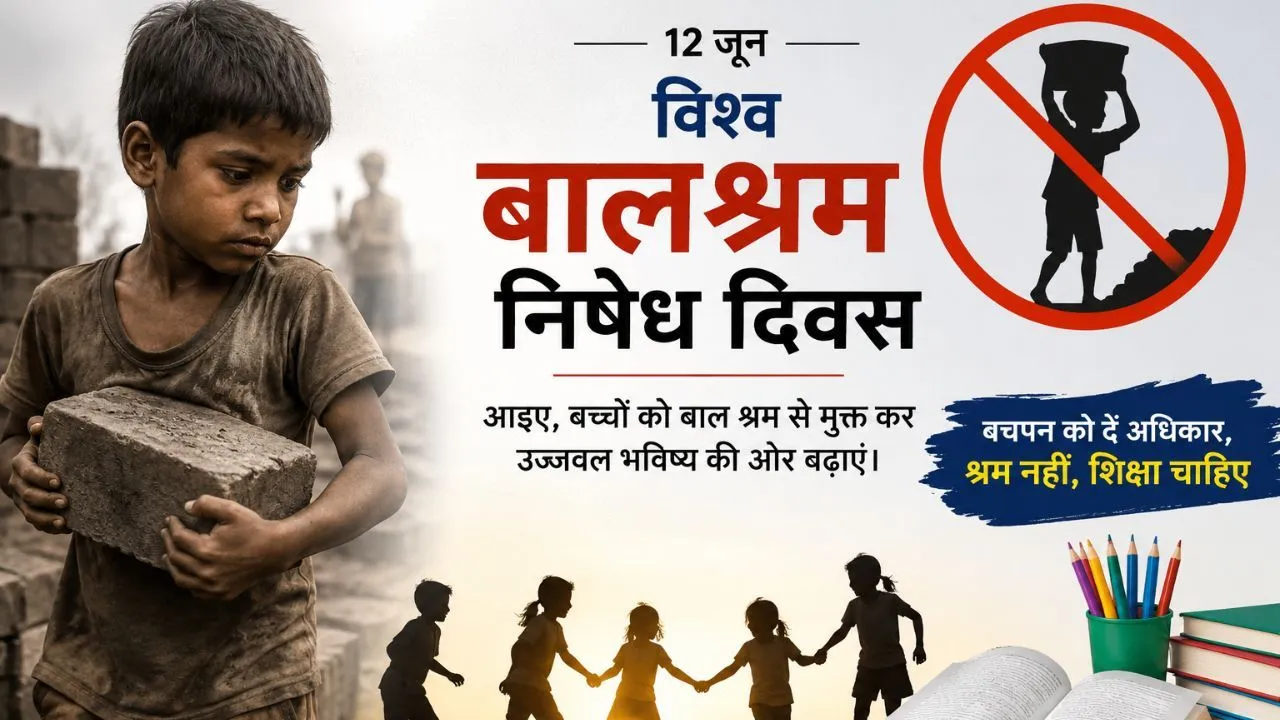
World Day Against Child Labor 2026: Steps are being taken towards a child labor free India. Challenges still remain

World Day Against Child Labor 2026: A childhood full of innocence, eagerness to learn and carefree… This is the most golden period of life. Childhood is a time when there is infinite curiosity in the mind. Any civilized society is identified by the education of its children and their secure future. But the irony is that even today there are crores of children in the world who have lost even their childhood.
At the age of playing, some people get burnt in the heat of brick kilns carrying the burden of responsibilities while others run around with a hammer, shovel or tea kettle in their hands. The reason for this is not only economic lack but also social inequality and administrative apathy.
World Day Against Child Labor is celebrated every year on 12 June. The main objective of this day is to spread awareness globally against child labour, empower children about their rights and provide them education by freeing them from child labour.
The country got independence but not the childhood…
If we look around us, even today we will find small children working in restaurants, dhabas, shops and other places. Everyone knows that making or forcing children under fourteen years of age to work is a crime. There can be punishment for this but despite this, people are not able to stop child labor for a little profit. The issue of interests and protection of children is enshrined in the Constitution of India. Despite this, even after 78 years of independence, children’s rights are being grossly violated.
Now the question arises that what is child labour? Let us tell you that according to the National Sample Survey in India, any child below the age of 14 years who works as a laborer comes under the category of child labour. One out of every ten children in India is unable to go to school due to child labour. However, not every work comes under the category of child labour. Cooperating with the family in safe tasks, learning skills or helping in general household tasks are not in the category of child labour, but when a child is forced to leave school and go into full-time labor in the name of earning, then it is called child labour.
Now even child labor has changed; earlier, children were seen working in factories, mines and farms, but now they are also seen working in household industries, waste management, e-commerce supply chains and digital mediums. The methods of exploitation have changed, but the problem remains the same.
The problem of child labor still poses a challenge in the country. Although the government is continuously taking many positive initiatives to get rid of this problem, still the problem still remains complex. Poverty and illiteracy give rise to child labor in India.
child labor prohibition day
Day Against Child Labor was first established by the International Labor Organization (ILO) in 2002. Its main objective is to work at the grassroots level to eliminate child labor and protect children from exploitation. According to statistics, millions of children around the world are still victims of child labour. The Government of India has enacted the Child Labor (Prohibition and Regulation) Act to protect children from child labour. Under this, it is a legal offense to employ children below 14 years of age in any hazardous industry/work.
Poverty is the biggest reason for child labor
The biggest reason for child labor is poverty. When a poor family is struggling to earn two meals a day, then instead of investing like education, they will find a way to earn income by doing the labor of the child. However, this path leads to more poverty in the future. A child deprived of education will grow up to become a laborer and the next generation will also get trapped in the same cycle of poverty.
Also read- Indian youth spend more than 2 hours on social media every day, girls are 47% ahead of boys.
New face of child labor- digital platforms
With the development of technology, the form of child labor has also changed. Today, commercial use of children in the name of online content creation on social media is also increasing rapidly. People have made the popularity of children a medium for financial gain. Working in front of the camera for hours, the pressure to get more likes and follows is pushing the child towards mental stress.
adverse effects of child labor
Due to working for long hours, children become victims of many dangerous diseases like malnutrition. Children may develop many problems like stress, depression, lack of self-confidence and social isolation.
Constitution and law and order of India
- Article 21A of the Indian Constitution: Right of children of 6 to 14 years of age to free and compulsory education.
- Article 23: Prohibition of bonded labor and human trafficking.
- Article 24: Prohibition of employing children below 14 years of age in hazardous industries.
- Article 39 (e) and (f): Directive to protect the health and development of children.
Apart from this, Child and Adolescent Labor (Prohibition and Regulation) Act, 1986 (Amended 2016), Right to Education Act, 2009 and Juvenile Justice Act have provisions to protect the rights of children.
child labor statistics
According to 2001 census data
total child population– 25.2 crores
Working children aged 5-14- 1.26 crores
According to the survey conducted by National Sample Survey Organization (NSSO) in 2004-05- Estimated number of working children 90.75 lakh
According to 2011 census- Number of working children aged 5-14 years 43.53 lakh (less than before)
Apart from this, according to the report of United Nations, UNICEF and International Labor Organization (ILO), about 138 million children worldwide became victims of child labor in 2024. Out of which about 5.4 crore children were involved in dangerous activities. Although the incidence of child labor has declined over the years, the goal of completely eliminating it is still a long way off. According to the report, poverty, lack of education, unemployment and poor economic condition give rise to child labour.
Measures to prevent child labor
- Every person in the society will have to pledge to participate in stopping child labour.
- If you want to contribute to the eradication of child labour, make people around you aware of the ill effects of child labour, promote education, help poor and underprivileged children to get education.
- Because education is the most correct and effective solution to child labour.
- If you see any child working around you, you can go to the PENCIL Portal and lodge a complaint directly. This is an official website of Government of India against child labour.

Comments are closed.