The total eclipse plunged a vast swathe of Spain from broad daylight into darkness Wednesday, drawing awed gasps and applause from spectators gathered in parks and cities across the country.
As impressive as it was fleeting — barely two minutes at most — the extremely rare astronomical event delighted Spaniards and tourists alike across a band of territory stretching from Galicia to the Mediterranean coast and the Balearic Islands.
As the light slowly faded in Tarragona, on the Mediterranean coast, a crowd looked on in almost reverent silence as the orange, late-afternoon glow gave way to almost complete darkness.
|
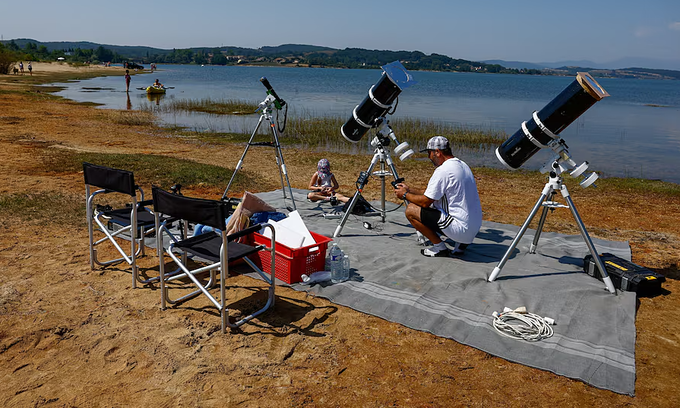
Tourists prepare a telescope to view the total solar eclipse from the beach, in Arija, Spain, August 12, 2026. Photo by Reuters |
“It’s crazy!” uttered a woman as the crowd beside suddenly burst into enthusiastic applause.
Tourists and residents of Catalonia alike had come to witness the spectacle, swept up in the fervour that gripped Spain in recent days with the approach of the eclipse, the first of its kind in the country in over a century.
“Very exciting,” said Laura Alarcon, 53, an accountant from Tarragona.
“I wasn’t expecting that. I though it wasn’t going to be as good. But the atmosphere, the situation, the way they prepared everything. I loved it!” she said. “And the glasses work too!”
What moved her most was “the moment the lights went out. Everyone started clapping, and then when you took off the glasses, you could really see that it was dark. I wasn’t expecting that much,” said Alarcon.
About 500 kilometers to the west, the town of Lodoso was likewise swept up in the collective excitement.
Shouts of joy and applause broke out as hundreds of people gathered in a heat-scorched field gazed at the sky at the moment darkness fell.
It was a moving atmosphere, immortalized by the countless phones raised to capture photos and videos of that precise instant.
 |
|
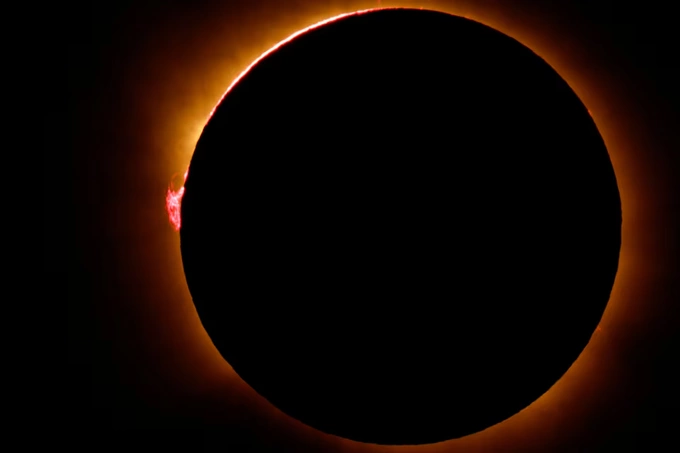
The moon completely covers the sun during a total solar eclipse as seen from Arija, Spain, Aug. 12, 2026. Photo by Reuters |
Some had waited all afternoon in sweltering heat beneath the scant shade of umbrellas, while others, the best prepared, had set up their telescopes.
On site, instructions were posted in several languages — French, Korean, Polish, German, English — to help the crowd get organized.
At the start of the partial eclipse, when the Moon began to cover the Sun at around 17.30 GMT, some people shouted “Wow!” eager to see what would unfold.
A group of South Korean tourists burst into enthusiastic applause.
‘A unique moment’
In the seaside resort of Palma de Majorca in the Balearic Islands, tourists, many in swimsuits, some standing in the water, watched the eclipse closely, protective glasses perched on noses.
At the moment of totality, people began applauding.
Elsewhere in Spain, the same fervour could be seen almost everywhere shadowed by the eclipse, such as the town of Colmenar Viejo, near Madrid.
“Spectacular, very beautiful, really, a unique moment,” said Rosa Maria Zamora, a 72-year-old retiree who had come from Madrid.
“It’s not very good for your eyes to look for so long, but it was amazing. Very beautiful!” she said.
Earlier, from the first minutes of the partial eclipse, a group of young boys cried out: “It’s starting! It’s starting!”
“How wonderful,” exclaimed a woman in the crowd.
In Madrid, the eclipse was not total but reached more than 99% coverage of the sun, plunging the Spanish capital into near-total darkness for a few moments.
In the park of the Temple of Amun, near the center, hundreds of onlookers had gathered despite the stifling August heat.
The same scenes of excitement played out on Barcelona’s iconic Montjuic hill, where hundreds of people had arranged to meet to enjoy the event.
By tomorrow, in communion with millions of others, they will be able to say: “I saw it!”
In Spain, authorities said up to 6 million visitors flocked to rural areas under the eclipse’s path across the north of Spain and the Balearic Islands.
Spain welcomed 96.8 million tourists in 2025, a record high and an increase of 3.2% compared with the previous year, making it the world’s second-most-visited country after France.
During the first six months of 2026, 46.57 million international visitors arrived in Spain, 4.6% more than during the same period last year.