

One of the most talked-about topics on the internet is E20 fuel and its effect on cars and bikes. We have seen multiple cases of people claiming that ethanol-blended fuel is actually causing issues in their vehicles. While we have videos about these issues on one side, there are also videos where the government is trying to justify and convince the public that E20 fuel does not cause any issues to vehicles. If you are among those who are worried about the current E20 fuel situation, here are three videos that are currently going viral online because they claim to offer a solution to the E20 problem.
It should be noted that these solutions are simply circulating online and are not something that we have tested personally. If you are planning to try any of these on your vehicle, please do so at your own risk.
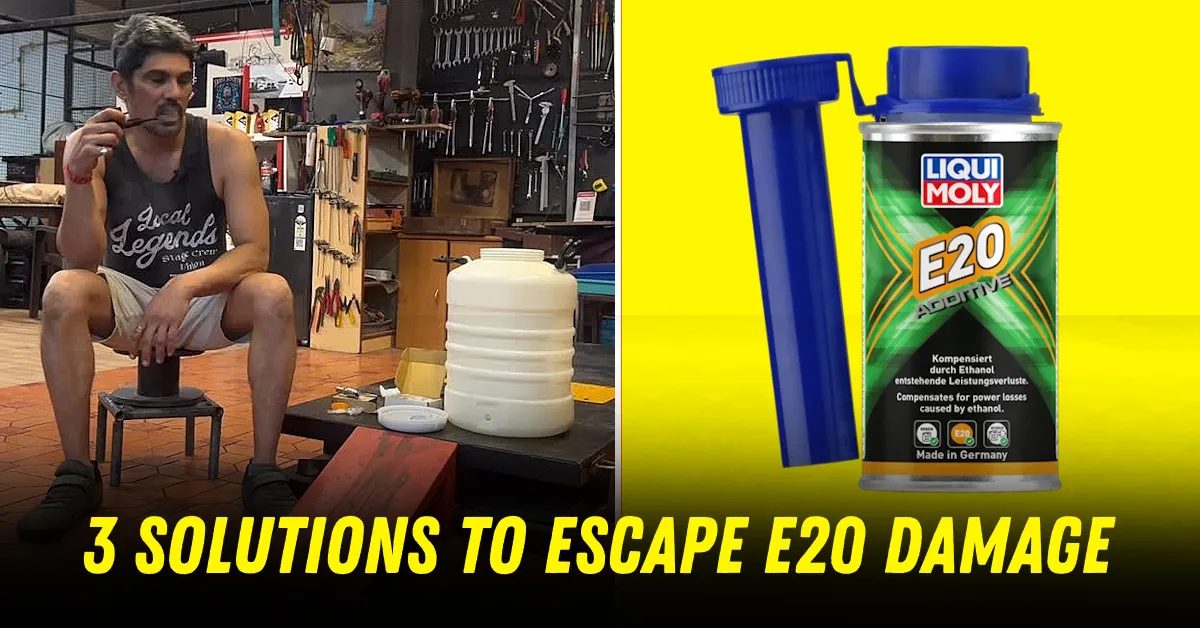
One of the first videos that went viral was from a biker who has an Instagram page named Bam Bam Bikes. He has shared a series of videos showing how to separate ethanol from the fuel purchased from petrol pumps. He came up with this solution after facing issues with the fuel pumps on a couple of bikes in his garage.
He built an apparatus that he calls the “De-Ethanoliser.” It is nothing but a large HDPE (High-Density Polyethylene) container with two separate taps placed at different levels. The tap at the bottom is for the ethanol, while the upper one is for the petrol.
He fills the container with E20 petrol, pours a small amount of water into the fuel, and then shakes the container. As we already know, ethanol is hygroscopic, meaning it absorbs moisture from the atmosphere. When the mixture is left overnight, the ethanol separates itself from the petrol. This leaves behind relatively pure petrol, which can be drained using the upper tap, while the ethanol-water mixture can be removed through the lower tap.
Another trick is being used by a Volkswagen Virtus owner who converts E20 fuel into an E10-equivalent blend. He is worried about the potential issues that E20 fuel could cause to his vehicle, and that is how he came up with this solution.
Whenever he visits a fuel station, he ensures that 50 percent of the petrol he fills into the vehicle is XP100, or E0 as many call it. The remaining 50 percent is regular E20 fuel. This way, he effectively reduces the overall ethanol concentration in the fuel tank. He mentions that the average refuelling cost is higher in this case, but compared to using regular E20 fuel, he gets better fuel efficiency. He also claims that his running costs have come down in the long run.
The third solution is a fuel additive from Liqui Moly that claims to protect the engine and other powertrain components from the negative effects of E20 fuel. Liqui Moly is a brand well known for manufacturing lubricants and additives for both bikes and cars.
Liqui Moly claims that it spent six months on the research and development (R&D) of this product. It can be used in E5-, E10-, and E20-compatible engines, as well as in engines that are not designed for any degree of ethanol blending. It acts as a fuel system cleaner and cleans the internals of the fuel lines, injectors, intake valves, and even the combustion chamber. This minimizes the risks associated with ethanol in E20 petrol, particularly corrosion caused by ethanol’s hygroscopic nature. It also helps safeguard the fuel from degradation due to water contamination. One can of the additive contains 150 ml, which is sufficient for 40 litres of E20 fuel – the average fuel tank capacity of a small car.
Comments are closed.