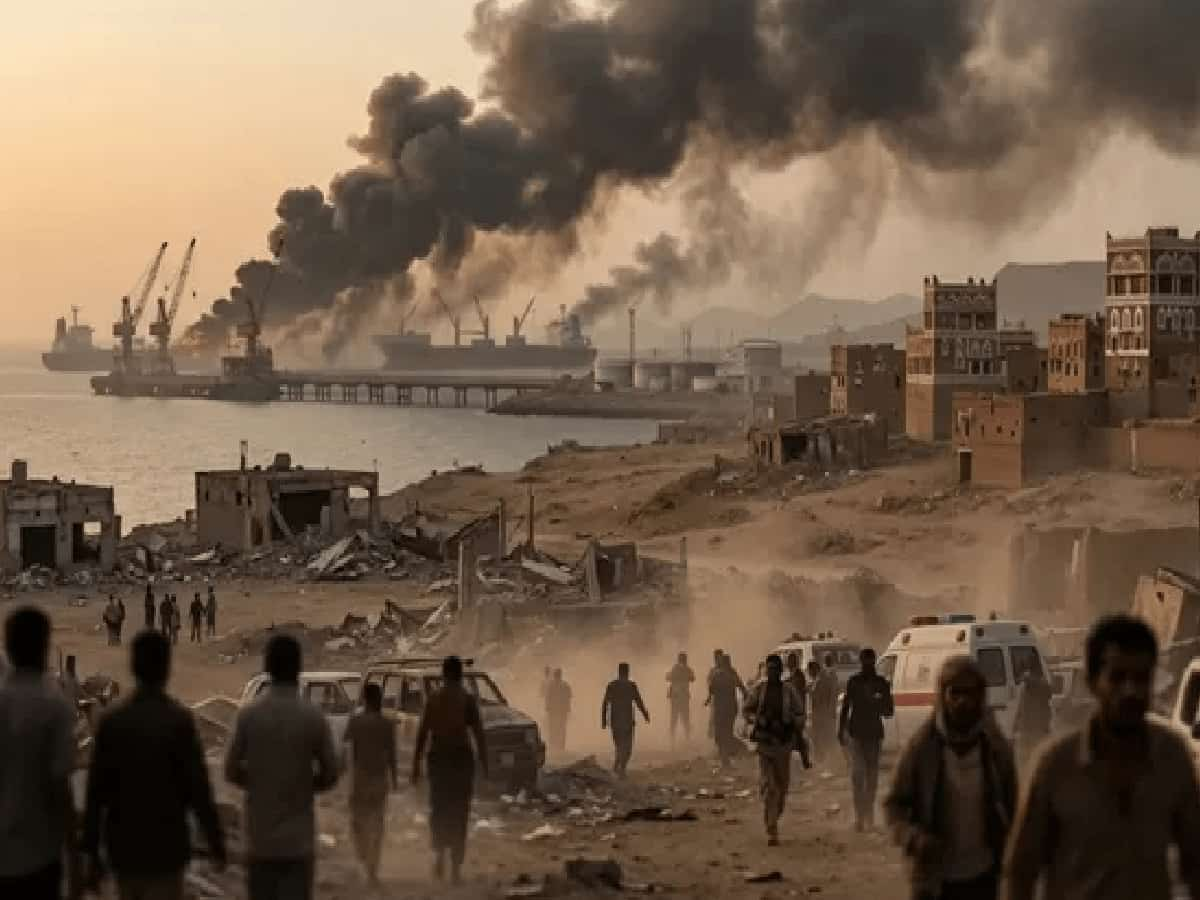
Amidst the ongoing geopolitical tension in West Asia, massive landmine blasts have once again echoed in Yemen's strategic and coastal province of Hadida. A Saudi Arabia-led military coalition launched a series of airstrikes on Monday against highly sensitive sea ports and major oil storage facilities in Hadida province, according to Iran-backed Houthi rebels who control Yemen's Red Sea coastline. Due to the fierce bombardment of fighter planes, the entire coastal area was shaken and huge clouds of black smoke appeared in the sky. According to official information released by local health authorities, at least seven people have been seriously injured in this airstrike, who have been immediately admitted to nearby trauma centers. Anis al-Asbahi, the official spokesman for the Houthi group's health ministry, confirmed details of the attacks in a statement issued on the social media platform X. He said Saudi warplanes deliberately targeted civilian infrastructure, port jetties and oil supply lines. These latest attacks have once again raised fears of a full-scale military confrontation in this entire region, which has been going through a period of fragile peace and sporadic conflicts for a long time. The Red Sea is an international sea corridor through which a major part of the world's trade and oil tankers pass, so this major attack on an important port like Hadida has raised concerns about the adverse impact on the global supply chain. Missiles hit jetty and merchant ship at Ras Isa Port, oil facility destroyed in Bajil district According to detailed ground reports received, the Saudi coalition air force carried out intensive air strikes mainly on two important geographical targets. The first major attack focused on Ras Isa Port, which is considered a major hub for export and import of crude oil. Al-Masirah television network, run by the Houthi rebel group, reported that the missiles were fired directly at the main sea jetty at Ras Isa port. Along with this, a commercial cargo ship anchored at the port also suffered heavy damage in these attacks. Four innocent port workers and civilians were seriously injured in the attack on Ras Isa Port. The second major target of the coalition forces became Bajil district of Hadida province, where deadly air strikes were carried out on a strategic oil facility center. After these attacks on the oil depot, a massive fire broke out there, which many fire engines had to work for hours to extinguish. Three other people were injured due to burn injuries and being hit by debris in the attack in Bajil district. Local eyewitnesses say that the blasts were so powerful that their echo was heard several kilometers away and the windows of nearby residential buildings were broken. The condition of some of the injured is said to be critical, due to which there is a possibility that the number of casualties will increase. Houthi rebels called the attacks 'war crimes', accused of violation of international humanitarian laws. After these devastating attacks, the Houthi rebel leadership is furious at the Saudi coalition and its international allies. Health Ministry spokesman Anis al-Asbahi issued a stern warning, saying that these repeated attacks on oil sites, public utility ports and non-military installations are a blatant and brazen violation of International Humanitarian Law. He said the deliberate targeting of civilian infrastructure goes against the spirit of the Geneva Conventions and is yet another series of organized 'war crimes' being perpetrated by the Saudi coalition on the innocent people of Yemen. Houthi commanders have indicated that these attacks will be met with a strong response at the appropriate time. Military analysts believe the Houthi rebels could retaliate for the crackdown with drones and ballistic missiles at Saudi Arabia's border oil refineries, Aramco facilities or coalition naval ships patrolling the Red Sea. This aggressive stance of the Houthis has dealt a deep blow to the efforts of the United Nations and other international peacekeepers, who were trying to establish a permanent and long-term ceasefire in Yemen. Yemen, battered by a decade of bloody civil war, is facing the brunt of the world's biggest humanitarian crisis. Yemen, counted among the poorest countries in the Arabian Peninsula, has been burning in the fire of a destructive, multi-cornered and bloody civil war for more than a decade. The crisis in Yemen reached its peak in late 2014 when Iran-backed Houthi rebels affiliated with the Shia Zaidi sect captured the capital Sanaa and large parts of northern Yemen. After this, Yemen's internationally recognized elected government had to leave its capital and take refuge in the southern city of Aden. Following this development, in 2015, a powerful coalition of Sunni Arab countries led by Saudi Arabia launched a massive military operation and air strikes on Houthi positions with the aim of restoring the Yemen government to power. This continuous conflict that has been going on for years has completely devastated Yemen. According to various UN humanitarian reports, the country is facing one of the worst humanitarian crises in history, with millions of people forced to live with starvation, lack of drinking water and lack of health services. Hadida port is a key lifeline for food, medicine and fuel for more than eighty percent of Yemen's population. In such a situation, due to military attacks on this port and its surrounding infrastructure, the distribution of humanitarian aid material within the country may come to a halt, due to which the lives of millions of innocent Yemeni citizens will once again be in grave danger.