
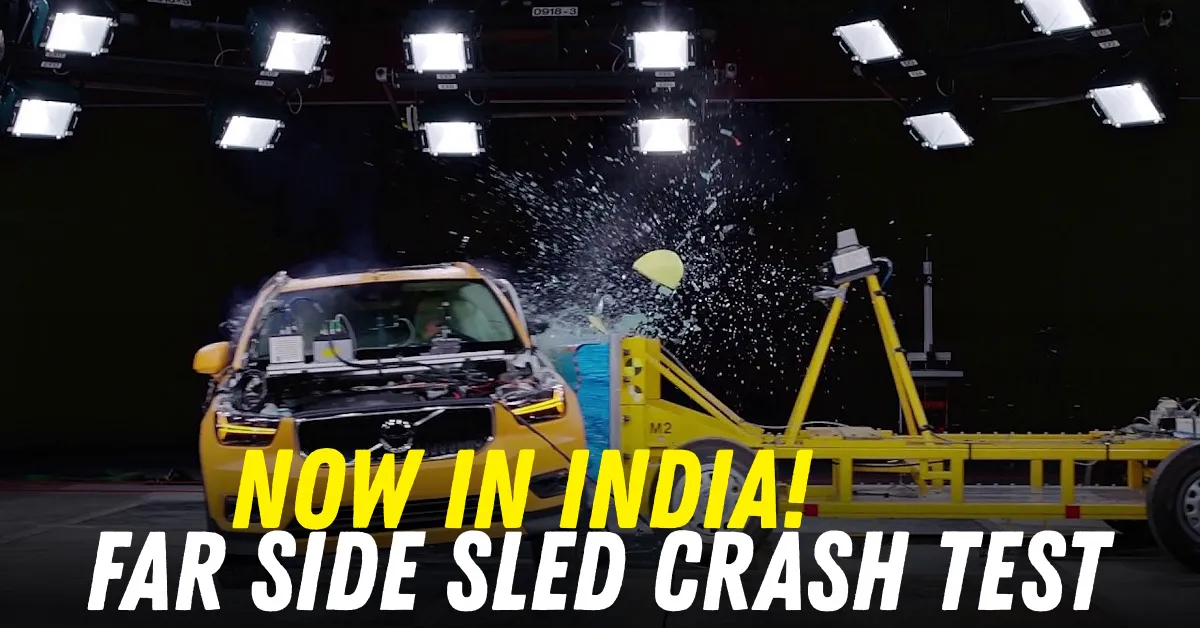

The Automotive Research Association of India, based in Pune, has achieved a significant capability upgrade. ARAI can now conduct the Euro NCAP 2026 Far-Side Sled Test, making it one of a small number of test facilities outside Europe able to run this specific evaluation.
For carmakers developing vehicles for India and global markets, this matters directly. Safety testing that earlier required overseas facilities can now be done domestically. That can reduce development time, lower testing costs, and allow engineers to run more validation cycles before a model reaches production.
A sled test simulates a crash without destroying an actual vehicle. The car’s seat, along with occupant restraint systems such as the seatbelt and airbag, is mounted on a sled that replicates the forces, angles and deceleration profile of a real collision. The test evaluates how well these systems protect the occupant under controlled conditions.
Euro NCAP uses sled tests to assess frontal, rear and side-impact scenarios, including far-side impact.
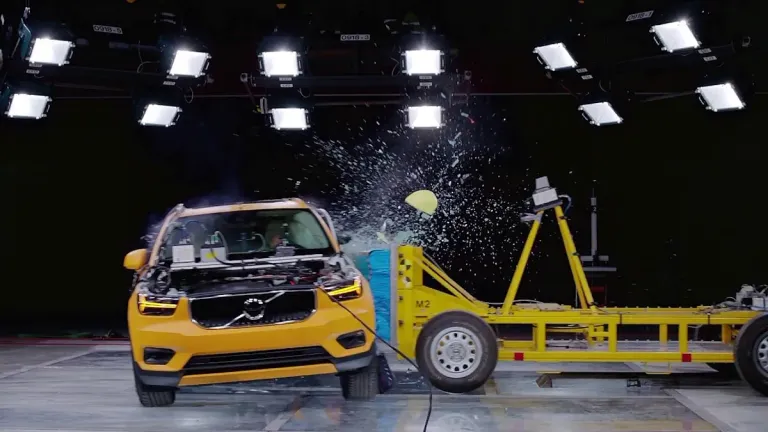
The far-side impact is a specific and often overlooked crash type. When a car is hit from the left, the occupant sitting on the right, away from the impact point, is thrown sideways toward the centre of the car.
If the car has a centre airbag, it deploys between the two front occupants to cushion this movement. If it does not, the occupant can strike the centre console, the other seat or the other occupant with significant force.
The 2026 Euro NCAP protocol specifically scores far-side protection, and centre airbags are one of the key technologies being evaluated. Without the ability to test this scenario in India, ARAI would have needed to send test hardware to European facilities, adding cost and time to each development cycle.
ARAI says it now has capability across the full range of NCAP sled tests, including knee mapping, vehicle test configuration, whiplash and far-side evaluations.
The direct consequence is that manufacturers developing cars in India can now complete a fuller safety test programme within the country. This matters for companies that sell cars locally, but it is also important for models engineered in India for export markets.
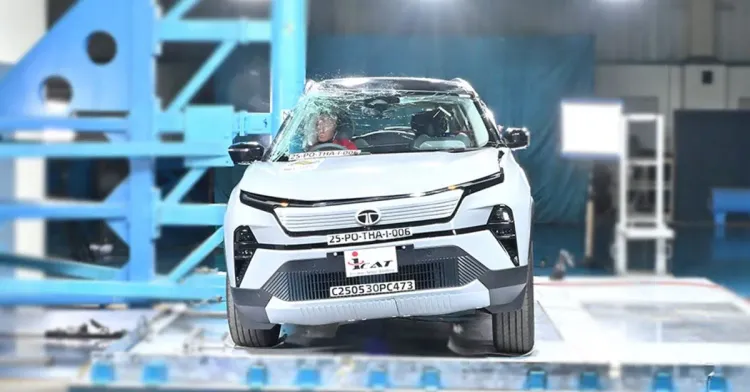
ARAI already supports Bharat NCAP evaluations, the domestic crash test programme launched in 2023. Bharat NCAP draws from global safety-testing methods, even though its rating system is separate from Euro NCAP. The far-side sled capability closes a gap between what ARAI could test earlier and what newer international protocols now expect.
Euro NCAP’s 2026 protocol is more demanding than the earlier system. It places greater emphasis not only on crash protection, but also on crash avoidance, safe driving and post-crash safety. That means carmakers chasing top ratings have to validate more systems, more often and in more conditions.
ARAI is positioning itself as a fuller testing and homologation facility, supporting both domestic regulatory work and international safety validation. That direction fits with the wider “Design and Validate in India” push.
For buyers, the benefit is indirect but real. Better local testing infrastructure means manufacturers can identify restraint-system problems earlier, adjust seatbelt and airbag calibration faster, and re-test without sending parts abroad each time.
It does not mean every car will automatically become safer. Safety still depends on the manufacturer’s design choices, cost priorities and commitment to engineering. But having this test capability in India gives carmakers fewer excuses and more opportunity to validate cars against newer global benchmarks.
Comments are closed.