

The report, “Beyond the Interview: A Decade of Student Visa Denials and What Comes Next,” was released earlier this month by education firm Shorelight in partnership with the Presidents’ Alliance on Higher Education and Immigration. It draws on F-1 visa data obtained from the U.S. State Department through a public records request.
The global refusal rate climbed to 35% in 2025, up from 31% the previous year and surpassing the 33% peak recorded in 2020 during the Covid-19 pandemic. A decade earlier, in 2015, the rejection rate stood at 23%.
The refusals are heavily concentrated in specific regions. Africa recorded the highest refusal rate at 64%, up from 43% in 2015.
Shorelight’s data showed at least 80% of applicants from Sierra Leone, Somalia, Benin and Burkina Faso were turned away last year, with the first two above 90%. Ghana, one of the fastest-growing African source markets for U.S. higher education, saw its refusal rate jump to 81% from 72% a year earlier.
ICEF Monitor, which analyzed the dataset, noted the surge coincides with President Donald Trump’s June 2025 travel ban. The order targeted 19 countries and halted F-1 visa issuance for affected nationals, more than half of them African.
South Asia saw equally sharp increases. India, the single largest source of international students to the U.S., saw its rejection rate climb from 36% in 2023 to 61% in 2025.
Denials hit 81% for Nepal, up from 59% the previous year, 73% for Bangladesh and 71% for Pakistan. By contrast, European refusal rates have held steady at around 9% over the past decade, while South America’s rate fell to 22% in 2025 from a 2022 peak of 31%.
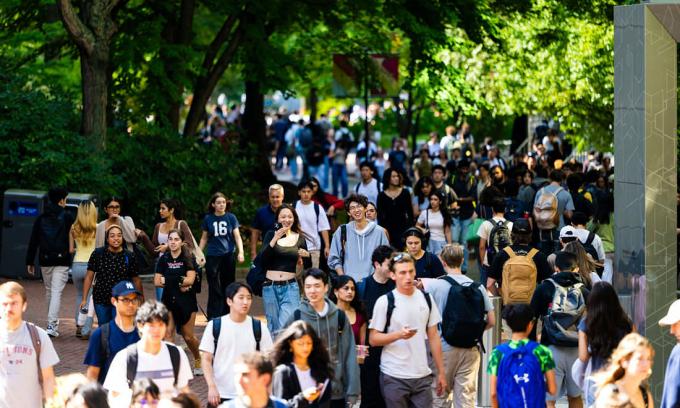
Northeastern University’s campus, one of the U.S. colleges with the largest international student populations. Photo courtesy of Northeastern University |
The surge follows a series of policy changes under the Trump administration that expanded security vetting for student visa applicants. U.S. consulates temporarily paused new F-1 interviews in summer 2025 to implement mandatory social media reviews, creating widespread appointment backlogs, particularly in high-demand markets such as India.
In August, the Department of Homeland Security also proposed capping student visa stays at a maximum of four years with no automatic extension.
Responding to the Shorelight findings, a State Department spokesperson told Inside Higher Ed the administration “is upholding the highest standards of national security and public safety through the visa process, making clear that entry to the United States is a privilege, not a right, and that the safety of the American people comes first.” All visa applications are reviewed case by case in accordance with U.S. law, the spokesperson added.
Shorelight CEO Tom Dretler described the situation as a “self-inflicted talent shortage,” arguing that the U.S. is effectively “building a ceiling” on international enrollment through policy rather than reaching a natural limit.
The firm estimates American universities could lose around $3 billion in tuition revenue this year. Analysts also warn of longer-term consequences, including weakened research output and diminished competitiveness as rival destinations such as Canada, Australia and Germany actively recruit global talent.
The U.S. still hosted a record 1.18 million international students overall in 2024-2025, a 4.5% increase that contributed $55 billion to the American economy, according to the Institute of International Education’s Open Doors 2025 report.
But the institute’s Fall 2025 snapshot, which captures trends in the current academic year, showed new international enrollment fell 17% at the 825 institutions polled.
Vietnam has been a rare bright spot. U.S. colleges and universities hosted 25,584 Vietnamese students in 2024-2025, up 15.9% and pushing Vietnam to the fifth spot among top sending countries and territories, behind India, China, South Korea and Canada. It was the country’s highest placement since the institute began tracking data on Vietnamese students more than two decades ago, and the sharpest yearly growth of any top-five source.
Comments are closed.