

The morning after the stampede last September, I walked through Velusamypuram on the outskirts of Karur and felt like I’d stepped onto a battlefield in slow retreat — slippers scattered by the hundreds across the road, flags and posters of the Tamilaga Vettri Kazhagam (TVK) — yet to come to power then — torn and trampled into the mud, the leftover wreckage of a rally that had ended in many deaths.
Also read: Karur visit: CM Vijay broke down in tears, says MP Jothimani
Going back to that same stretch this week, I caught myself doing a double take. The debris was gone. The road lay bare and unremarkable, the air almost serene, so ordinary that for a moment I wondered if I’d even found the right spot.
Vijay’s arrival in Karur as CM
July 10 saw Vijay’s first trip to Karur since becoming the chief minister of Tamil Nadu, and his first return to the city since the stampede on September 27 that claimed 41 lives at his own rally. The visit comes at a politically loaded moment for both the city and his party. The TVK emerged as the largest party in the state Assembly in the April elections, winning 108 seats in a 234-member Assembly. It fell short of a majority, but yet formed the government with support from the Congress, the Left and some other parties.
Karur, however, eluded Vijay’s party. The All-India Anna Dravida Munnetra Kazhagam’s (AIADMK) M R Vijayabhaskar edged his TVK opponent by less than 1,900 votes to clinch the seat. However, things took a drastic turn in June when Vijayabhaskar resigned as the MLA and joined the TVK. His move has left the Karur constituency vacant and awaiting a by-election, which the Election Commission is yet to schedule.
Whatever the CBI’s ongoing investigation eventually concludes about the events of September 2025, one thing was unmistakable in Karur this week. Its people have already reached their own verdict, and it carries no blame for Vijay.
It’s in this context, a seat up for grabs once again within months, and a one-time rival poised to contest it under Vijay’s party this time, that the CM’s highly anticipated visit took place.
Vijay’s moving fortress
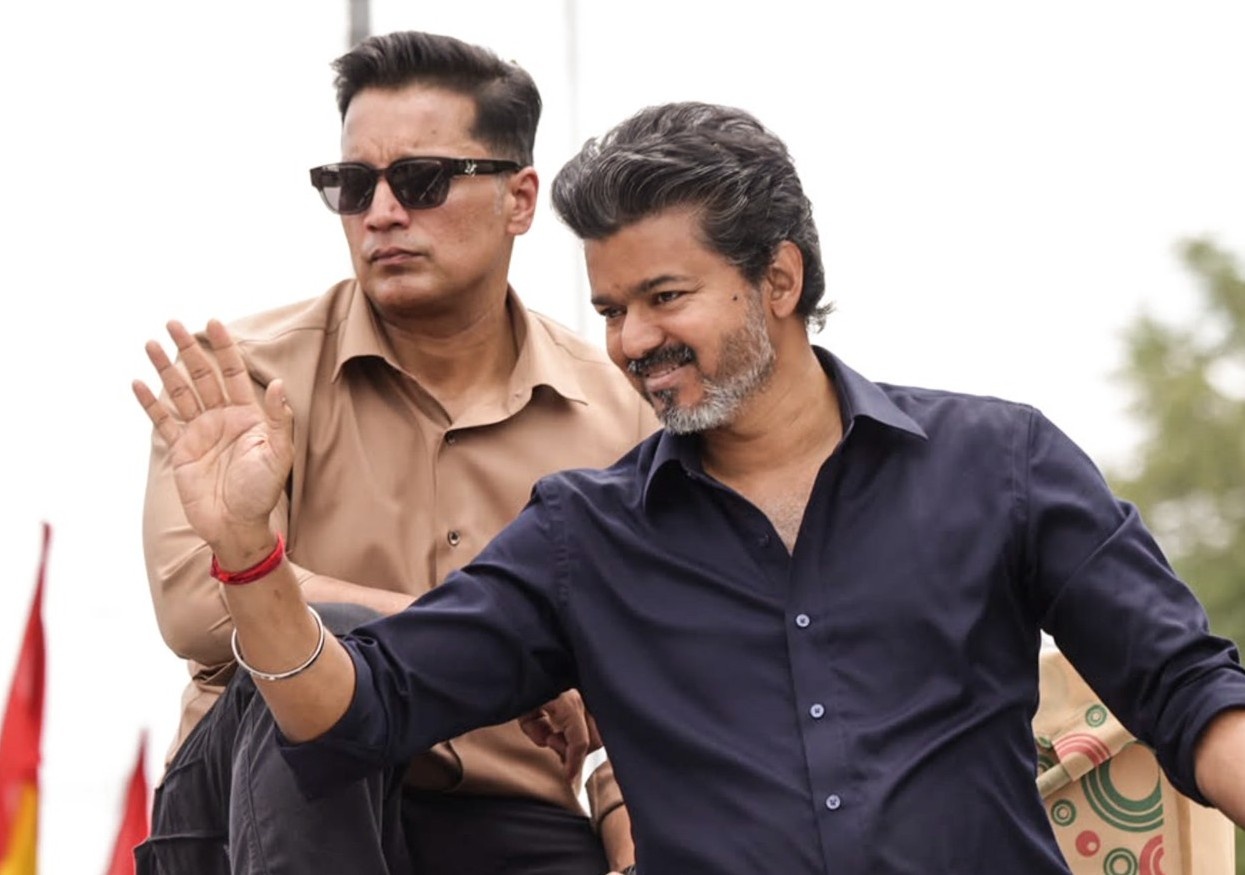
Unsurprisingly, getting anywhere near Vijay took effort. The first event, at Atlas Kalaiarangam, where the black-clad chief minister addressed the crowd standing atop his white van, was capped at 5,000, with entry regulated through QR-code passes.
Reporters and residents alike were made to park a kilometre and a half away and walk the rest, funnelled through barricades manned by police personnel, more than 5,000 by a rough estimate.
The scene repeated itself later in the day at the local district collectorate, the venue for the government appointment order ceremony. The venue was hemmed in by barricades, and the layers of security reinforced the sense that this was less of a condolence visit than a fortress rolling from one location to another.
The moment that might have told us the most, we weren’t allowed to see. At the collectorate, the appointment-order ceremony was a closed affair. Besides Vijay, TVK ministers K G Arunraj, K A Sengottaiyan and Aadhav Arjuna, and Karur’s Congress MP Jothimani were among the few dignitaries present as the chief minister met the victims’ families.
Jothimani later said the CM broke down while meeting them.
Reporters were held back outside, allowed in only once it had ended, forced to piece together, at a remove, a moment of grief that had just played out mere metres away behind closed doors.
Nothing quite prepared me for the crowd. This was the first time I was covering a Vijay rally. Every time a visual of Vijay approaching Atlas Kalaiarangam flashed on the big screens, the ground erupted. People climbed onto the chairs laid out for them, twirling their red-and-yellow TVK towels overhead.
Also read: Vijay accuses DMK of seeking political gain over Karur tragedy
It felt less like a political rally than a first-day-first-show crowd waiting for the hero to walk in. And yet, when the Tamil Thai Vaazhthu (Tamil Nadu’s official song) played, the same crowd that had just been standing on furniture came down and stood in silence. It was a small, telling moment of order inside the frenzy.
Minutes later, the loudspeakers switched to Vijay’s campaign song. Its refrain — “Whistle kettey vaazhdhavanin kadhai than idhu” (“This is the story of one who has lived to the sound of whistles”) — captured the mood inside the venue, where supporters seemed determined to turn the rally into a celebration as much as a political gathering.
The shift was small, but a telling one. At most political events, a TV camera draws a crowd of its own. People jostle to get on frame, wave and mug for the lens. Not this time. Vijay hadn’t even arrived yet, but our cameraperson was still waved aside, told bluntly that he was blocking the view of a stage that, at that point, was empty. The media wasn’t the spectacle. The mere possibility of Vijay was.
When Vijay put blame for tragedy on cops
The crowd wasn’t just watching. It was listening and reacting to every line. When Vijay blamed the Karur police, then working under the Dravida Munnetra Kazhagam administration, for failing to issue any warning before the stampede, I was standing close enough to see the faces of policemen on duty nearby. They gave nothing away, no visible reaction at all, which was its own kind of striking. The crowd, on the other hand, cheered as if a verdict had just been delivered.
The CBI investigation into what actually happened that day is still ongoing, but at that moment, in that crowd, the police had already been tried.
Vijayabhaskar, until recently an AIADMK man, also got a rousing welcome. Standing beside Vijay atop the campaign vehicle, he pledged to stay with him and turn Karur into a TVK bastion and presented the CM with a silver sword as a gesture of that commitment. At one point, mid-speech, old habits slipped through. He said “AIADMK” where he clearly meant “TVK.” The crowd noticed instantly. For a few seconds, the cheering stopped, and an odd silence took over before the moment passed and the welcome resumed.
None is angry with Vijay
If there was one thing I could not find in Karur, it was anger. A boy, no older than 10, speaking in the unmistakable, high-pitched voice of childhood, walked up to me near the venue, unprompted, wanting to talk.
He told me he had been waiting for Vijay to visit for 10 months, and that he was happy the wait was finally over. A woman I spoke to, a Karur native, said much the same in her own words. Vijay coming to the city now, as the chief minister, was itself the win.
He hadn’t been “allowed” to come earlier, she said, echoing almost word for word the explanation Vijay himself had offered for his delayed visit. Neither of them, nor anyone else I spoke to, showed any resentment, not over the time gap, and not even over Vijay’s decision, in the tragedy’s immediate aftermath, to meet victims’ families at a resort in Mahabalipuram rather than in Karur itself, a month after the tragedy. It was hard to find any anger on the ground.
Also read: As governor friction mounts, will Vijay fight back or seek quiet truce?
Watching it all unfold, I couldn’t help but think the day had been scripted like a film, not in a cynical sense, but almost literally. It had all the ingredients: a rival to take down, in Senthil Balaji, invoked through a line from Vijay’s own filmography; the joy of a fan crowd greeting its hero; the grief of a closed-door meeting where a chief minister reportedly broke down; and, running through it all, an attempt at consolation through jobs, a factory and a promised memorial.
Every note a Vijay film script and a Vijay political rally have in common turned up that day, one after another, like a well-cut trailer.
Except for one thing, which stayed with me personally as a reporter more than anything else on the ground. When the stampede happened last September, Vijay had famously not met the press for so much as a quick bite, choosing distance over a statement.
I’d assumed, naively, that this visit, built around undoing that earlier absence, might undo this one too. It didn’t. If anything, the barricading felt more deliberate this time, the distance between Vijay and the press wider than before. At one point, a senior reporter and I stood together, mics raised uselessly in the air, going through the motions of trying for a soundbite we both knew wasn’t coming.
“This is a free press nation,” one of us said, half-joking, half not.
Whatever the CBI’s ongoing investigation eventually concludes about the events of September 2025, one thing was unmistakable in Karur this week. Its people have already reached their own verdict, and it carries no blame for Vijay.
That divide, between the scrutiny the tragedy drew elsewhere and the loyalty it left intact at home, may be Karur’s truest story today.

Comments are closed.