
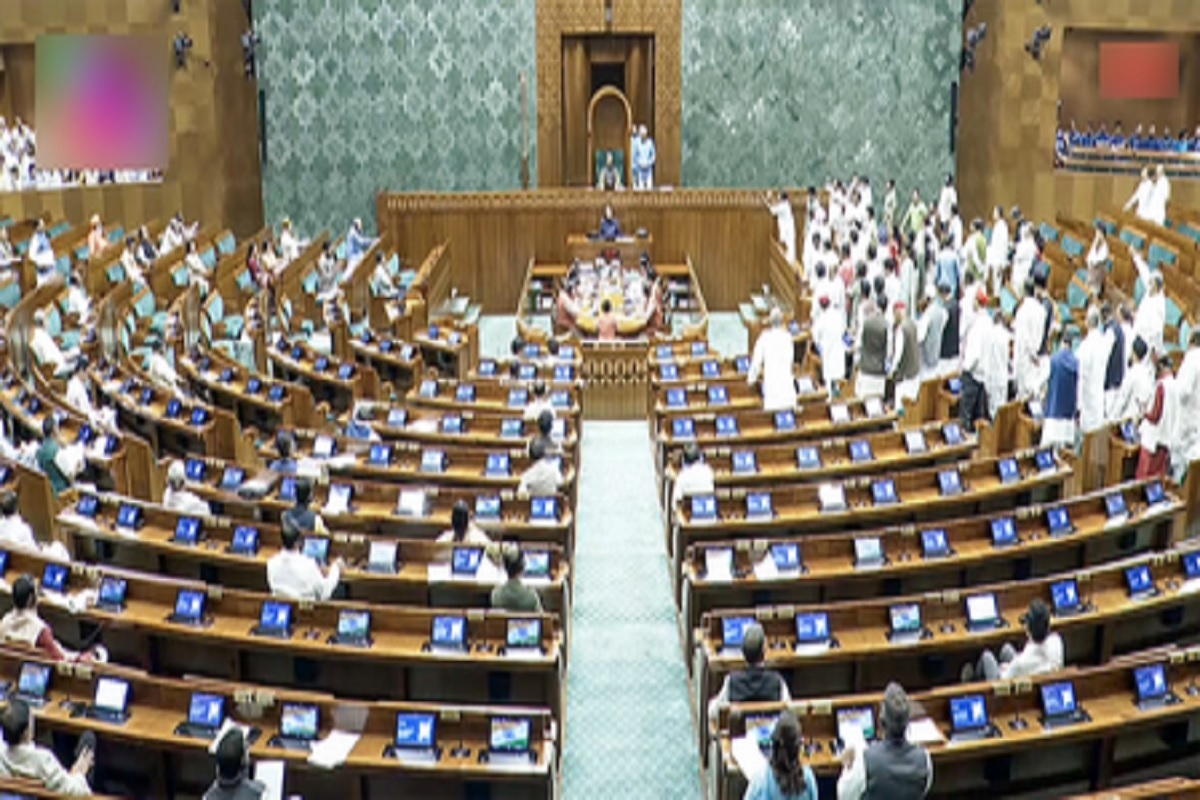

The central government on Tuesday shared the draft of the Constitution (131st Amendment) Bill, 2026 with MPs. This is a proposed amendment to the Women’s Reservation Bill, which aims to increase the number of Lok Sabha seats to 850, which will include members from states and union territories.
The bill proposes a limit of 815 on the number of members to be elected by direct election from constituencies in the states. For Union Territories (UTs), the bill said, “There shall be not more than 35 members to represent the Union Territories, who shall be elected in such manner as Parliament may by law determine.”
At present there are 530 members of Lok Sabha from states and 20 members from Union Territories. However, a Delimitation Commission fixed the number at 543.
Another important change in the bill is the definition of population, which gives Parliament the right to decide what data should be used to increase the number of seats.
The Bill proposes to amend clause (3) of article 81 of the Constitution to read, “(3) ‘Population’ in this article means the population ascertained by such census as may be determined by Parliament by law and the necessary figures of which have been published.”
The Union Cabinet recently approved the bill, which aims to amend the Constitution to quickly implement 33 percent reservation for women in the Lok Sabha and Assemblies. Besides, there is also a proposal to increase the number of seats in the lower house of Parliament through this.
The amendment bill also proposes changes in Article 82, under which the words “allocation of seats” will be substituted for “on the completion of each census, the allocation of seats”.
The proposed amendment aims to delink the implementation of the quota from the 2027 census and instead base it on the 2011 census, allowing it to be implemented before the 2029 general elections.
The Bill to amend Article 82 also proposes to include the role of the Delimitation Commission.
The Bill also provides for reservation of seats in the Lok Sabha and the Legislative Assemblies on a rotational basis and also contains articles relating to the periods for which reservation for women will remain in force, subject to approval by Parliament.
Earlier, Union Parliamentary Affairs Minister Kiren Rijiju said that there is nothing controversial in the proposed amendment to the Women’s Reservation Bill. He appealed to all political parties to support this issue without politicizing it.
Speaking to IANS, Rijiju said that women’s reservation cannot be made a political issue in any form. If we give it a political colour, it will be injustice to women.
The Prime Minister has made a very simple and clear appeal to rise above party politics. Nari Shakti Act (Women’s Reservation Act) is a law which was supported by all parties and which was passed unanimously. Now, we have called a special session of Parliament to implement it.
Let us tell you that the government has called a three-day special Parliament session from April 16 to discuss and pass the Nari Shakti Vandan Act.
The BJP has issued a three-line whip to all its MPs in the Lok Sabha and Rajya Sabha, directing them to remain present in the House from April 16 to 18 during the upcoming Parliament session.
All Indian sailors safe in Gulf region, more than 2,262 returned: Government

Comments are closed.