
Vijayanand Travels has placed an order for 150 Volvo 9600 luxury sleeper coaches, the largest single order Volvo Buses has received from a private bus operator in the country. Around 70 to 80 of these coaches will get onboard washrooms, aimed specifically at long-distance routes where toilet stops are one of the biggest limitations of overnight bus travel.
The new buses will help Vijayanand Travels expand beyond its existing South, West and Central operations into more states. The operator already carries around 20,000 passengers a day and says its booking app has crossed two million downloads.
For passengers, this order points to a bigger push towards premium overnight buses that compete not only with ordinary coaches, but also with trains and short-haul flights on certain routes.
The Volvo 9600 sleeper is a large, purpose-built intercity coach rather than a bus chassis converted locally into a sleeper body. Its tall body accommodates 40 sleeper berths and provides 8.5 cubic metres of luggage space. That matters on long routes where passengers are likely to carry substantially more baggage than on a short intercity trip.
The onboard washroom is the more interesting addition. Toilets in private intercity buses are still unusual because they add cost, consume space and need regular cleaning and waste-management systems. Vijayanand plans to deploy them on a large enough scale for the feature to become a meaningful part of its premium Gold Class operation.
The company already runs Bengaluru-Jodhpur, which it calls Asia’s longest continuous bus route. Journeys of that length make onboard facilities much more useful than they would be on a four-hour sector. Vijayanand also uses double-driver deployments on long-distance routes and maintains its own repair infrastructure.
The 9600 is manufactured at VE Commercial Vehicles’ Hoskote plant in Karnataka. Power comes from Volvo’s D8K 8-litre diesel engine, producing 350hp and 1,350Nm. It is paired with Volvo’s I-Shift automated manual transmission.
Safety equipment includes an Electronic Braking System, Electronic Stability Program and Hill Start Aid. The coach also gets fire detection and suppression for the engine compartment and a fire alarm and protection system for the passenger area.
These features are particularly relevant for sleeper buses because passengers may be asleep when an incident begins. The 9600’s local production also matters to an operator buying 150 vehicles. Fleet economics depend on far more than the purchase price. Parts availability, workshop support, fuel consumption and the number of days each coach remains on the road determine whether such an investment works.
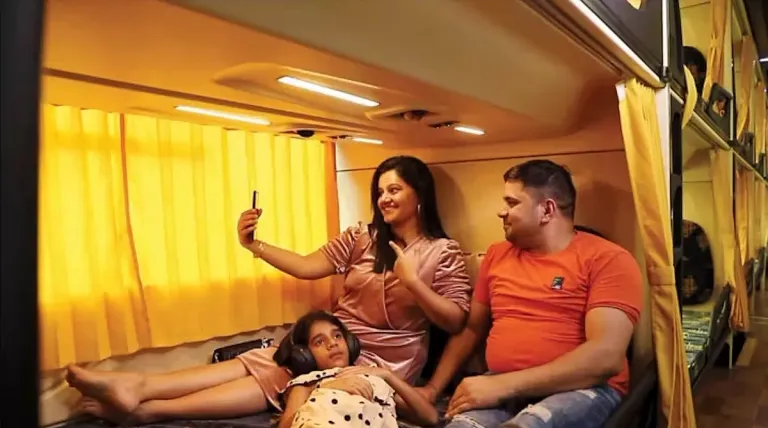
A 150-coach purchase is a substantial bet on passengers paying more for comfort. Sleeper buses have one practical advantage over flights and trains. They can connect city centres and smaller destinations directly without airport transfers or fixed railway availability.
An overnight bus also allows a passenger to travel while sleeping and arrive in the morning without paying for a hotel. The disadvantages are equally obvious. Road congestion can make arrival times unpredictable, ride quality depends heavily on road condition, and very long journeys need clean rest stops and dependable crew management.
Adding washrooms addresses one of those weaknesses directly. Vijayanand’s order will also give it the highest number of Volvo buses among private operators once the new fleet is deployed. That makes the 150-bus deal more than a fleet replacement exercise. It is an expansion programme built around long-distance premium travel.