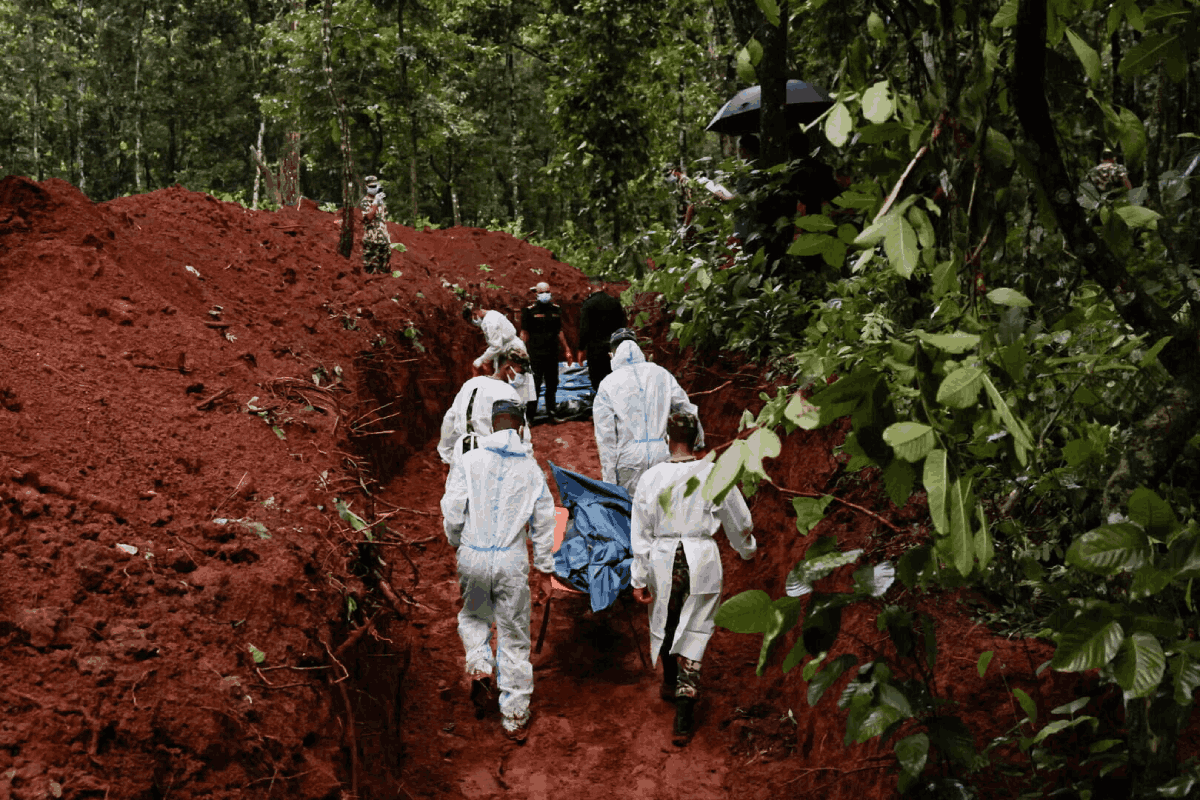
Authorities in Nepal have started burying the bodies of unidentified people killed in the Bhotekoshi-Trishuli-Narayani floods after taking DNA and forensic evidence for cremation. This is because mortuaries are filled and it is becoming difficult to identify the bodies washed up in the river.
According to the information released on Sunday evening, the work of removing the dead bodies is still going on. Out of more than 650 dead bodies, only 29 have been identified so far. According to Nepal Police, of the initial 669 bodies found so far, 211 were in very poor condition or their bodies were incomplete or dismembered. “Many bodies remained buried in thick mud and water for two to three days,” police said.
The dead bodies washed ashore from Rasuwa were found in Nuwakot, Chitwan, Gorkha, Tanhu and Nawalparasi. These places were often far from where the victims went missing. Chitwan has been the biggest hotspot for finding dead bodies. As of Sunday, 259 bodies were found along the banks of Trishuli and Narayani rivers; But, only nine of them could be identified. After autopsies and taking DNA samples, officials started burying unidentified bodies in the Devghat forest. In the first phase, 26 bodies were buried in the ground.
This process has been done in such a way that even after the burial of the dead body, the search for the family members does not stop. Every corpse has been given an identification number. Records of photographs, physical appearance, clothing, jewelry and other items of the corpse are kept. Along with this, DNA, fingerprints and other forensic samples have also been preserved. Burial sites have been geo-tagged so that bodies can be retrieved if relatives identify them later.
In Gorkha district, 29 unidentified bodies and body parts were found buried after DNA samples were taken. Gorkha Chief District Collector Tulsi Prasad Shrestha said, “Gorkha does not have enough facilities to store dead bodies and dead bodies are being found every day.”
A similar process was started in Nawalparasi East on Sunday. After taking forensic samples and giving them identification numbers, twenty unidentified bodies were buried in the ground. For families, identifying the dead depended largely on small clues. More than 1,000 relatives reached Pokhara on Saturday. They had come to see photographs of 102 dead bodies brought from the lower districts. Police said families identified their loved ones by looking at tattoos, necklaces, earrings and even school uniforms.
A father has identified his five-year-old son from a photo he saw online. The boy's body was found in Nawalparasi, far away from where he had gone missing. Police inspector Deepak Rijal said, “In cases where faces cannot be identified, relatives are identifying the bodies based on marks and objects found near the body. More relatives are coming.”
Also read-
- 'China did not give information about the glacier'