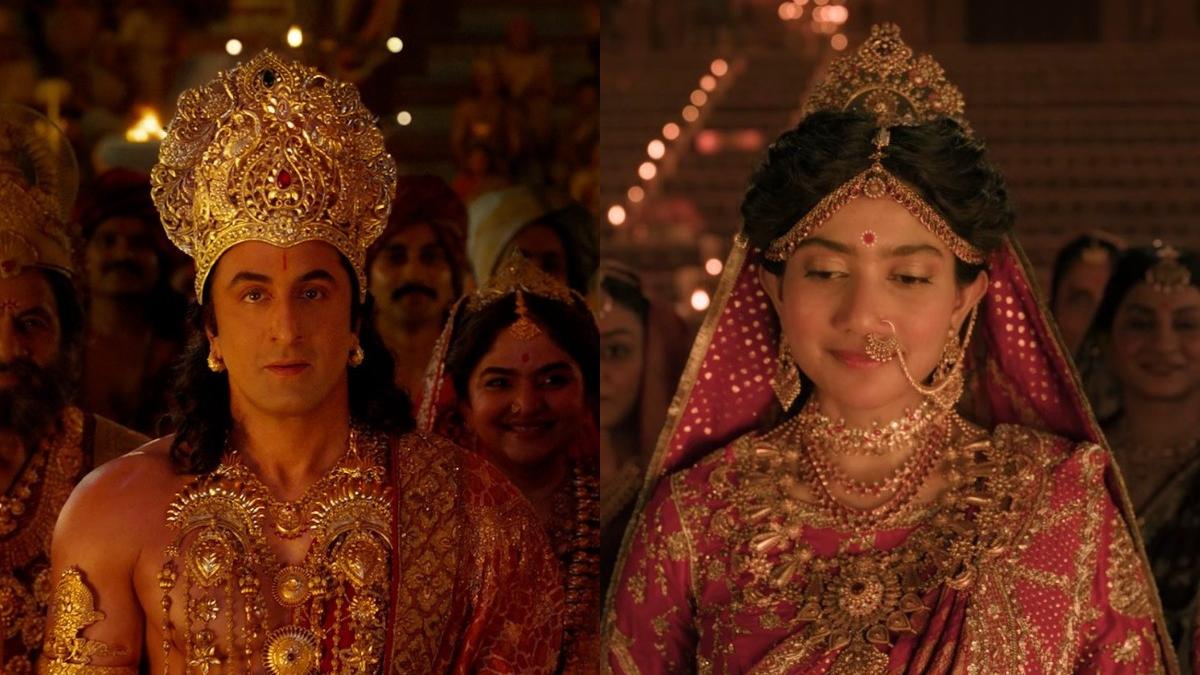
From the sun-inspired ornaments of Ranbir Kapoor's Ram to the floral designs worn by Sai Pallavi's Sita, the jewelery created for Nitesh Tiwari's upcoming epic draws on India's rich artistic heritage to give Ayodhya, Mithila and Lanka their own distinct identities.
When we think of jewelery in a grand period film, we tend to picture a few statement necklaces, an elaborate crown or perhaps a pair of ornate earrings. But creating jewelery for a film on the scale of 'Ramayana' calls for a very different approach. Every ornament must belong to its world, reflect the person wearing it and fit into the larger story being told on screen.
For Nitesh Tiwari's ambitious adaptation of the Indian epic, jewelery brand Tribe Amrapali has created more than 4,500 pieces for the first installment alone. The project took over 18 months of research, design and craftsmanship, with the team working to establish distinct visual identities for Ayodhya, Mithila and Lanka.
The result is not simply a collection of elaborate ornaments for a mythological spectacle. It is an attempt to bring the cultural character of three kingdoms to life through jewellery, drawing on traditional Indian ornamentation, ancient sculptures, temple art and the visual language of mythology.
More than 18 months of research and design
Designing jewelery for Ramayana was far removed from putting together a collection for a conventional film. The team had to study mythological narratives, ancient Indian jewellery, temple sculptures and traditional art forms before developing designs that would complement the film's interpretation of the epic.
Led by Tarang Arora, creative head of House of Amrapali, the design team worked closely with the film's creative department for more than 18 months. The process involved everything from developing initial concepts and selecting suitable materials to creating models and working with skilled craftspeople to bring the designs to life.
The scale of the assignment extended well beyond the principal cast. Jewelery was needed for royal families, warriors, courtiers, attendants, supporting characters and even performers appearing in the background. Each piece had to fit into the visual world of the kingdom it belonged to, while retaining details that made it distinctive.
This meant that the ornaments worn in Ayodhya could not simply be replicated for Mithila or Lanka. Each kingdom needed its own design language, with the jewelery reflecting its culture, character and sense of grandeur.
Ayodhya: A royal legacy inspired by the sun
The jewelery created for Ayodhya draws on the kingdom's royal heritage, with an emphasis on symmetry, precise forms and traditional detailing. Rather than relying on extravagance alone, the designs aim to convey dignity, authority and an understated sense of grandeur.
For Ranbir Kapoor's Lord Ram, the sun is one of the most significant motifs. As a member of the Suryavansha, or Solar Dynasty, Ram's connection to the sun is an important part of his lineage. Incorporating sun motifs into his jewelery helps communicate that heritage through visual details.
The designs also feature circular embellishments inspired by the dharma chakra, lotus motifs associated with purity, and intricate traditional carvings. Together, these elements seek to express not only Ram's royal standing but also his spiritual significance.
The idea is to make the jewelery an extension of the character rather than an accessory added simply to complete his appearance. Each ornament contributes to a visual identity rooted in lineage, symbolism and the traditions associated with Ayodhya.
Mithila: Sita's connection with nature
If Ayodhya's jewelery is defined by its regal restraint, Mithila takes a softer, more nature-inspired approach. Flowers, leaves and delicate organic forms inform the designs, reflecting the kingdom's cultural richness and its association with the natural world.
For Sai Pallavi's Sita, floral motifs and intricate detailing take center stage. The jewelery is designed to express her gentleness without overlooking the strength of her character. Instead of depending on size or ostentation to make an impression, the pieces rely on careful craftsmanship and considered details.
The sacred gardens associated with the Ramayana, along with Mithila's cultural and artistic traditions, serve as sources of inspiration for this design language. The result is jewelery that feels distinct from Ayodhya's formal royal aesthetic and Lanka's dramatic opulence.
The contrast is an important one. Sita's ornaments are not intended to make her appear less significant than the other characters. Rather, their beauty lies in a different kind of expression, one built around delicate forms, natural motifs and fine workmanship.
Lanka: Bold shapes, dark stones and dramatic designs
Lanka has an entirely different visual identity. Its jewelery is more imposing, with sharp contours, asymmetrical forms and dark-coloured stones creating a sense of power, wealth and theatrical grandeur.
For Yash's Ravana, the designs use angular shapes and striking ornamentation to convey authority and an imposing presence. The same broader design language extends to characters such as Mareecha, Shurpanakha and Vidyujjeeva, whose jewelery is intended to complement the dramatic world of Lanka.
Yet the kingdom's ornaments do not follow a single formula. Mandodari and Vibhishana are given more balanced designs, along with lighter, luminous stones. These details reflect their wisdom, composure and inner strength, setting them apart from the more aggressive visual language associated with other characters.
The differences show how jewelery can communicate distinctions between personalities even when they belong to the same kingdom. Lanka's identity remains bold and opulent, but the individual designs acknowledge that its characters are not alike in temperament or outlook.
The craftsmanship behind 4,500 pieces
Creating more than 4,500 individual pieces for the first part of the film required the combined efforts of designers, master artisans, model-makers, craftsmen and technical teams.
The work involved several stages, from research and sketching to material selection, model-making, assembly and final finishing. Traditional techniques such as metal embossing, intricate carving and filigree-style ornamentation were used, alongside designs incorporating small pearls and stones.
The challenge was not merely to produce jewelery on a large scale. Every piece had to remain consistent with the aesthetic of its kingdom while retaining its own character. An ornament worn by a warrior, for instance, had a different purpose from one designed for a royal family member or a court attendant.
Maintaining that distinction across thousands of pieces required close attention to detail and coordination between the design and production teams. The project also brought traditional jewelry-making skills into a large-scale cinematic setting, where the ornaments would need to work as part of a carefully constructed visual world.
When jewelery becomes part of the story
For Tarang Arora, being part of 'Ramayana' is meaningful because the epic is a story generations of Indians have grown up hearing. Reimagining it for a new generation offers an opportunity to bring a familiar cultural narrative to audiences in a fresh visual form.
That sense of responsibility extends to the jewellery. The ornaments are not merely intended to make the characters look grand or enhance their appearance. They also help communicate their heritage, personalities and place within the story.
Ram's sun-inspired designs, Sita's floral ornaments and Ravana's striking, angular jewelery each tell a different story. The 4,500 pieces created for 'Ramayana' therefore represent more than the sheer scale of a film production. They also offer a glimpse into the depth of India's jewellery-making heritage and the many ways traditional craftsmanship can be adapted for the screen.