
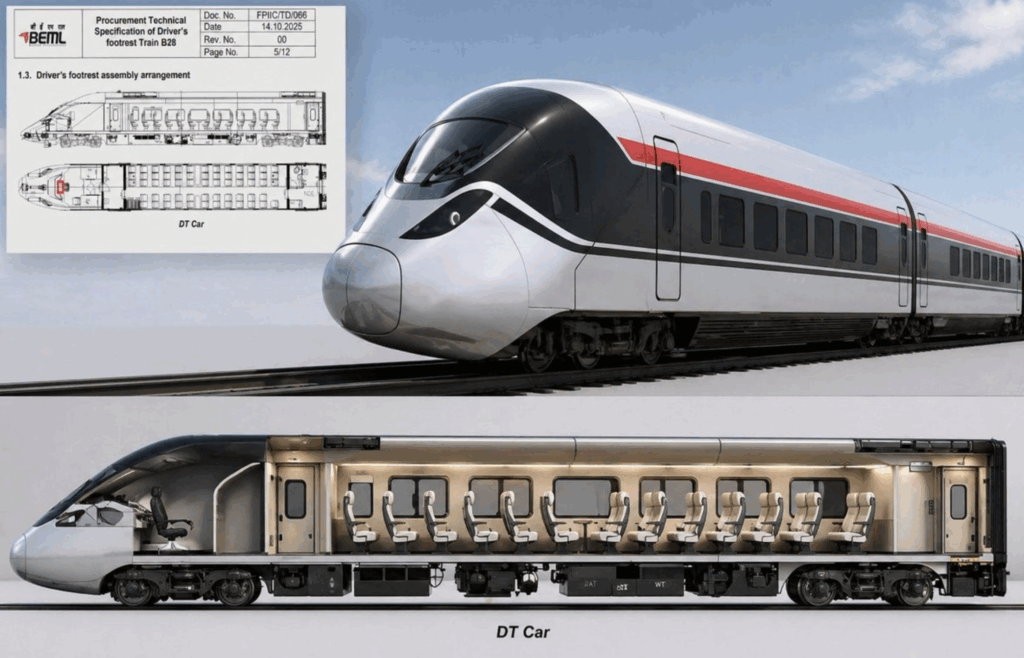

India’s ambitious high-speed rail dream is now becoming tangible. The upcoming B28 bullet trainbeing built by BEML in Bengaluru, is not just about speed—it represents a full-stack shift toward indigenous engineering, modern coach design, and global-level passenger experience.
Built in India: The B28 Milestone
The B28 trainset will be manufactured at BEML’s newly inaugurated Aditya high-speed rail complex in Bengaluru. Developed in collaboration with the Integral Coach Factory (ICF), it marks India’s first domestically designed bullet train.
- Target completion: March 2027
- Initial deployment: Mumbai–Ahmedabad corridor
- Design speed: 280 km/h
- Operational speed: ~250 km/h
This project is a major step under the Atmanirbhar Bharat initiative, reducing reliance on foreign high-speed rail tech.
Inside the Coach: Futuristic Design & Passenger Experience
The viral visuals shared online (as seen in the IndianTechGuide post) highlight a next-gen coach design philosophy—closely aligned with global bullet trains but adapted for Indian conditions.
6
Key Design Highlights
- Aerodynamic Nose Cone
Designed for ultra-high speeds, reducing air resistance and noise—similar to Japan’s Shinkansen-inspired styling. - Pressurized Cabins
Ensures passenger comfort during high-speed travel and tunnel transitions, with advanced HVAC and air filtration. - Ergonomic Rotating Seats
Seats can rotate to align with travel direction, improving comfort—especially for long-distance journeys. - Wide Gangways & Accessibility
Designed for smooth movement, including provisions for passengers with reduced mobility. - Smart Interiors
Expected features include infotainment systems, modular bio-toilets, and modern lighting for a premium travel feel.
Engineering & Technology Backbone
Beyond aesthetics, the B28 is a serious engineering machine:
- Distributed traction system (IGBT-based) for faster acceleration
- Microprocessor-controlled braking systems
- ETCS Level-2 signalling compatibility for high safety standards
- Designed to operate in extreme Indian climates (heat, dust, humidity)
This makes it not just fast—but reliable and scalable for India’s conditions.
Key Comparison: B28 vs Traditional Indian Trains
| Feature | B28 Bullet Train | Traditional Express Trains |
|---|---|---|
| Top Speed | 250–280 km/h | 100–130 km/h |
| Manufacturing | Indigenous (BEML + ICF) | Mostly legacy platforms |
| Coach Design | Aerodynamic, pressurized | Non-pressurized |
| Seating | Rotating, ergonomic | Fixed seating |
| Comfort | Airline-like interiors | Basic comfort |
| Technology | Advanced signalling, smart systems | Limited automation |
Why This Matters
The B28 isn’t just a train—it’s a strategic shift. It positions India among nations capable of designing and building high-speed rail systems domestically.
Once operational, routes like Chennai–Bengaluru could shrink to just over an hour, redefining intercity travel.
More importantly, it lays the foundation for future upgrades like the B35 (350 km/h) trains already being planned.
The Big Picture
India’s bullet train journey is no longer dependent solely on imports or collaborations. With B28, the country is building its own ecosystem—design, manufacturing, and innovation—all under one roof.
This isn’t just infrastructure. It’s a statement.
Image Source
Comments are closed.