Historically, miost of the largest-displacement engines in production today, only one is a six-cylinder. Even then, it’s an inline-6 rather than a V6. Historically, most of the largest six-cylinders in production have been of the inline variety. Oldsmobile’s giant 707 cu-in (11.6-liter) inline-six is a particularly gargantuan example, and it could be found in its flagship cars in the early 1910s. Two decades later, huge inline-six engines were still popular in luxury cars like the legendary Bentley 8 Litre, which wore its engine’s displacement as its nameplate.
In general, V6 engines don’t reach displacements anywhere close to their inline-six or V8 cousins. Many of the highest-horsepower modern V6 engines feature displacements in the 3.0-liter range, but there are a handful of older V6 engines that have boasted significantly higher displacement figures.
Many of those big V6 engines can be found under the hoods of trucks, but a few cars have also sported a high-displacement V6 in place of a traditional V8. These three engines are among the largest-displacement V6s to feature in production vehicles to date, with each one with the kind of displacement figure you’d expect to see in a V8 or V12 instead.
GM 4.3-liter Vortec V6
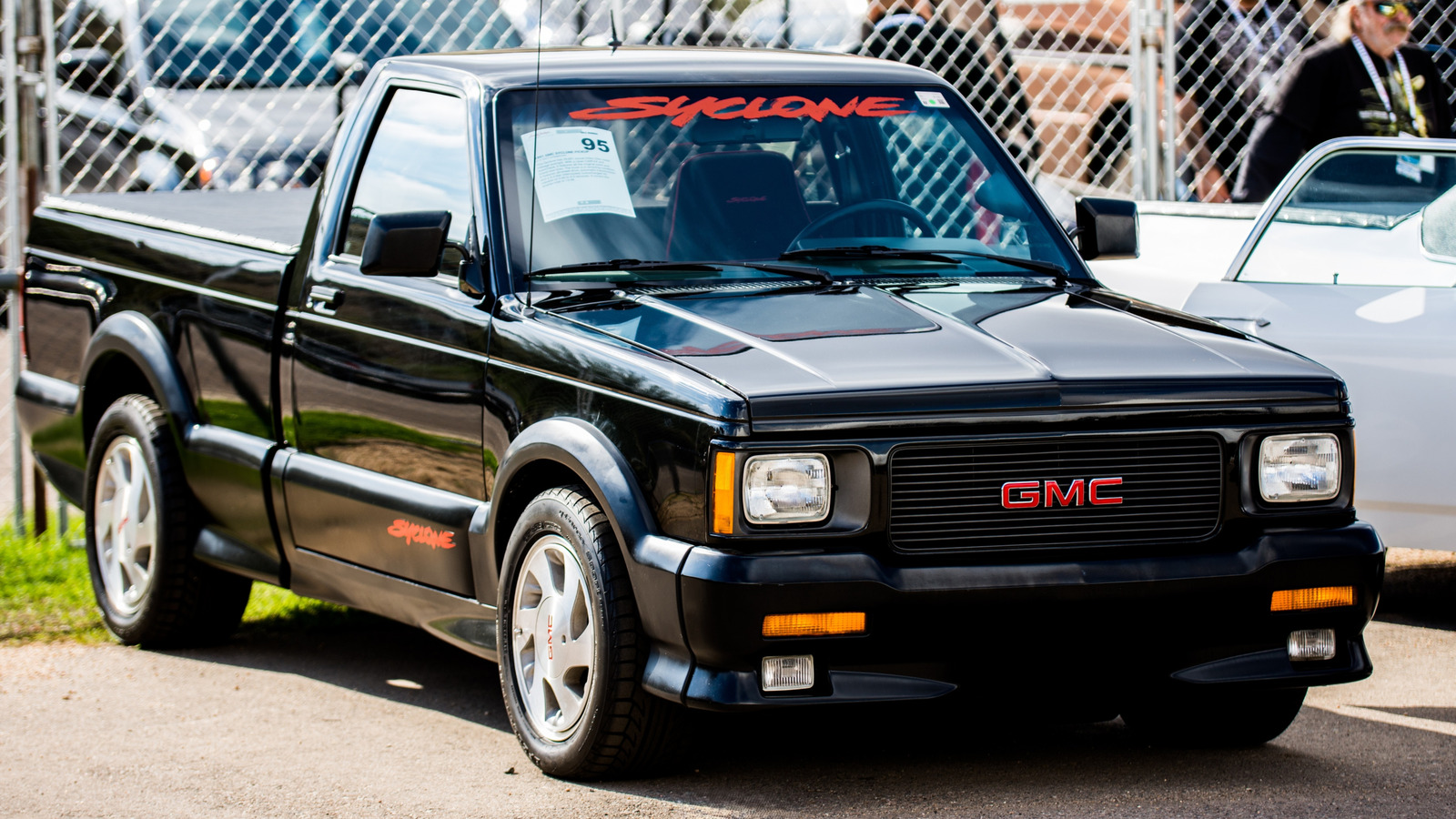
GM has a long history of making V6 engines for its trucks, with its Vortec V6 being a particularly notable chapter in that history. The automaker also fitted versions of the Vortec engine to cars like the Chevrolet Caprice and Chevrolet Monte Carlo, making it one of the largest V6 engines ever used in a passenger car. The 4.3-liter engine debuted in 1985 and was originally designed as an efficient workhorse, but in 1991, GM turned it into something very different.
The GMC Syclone was a high-performance pickup that was unlike anything else on the market, and it was powered by a turbocharged version of the Vortec V6. This factory-built hot rod produced 280 horsepower and sent it to all four wheels. As a result, it was very quick off the line. So quick, in fact, that Car and Driver famously pitted a Syclone against a V8-powered Ferrari 348 and found that the Syclone completed the quarter-mile 0.4 seconds faster. Adding insult to injury, the GMC also stopped faster than the Ferrari.
In the decades since, Ferrari has managed to squeeze far more horsepower out of its V6 engines than GMC did. The twin-turbocharged 3.0-liter V6 in the modern 296 GTB churns out 654 horsepower, and it’s assisted by an electric motor that increases the car’s combined power output to north of 800 horsepower. However, few V6 engines fitted to passenger cars have matched the Vortec’s 4.3-liter displacement.
GM 4.3-liter LV3 V6
The LV3 is another 4.3-liter V6 engine, and it was built to replace the previous 4.3-liter V6 that GM had been making for three decades. It shares its displacement with its predecessor, but not much else. That’s because the LV3’s design is related to GM’s latest V8 engines, including the LT-series V8s, while the older Vortec V6 was based on GM’s previous-generation V8 architecture.
In stock form, the LV3 made 285 horsepower and 305 lb-ft of torque at launch. Although it hasn’t received as much attention as the LT1 and LT2 V8 engines, some specialists have now built LV3 engines that make more than 1,000 horsepower. In early 2026, Scoggin-Dickey Parts Center (SDPC) showed off its latest LV3 project, which made 1,403 horsepower, with Hot Rod magazine an early look at the project. Another notable project saw a custom LV3 engine fitted to a Porsche 914. Both Chevrolet and GMC trucks have been fitted with the engine, although, unlike the older 4.3-liter V6, GM chose not to fit the LV3 into any passenger car models.
GMC 478 7.8-liter V6
Modern six-cylinder HD truck engines feature an inline-6 layout rather than a V6, but back in the ’60s, GMC offered a whole line of V6 engines. At the time of its launch in 1960, GM’s promotional material billed the engines as being longer-lasting than its previous truck engines, claiming that they would be able to cover 200,000 miles before needing a major overhaul.
The largest variant of the V6 engine measured 478 cu-in, or 7.8 liters. If that wasn’t enough, the same engine family also included a 275-horsepower Twin-Six V12 engine, which was later replaced by a 637 cu-in (10.4-liter) V8 engine. The record-breaking V6 was available in GMC’s 6500-series trucks, with diesel and gas variants available. Diesels were marketed as Toro-Flow engines and launched in 1964. Unfortunately, Toro-Flow engines became known for reliability issues, and they never became as popular as their gas-powered counterparts.