
Vietnam, China agree to boost cooperation in infrastructure, sci-tech and tourism as top leaders hold talks

The meeting, part of the Vietnamese leader’s state visit to China, followed a welcome ceremony with the highest protocol reserved for heads of state at the Great Hall of the People.
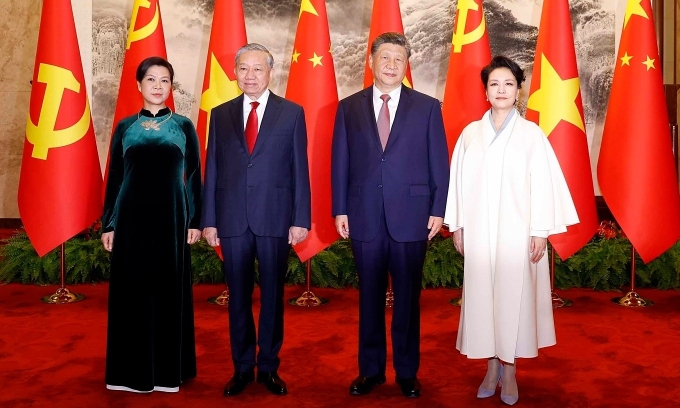
Vietnam’s Party General Secretary and President To Lam (2nd, L) and his spouse pose for a photo with China’s Party General Secretary and President Xi Jinping and his spouse at the Great Hall of the People in Beijing, China, April 15, 2026. Photo by VNA |
The top leaders held in-depth and comprehensive discussions on their respective national situations, bilateral relations, and regional and international issues of mutual concern.
Amid complex global developments, the two leaders affirmed that the two Parties and countries should further strengthen solidarity, enhance strategic trust, and promote policy connectivity, trade, infrastructure, and energy. They agreed to continue deepening and elevating Vietnam-China relations in the new phase, practically contributing to peace, cooperation, and development in the region and the world.
Regarding future directions, they agreed to continue directing relevant agencies to adhere to the overarching “six major orientations”, maintain regular high-level exchanges, and promote the guiding role of Party-to-Party channels. They emphasised the need to expand substantive cooperation across sectors, reinforce the social foundation of bilateral ties, enhance close coordination at multilateral mechanisms, and better manage and resolve differences.
At the talks, the two leaders officially announced the launch of the “Vietnam-China Tourism Cooperation Year 2026-2027,” agreeing to step up joint promotion activities, improve tourism infrastructure and services, and maintain each country’s position as a leading source of tourists for the other.
General Secretary and President Lam also proposed both sides consider visa exemptions for group tourists at designated destinations on a reciprocal basis.
He proposed that the two sides strengthen political trust and strategic coordination at a new level, step up high-level exchanges, and continue to promote the role and effectiveness of comprehensive cooperation across Party, Government, National Assembly/National People’s Congress, and Vietnam Fatherland Front/Chinese People’s Political Consultative Conference channels.
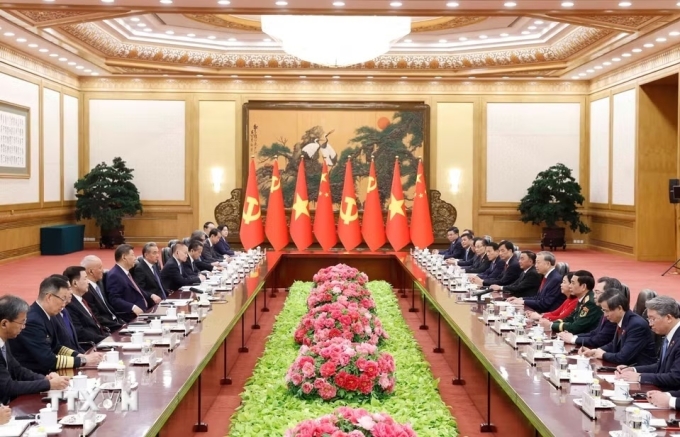 |
Vietnam’s Party General Secretary and President To Lam and his delegates (R) hold talks with China’s Party General Secretary and President Xi Jinping and his delegates in Beijing, China, April 15, 2026. Photo by VNA |
The Party and State leader of Vietnam called for enhanced theory exchanges and cadre training, stronger substantive cooperation between key agencies, particularly in diplomacy, national defence, and public security, and the effective implementation of the ministerial-level “3+3” strategic dialogue mechanism. He also proposed increasing cooperation in security, defence industry, and military trade, along with support each other in successfully hosting APEC Year 2026 and 2027 in each country.
He further suggested elevating economic, trade, investment, and tourism ties to a new height to contribute to the realisation of each country’s development goals. Priority should be given to upgrading strategic infrastructure connectivity, especially railway, shifting from simple trade to deeper economic linkages, and associating bilateral trade with infrastructure, logistics, and market connectivity.
General Secretary and President Lam proposed that China open its market as wide as possible to Vietnamese goods and work toward balanced and heathy trade. He also called for stronger investment, technology transfer, development of supporting industries, and the establishment of complete production and supply chains in Vietnam, as well as coordination in building mechanisms to ensure strategic energy supply.
In addition, he emphasised expanding cooperation in education and training, science and technology, culture, people-to-people exchanges, and local-level cooperation, including providing more scholarships for Vietnamese students and boosting collaboration between leading universities of the two countries.
Agreeing with and highly valuing the proposals, General Secretary and President Xi suggested that the two sides further intensify political trust and strategic exchanges, maintain the tradition of high-level contacts, and bring into play the special role of Party-to-Party relations. He asked for in-depth exchanges of experience in the Party building and state governance, and for maximising the role of the ministerial-level “3+3” strategic dialogue on foreign affairs, national defence, and public security between Vietnam and China to firmly advance the socialist cause in both countries.
The host recommended the two sides effectively align the Belt and Road Initiative with the “Two Corridors, One Belt” framework, accelerate strategic infrastructure connectivity, and actively implement the three standard-gauge railway projects linking the two countries.
He welcomed the increasing export of high-quality Vietnamese goods to the Chinese market, and called for deeper cooperation in key sectors, stronger production and supply chain collaboration, and encouragement for Chinese enterprises to invest more in Vietnam.
The two countries should enhance policy coordination in science and technology, promote diverse people-to-people exchanges, actively implement global initiatives on development, security, civilisation, and governance, and jointly contribute to a stable, open and cooperative international environment while together promoting the socialist cause around the word as well as safeguarding peace, stability, and prosperity in the region and beyond, the Chinese leader added.
At the talks, the two sides agreed to properly resolve differences and promote cooperation in line with the new level of Vietnam – China relations on the basis of international law, seriously comply with the consensus between the Association of Southeast Asian Nations (ASEAN) and China on the implementation of the Declaration on the Conduct of Parties in the East Sea (DOC), and accelerate negotiations to soon finalise an effective and substantive Code of Conduct (COC) in accordance with international law, particularly the 1982 United Nations Convention on the Law of the Sea (UNCLOS).
The top leader of Vietnam asked both sides to truly respect each other’s rights and legitimate interests and resolve differences through peaceful means in line with international law, especially the 1982 UNCLOS.
Following the talks, the two leaders witnessed the signing of cooperation documents across Party, public security, judicial, economic, science and technology, production and supply chain, social welfare, media, and local collaboration, reflecting the comprehensive outcomes of the visit.
Comments are closed.