

The Ho Chi Minh City People’s Committee issued the investor approval on April 13, based on the investment policy the Prime Minister signed on Jan. 16, 2025, and on the special mechanisms the National Assembly has granted the city.
Within the consortium, Terminal Investment Limited Holding S.A. holds 49%, Vietnam Maritime Corporation (VIMC) 36% and Saigon Port JSC 15%. Saigon Port is a subsidiary of VIMC. The consortium will directly contribute 15% of the total investment, with the remainder raised from other sources.
Terminal Investment Limited Holding S.A. is the terminal arm of Geneva-based Mediterranean Shipping Company (MSC), the world’s largest container carrier, which moves more than 23 million TEU annually and accounts for roughly 18% of global container shipping capacity, according to VIMC.
MSC connects over 500 ports worldwide and already serves container terminals in Hai Phong, Da Nang and the Cai Mep-Thi Vai area. Its fleet carries more than 1 million TEU of Vietnamese imports and exports each year to markets including the U.S., Europe, China, Japan and Australia. Anchoring the new hub with the world’s largest line effectively secures a baseload of cargo volumes that have historically moved through Singapore and Port Klang.
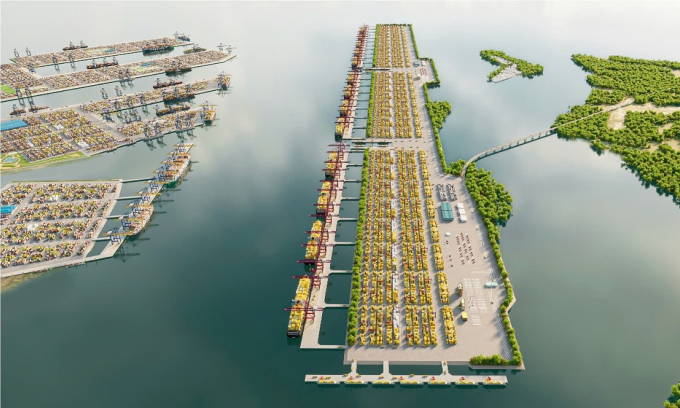
A rendering of the Can Gio International Transshipment Port project in Ho Chi Minh City. Photo courtesy of Portcoast |
The groundbreaking ceremony is scheduled for April 30 at the Nha Rong-Khanh Hoi port area, timed to the 51st anniversary of Vietnam’s reunification.
Can Gio port will span roughly 571 hectares on Go Con Cho Islet at the mouth of the Cai Mep River, with a main quay stretching 7.5 km. Designed capacity is set at 4.8 million TEU by 2030, rising to 16.9 million TEU by 2047.
The first phase will include two to four berths built to handle vessels of up to 250,000 metric tons, equivalent to the 24,000-TEU class that represents the largest container ships in operation today. Long-term expansion could push the port to 13 berths.
Under conditions set by the city, the investors are barred from transferring the project for 10 years from the date of land handover. They must disburse at least VND50 trillion ($1.9 billion) within the first decade and complete the entire project within 20 years. The project’s operational term is 50 years.
Once at full design capacity, Can Gio is projected to generate VND34-40 trillion ($1.29-1.52 billion) in annual revenue and create 6,000 to 8,000 direct jobs along with tens of thousands of indirect ones. Authorities expect the port to strengthen Vietnam’s position in the global logistics chain.
The port is one piece of a broader development push in the area. Can Gio is also being planned for a nearly 2,870-hectare coastal urban area, the Ben Thanh-Can Gio metro line, the Can Gio bridge and several inter-regional road connections designed to tie the new hub into Ho Chi Minh City’s transport network.
Comments are closed.