
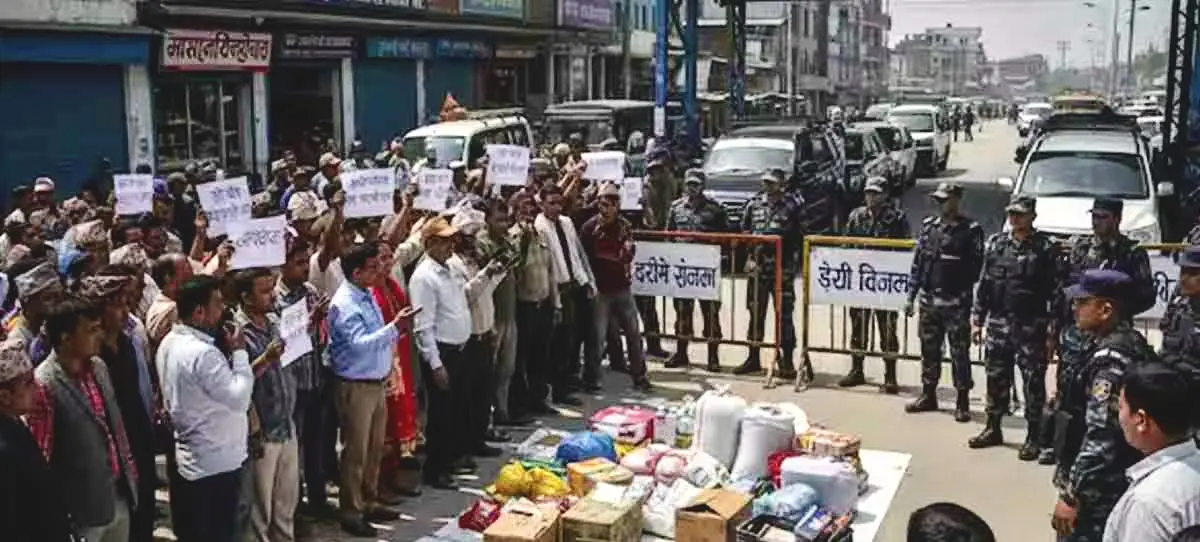

Kathmandu: Barely a month after he took charge, Nepal prime minister Balendra Shah is facing a major protest over the imposition of customs duty on items purchased from India.
Nepalese citizens have been known to visit border bazaars of India to buy groceries, medicines, utensils, electronics, and products for weddings for decades.
Though a customs duty did exist, it was never enforced and people faced no difficulty in taking the items they purchased in India across the border into Nepal.
Shah’s government is now facing a backlash for enforcing imposition of the customs duty on goods worth over Nepalese Rupees (NPR) 100 (INR 63) imported from India. Depending on the item, the customs duty will reportedly range from 5% to 80%.
“For the rituals performed here [in Nepal] from birth to death, we bring all the essentials from there [India]. Even the fertilisers that the government of Nepal are at times unable to provide on time we bring from India. Now the situation has turned different; it is an unannounced blockade,” one of the protesters told news agency ANI.
The protests were held in Nepal’s border town, Birgunj, and in the capital, Kathmandu, as reported by India Today.
The move would “directly affect their lives” because they rely heavily on “cross-border purchases for daily items”, those living close to the border said.
Shah is also facing a protest by students for his decision to ban students’ unions in the country that are affiliated with political parties. During a meeting with the vice-chancellors at the Nepal PM’s office on Monday, Balendra Shah ordered the immediate implementation of the decision to remove party-affiliated student and staff unions from campuses.
Thousands of people from Nepal used to visit Indian markets close to the border to purchase essential commodities, clothes, medicines, groceries, utensils, electronics accessories, and festival or wedding items. The numbers have dropped since the imposition of the customs duty.
Chairman of Rastriya Ekta Dal, Binay Yadav, called this move by the Nepal government an “undeclared blockade”.
“This step is against the provisions of the 1950 Peace and Friendship Treaty. The government should immediately remove the customs limit for household items and instruct security personnel to behave in a citizen-friendly manner,” he told The Times of India.
He warned of a larger protest across the Indo-Nepal border region if the Balen Shah government’s order was not rolled back soon.
Videos of the strict enforcement of the rule and people fighting with Nepalese officials and security personnel have emerged on social media.
One of these show a woman, carrying some packets of potato chips for her children in Nepalgunj, being stopped from entering Nepal and being told that her items would be seized by the Nepal Police.
“I have only four-five packets of chips. Give me the money I spent on them, and I’ll allow you to seize them,” she is heard telling the police personnel.
“All these shops in Nepal have Indian products, first stop them and then take action against us,” she says angrily.
The Government of Nepal decided to tighten this rule after receiving complaints that residents in border areas incessantly travel to Indian markets to purchase food items, clothing, and other household goods, resulting in losses to shopkeepers in the local markets, and also to Nepal’s national revenue. The government also stated that this was an attempt to curb revenue leakage and illegal imports.
The information officer of the Nepal Department of Customs, Punya Bikram Khadka, announced that the duty would be charged on goods above NPR 100 brought from Indian markets.
Nepal’s security personnel at the border checkpoints have started to make announcements on loudspeakers regarding the customs duty rules.
Shah’s political opponents have opposed the move. The Nepali Congress party has demanded the immediate withdrawal of the customs duty, calling it an “anti-people and insensitive” move.
Incidentally, the order has also come in for criticism from members of Shah’s own party, the Rastriya Swatantra Party (RSP). Rajiv Jha of the ruling RSP called the move “impractical”.
“Setting a limit of NPR 100 in today’s inflation era is extremely low and impractical,” Jha was quoted by TOI as saying. He urged the government to “review the matter” immediately.

Comments are closed.