
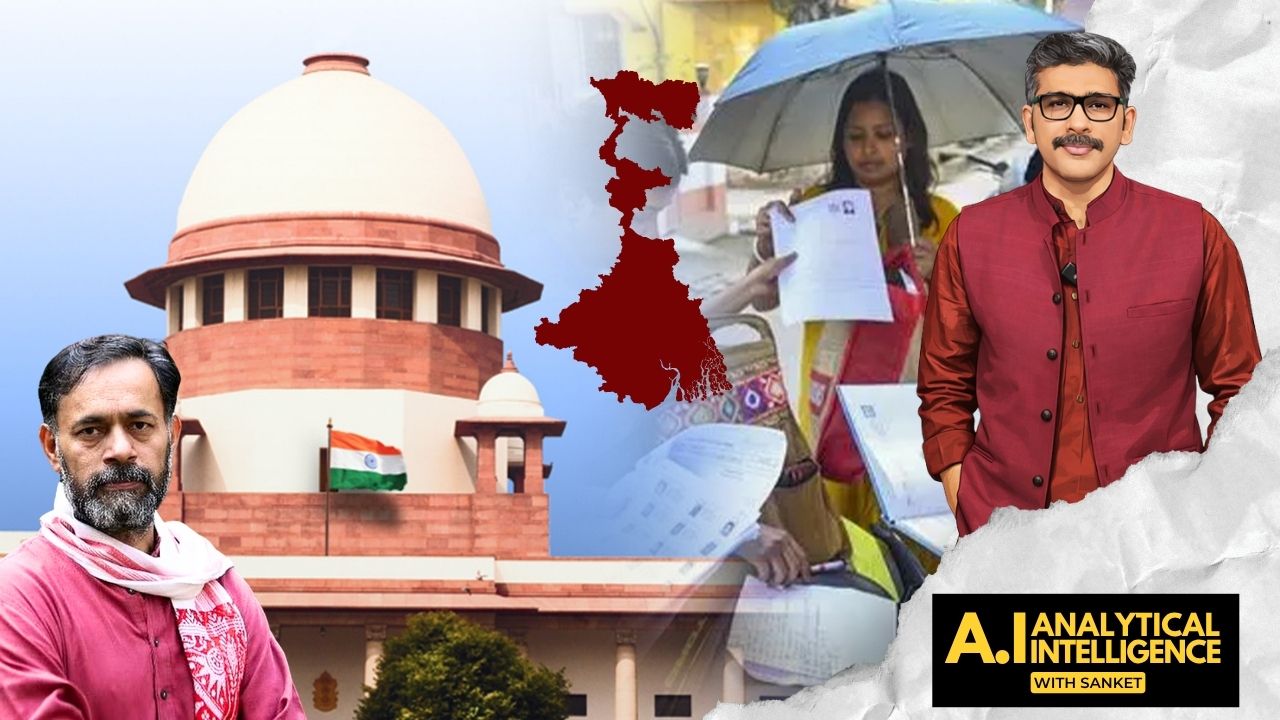

“Twenty-seven lakh people have been denied their voting rights wrongly, and most of these last-minute corrections will amount to nothing,” says political analyst Yogendra Yadav, raising serious concerns over the controversial special intensive revision (SIR) of electoral rolls in West Bengal. With voter lists reportedly being revised even as polling approaches, questions around legality, fairness, and institutional response have intensified.
Also read: Second disenfranchisement? Travel hurdles rob Bengal’s migrant workers of their votes
The Federal spoke with Yadav in this episode of AI With Sanket about what he calls an unprecedented situation in India’s electoral history.
Here are some excerpts from the interview:
Has there ever been a situation where voter lists were revised so close to the polling day?
Never. There is a simple law in this country which says that electoral rolls — that is, the voters’ list — should be frozen on the last day of nomination, which is almost a month before polling. Therefore, it is not legally possible for the Election Commission (EC) to add or subtract names after that deadline. This is an unusual case because the Supreme Court is invoking its very special powers under Article 142 of the Indian Constitution.
What does Article 142 allow, and how is it being used here?
Article 142 gives the Supreme Court the power to do whatever it deems fit in the interest of justice. It can override law, constitutional precedent — everything. But the question is, can it override ground realities? While the apex court is saying last-minute insertions can be made, the truth is that nothing of that kind will meaningfully happen. The court has effectively put its stamp of approval on the deletion of no less than 27 lakh voters.
Are these last-minute corrections meaningful at all?
Not really. The Supreme Court seems aware that something unacceptable has happened, but now it is trying to soften the impact. Whether 27 or even 2,700 names are restored, it makes no difference when 27 lakh people have been excluded. These are cosmetic measures. In reality, these people are off the voters’ list.
Also read: From land crusade heart, Nandigram emerges as Hindutva hub in Bengal | Ground Report
Does this raise questions about the fairness of the SIR exercise itself?
Absolutely. This creates a cruel choice — whether to conduct elections on time or to conduct them fairly. Unfortunately, the conduct of the EC, along with the Supreme Court’s silence earlier, has forced this situation upon us. While SIR is conducted across the country, its implementation in West Bengal has been exceptionally different.
Was there any statistical basis to treat Bengal differently?
No, there was none. I checked multiple indicators. The size of the voter list in Bengal was almost a perfect match with its adult population — 6.66 crore voters against 6.67 crore adults. That’s an unusually close match, so there was no inflation. Even recent additions before SIR saw 41 per cent rejection rates, which shows there was no mass manipulation.
What about concerns around “mapping” or verification?
Even there, Bengal was not unusual. The proportion of “unmapped” voters in Bengal was 4.5 per cent, which is actually higher than in states such as Rajasthan and Madhya Pradesh, where it is just 1.6 per cent. So, the claim that Bengal was suspicious doesn’t hold statistically.
Then why do you think Bengal was treated differently?
After the first stage, the EC decided to treat Bengal as a special case — without any statistical basis. It deployed 30 observers in the state compared to just four in Uttar Pradesh. It appointed 8,000 micro-observers in Bengal and none elsewhere. Around 95 per cent of officer transfers happened in Bengal. This cannot be explained statistically — only politically.
What political explanation do you see behind this?
The BJP has a 4D problem in Bengal — it is desperate, organisationally weak, faces a strong opponent in Mamata Banerjee, and has a demographic disadvantage. Roughly one-third of Bengal’s voters — largely Muslims — are unlikely to vote for the BJP. If their numbers are reduced, the electoral path becomes easier. That is what SIR appears to be doing.
Also read: From TVK surge to SIR row: Key forces shaping Tamil Nadu and West Bengal elections
Are there signs of targeted deletions?
Yes. Take Nandigram — Muslims are about 25 per cent of the population, but 95 per cent of those recommended for deletion are Muslims. That is statistically impossible. In Bhabanipur, where Muslims are 54 per cent, about 76 per cent of deletions are from that community. This completely inverts the logic of electoral democracy.
You also mentioned a broader pattern beyond SIR. What do you mean?
SIR is just one part. There is a larger attempt to reshape democracy through three elements: geography, calendar, and actors. Geography is being altered through delimitation. The calendar is being changed through proposals like One Nation, One Election. And actors — meaning voters — are being reshaped through exercises like SIR.
Should the elections have been postponed in such a situation?
Ideally, yes. If Article 142 could be used to create this extraordinary adjudication system, it could also have been used to postpone elections or allow these 27-lakh people to vote pending appeal. Only 134 appeals have been heard so far, and 132 were found valid. That shows most exclusions were likely wrong.
Was there any alternative to postponement?
Yes, the Supreme Court could have allowed all those who appealed to vote until their cases were decided. That did not happen. Post-election remedies don’t work because election petitions take years. So, whatever could have been done had to be done before polling.
Also read: Can DMK retain power in TN and will TMC survive BJP challenge in Bengal? | Capital Beat
Who do you hold responsible for this situation?
The EC is the principal actor here. But the Supreme Court also failed to intervene when it could have. It allowed a system where 60 lakh cases were decided in 35 days — that’s less than three minutes per case. That cannot be called fair adjudication.
What is your final assessment of the situation?
This is a serious miscarriage of voter justice. These are not people who are absent or dead — they submitted documents, attended hearings, even produced passports. Yet they were excluded. Even if a few thousand names are restored now, it is symbolic. The damage is already done.
You’re saying this could have been avoided?
Yes. Either allow them to vote pending appeal or postpone elections. Neither happened. So we are left with a situation where lakhs of people have effectively been denied their democratic right.
The content above has been transcribed from video using a fine-tuned AI model. To ensure accuracy, quality, and editorial integrity, we employ a Human-In-The-Loop (HITL) process. While AI assists in creating the initial draft, our experienced editorial team carefully reviews, edits, and refines the content before publication. At The Federal, we combine the efficiency of AI with the expertise of human editors to deliver reliable and insightful journalism.

Comments are closed.