
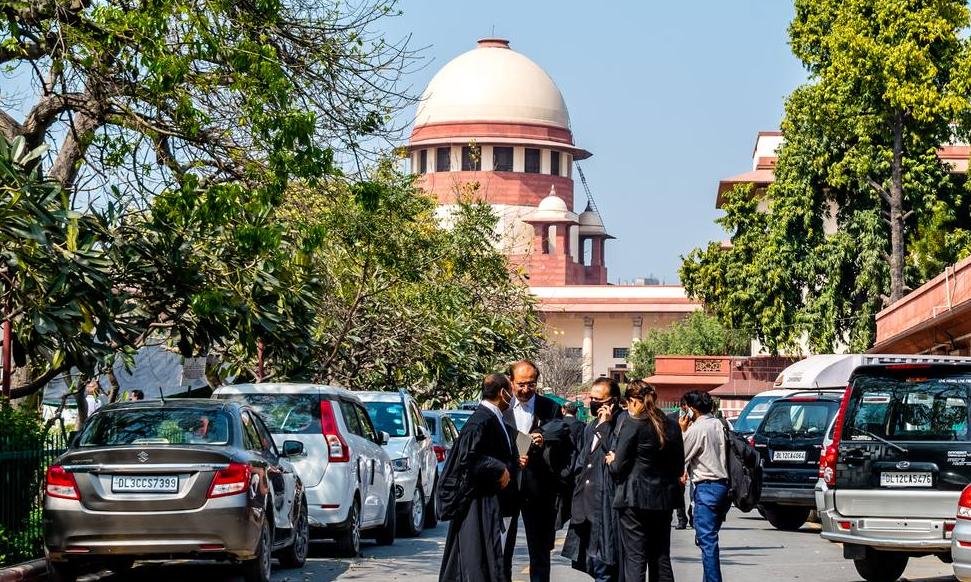

The Supreme Court on Wednesday (April 22) remarked that in case of a Chief Minister interfering with an ongoing probe by a central agency, the matter cannot be termed as a dispute between the Centre and the State government.
ED plea and courtroom context
The oral observation were made by a bench of Justice Prashant Kumar Mishra and Justice NV Anjaria during the hearing of a petition filed by the Enforcement Directorate (ED) seeking the registration of a CBI FIR against West Bengal Chief Minister Mamata Banerjee and the state police officials for alleged obstruction to the ED raid at the Kolkata office of the I-PAC, the political consultant of the ruling Trinamool Congress (TMC).
Also Read: SC asks if ED can seek relief from state in case involving CM Mamata Banerjee
The ED officials have also filed a writ petition challemging the FIR lodged by the West Bengal Police against them. The West Bengal government has questioned the maintainability of ED’s writ peyition filed under Article 32 of the Constitution.
State’s jurisdiction argument
Appearing for the State officials, senior advocate Advocate Menaka Guruswamy argued that a suit under Article 131 of the Constitution of India should be filed instead of a writ petition under Article 32 as the matter was essentially a dispute between the State and the Union.
However, Justice Kumar disagreed with her argument stating that the matter was not a Centre-State dispute.
Bench on ‘Centre-State dispute’ claim
“What right of the state does this involve? This is not a dispute between the state and the central government. You cannot walk in. Any Chief Minister of any state walks in the midst of an inquiry of an investigation and you say that it is a dispute essentially between the state and the central government?” said Justice Kumar.
Also Read: SC questions West Bengal on Mamata’s alleged interference in ED’s I-PAC raids
“Any Minister just walks in midst of an enquiry and you see make the democracy in peril and argues that it’s a dispute essentially between the state and centre?” he added as quoted by Live Law.
Allegations of interference
At this point Solicitor General of India Tushar Mehta interjected claiming that the Chief Minister also took away incriminating material.
“This is not per se a dispute between the state and the union. This is per se an act committed by an individual who happens to be the Chief Minister of a state, keeping the whole system and whole democracy in…you are saying if it all this can be maintainable this cannot be maintained under Article 32 but only under Article 132…you have taken us through Keshavanand Bharati and Seervai,” said Justice Kumar.
“But none of them would have ever conceived of this situation than that in this country a day will come when a sitting Chief Minister will walk into the office of some other agency….,” he added.
Debate over Article 32 and precedent
Guruswamy said she disagreed with the view taken by the bench and submitted that the ED could not invoke Article 32 by alleging violation of fundamental rights.
Also Read: Mamata Banerjee urges CJI to protect Constitution, democracy amid I-PAC raid row
She argued that Article 32 is meant for individuals and not for a government department, adding that the present writ petition was without precedent. According to her, the issues raised involved substantial questions of law and ought to be placed before a Constitution Bench of five judges under Article 145.
Justice Kumar responded that every petition would involve some question of law and accepting such a submission would mean referring all matters to a larger bench. Guruswamy, however, maintained that the case raised a “unique proposition of law” which had not been tested earlier. She also pointed out that a petition on the same cause was pending before the Calcutta High Court.
ED’s version of the January 8 search
According to the ED, Chief Minister Mamata Banerjee entered the search premises with party leaders and police officials, confronted officers and allegedly removed files and digital devices. The state police subsequently registered three FIRs against ED officials.
Also Read: Calcutta HC disposes TMC’s plea after ED denies any seizure during I-PAC raid
The ED has sought a direction for registration of an FIR and a probe by the CBI, alleging interference by the state executive. The State opposed the plea, referring to parallel proceedings before the High Court and contending that materials were taken without objection. It also claimed police acted on information regarding impersonators.
In its rejoinder, the ED disputed this version and alleged removal of material without consent. In January, the Court issued notice and stayed proceedings in the FIRs, observing the need to examine the matter to prevent a possible “situation of lawlessness,” and directed preservation of CCTV footage and electronic records related to the January 8 search.

Comments are closed.