
West Bengal Election Result 2026: PM Modi’s ‘Temple Politics’ in Bengal; Will the election picture change in the slog over?

- PM Modi’s ‘Temple Politics’ in Bengal
- Will the election picture change in the slog over?
- What political meanings are being drawn?
West Bengal Election Result 2026 : of West Bengal Voting for the final phase of 142 seats will be held on April 29, with campaigning ending on Monday. What are the political implications of Prime Minister Modi’s visit to Kali temple in Kolkata and Matua Thakur temple in North 24 Parganas to pray in the final phase of Bengal elections?
One of the most exciting moments in cricket is the slog over. A slog over is the last moments of an innings, when the batsman tries to score as many runs as possible, while the bowler on the other hand tries to prevent runs and take as many wickets as possible. Similarly, in a slog over of the Bengal Assembly election political game, Prime Minister Modi on Sunday entered Mamata Banerjee’s stronghold and tried to create a political environment in favor of the BJP.
This is the final round of West Bengal elections, voting for 142 seats will be held on April 29. This region is considered Mamata Banerjee’s stronghold. Thus, PM Modi has resorted to ‘temple politics’ to win the last stage political battle.
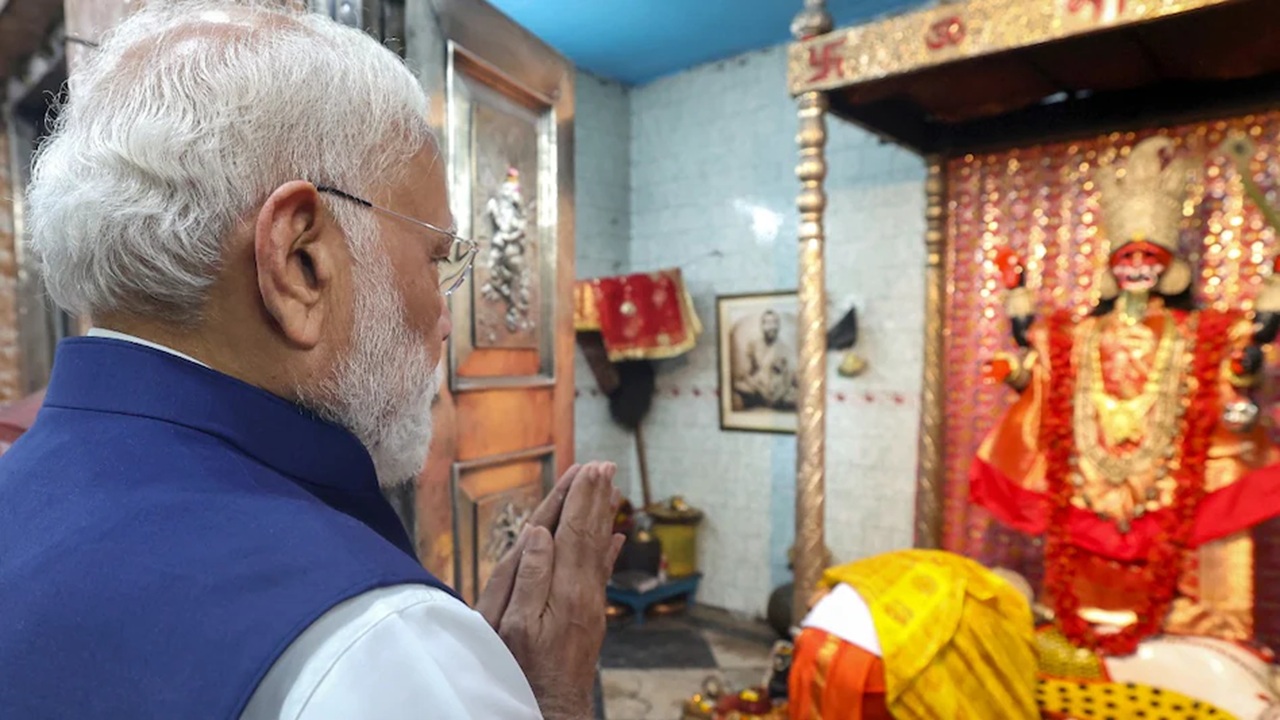
Prime Minister Modi on Sunday (April 26, 2026) visited two different temples in Bengal to offer prayers and deliver a political message. Before the roadshow in Kolkata, he visited the Thanthania Kalibari temple and then visited the North 24 Parganas area, where he offered prayers at the Matua Thakur temple and further attracted the Matua community.
Supreme Court News: Alleged omission of names from voter list; The Supreme Court refused to hear, a big blow to the petitioners
Prime Minister Modi’s visit to Kali temple
Prime Minister Narendra Modi prayed at Thanthania Kalibari in Kolkata on Sunday. He worshiped ‘Maa Siddheshwari’ here. It is one of the oldest and most revered Kali temples in Kolkata. It is believed that Ramakrishna Paramahansa used to visit here often and sing in praise of the Goddess.
Maa Siddheshwari is one of the few Kali temples where meat is offered as ‘Prasad’. This is being seen as a masterstroke played to attract voters in the wake of the Bengal elections. Prime Minister Modi’s Kalibari temple visit was aimed at disproving the Trinamool Congress narrative that the BJP would ban non-vegetarian food if it comes to power.
Prime Minister Modi himself is a vegetarian and fasts during Navratri. BJP is confident that PM’s temple visit will successfully convey the message that BJP is not against non-vegetarian food. Moreover, this temple visit is also seen as an attempt to win the hearts of the people of Bengal.
An attempt to respond to Mamata Banerjee’s narrative
Mamata Banerjee had said that BJP will ban non-vegetarian food in the state if it comes to power. Mamata had also said that the BJP would replace Bengali customs in Bengal with those of North Indian states, where eating meat on religious auspicious days is considered inauspicious. Portraying the BJP as a party of ‘outsiders’ ignorant of Bengali values, has been the main target of their political attacks. BJP has to make a concerted effort to remove this image. During the election campaign in Bengal, BJP leaders were seen eating ‘mach-rice’.
Prime Minister Modi visited Thakur Temple
Before visiting the Kali temple in Kolkata, Prime Minister Modi was in the North 24 Parganas area on Sunday, where he offered prayers at the Mutua Thakur temple. Later, addressing a public meeting, he reiterated his government’s determination to complete the process of granting Indian citizenship to the Matua community through the CAA at the earliest. He also appeared to have strengthened his ties with the Matua community. Prime Minister Modi emphasized his relationship with the Matua community. Orakandi, located in Bangladesh, is considered the center of the Matua community, which has influence over 32 seats in Bengal, most of which fall in the second phase of elections. Hence, Prime Minister Modi visited his temple in an attempt to win the trust of the Matua community.
BJP’s plan to attract Matua community
In 2019, PM Modi had posted a photo of his meeting with Matua community chief Binapani Thakur. The strong support of the Matua community to the BJP and the party’s impressive performance in the state in the 2019 Lok Sabha elections were decisive for the BJP to emerge as TMC’s main challenger in the 2021 assembly elections, but the situation has since cooled down a bit. Bengal Chief Minister Mamata Banerjee has intensified her efforts to attract the Matua community. They are trying to show that the CAA is not as straightforward as it initially seemed when it comes to granting citizenship to non-Muslim refugees.
The TMC has long alleged that the CAA would harm the Matua community by encroaching on the documents linking them to their original ties with Bangladesh, when on the other hand, in reality most of them already enjoy many rights in India. TMC has created its own leadership in this community to shake the BJP’s support. In this election, the top leadership of the BJP has placed special emphasis on reaching out to the Matua community, culminating in Modi’s temple visits and public meetings in the community’s stronghold.
BJP will enter Mamata Banerjee’s stronghold
Out of 142 seats in the second phase of the Bengal elections on April 29, the BJP won only 18 seats in the 2021 elections, while the TMC won a hat-trick of power by winning 123 seats. Not only in Kolkata, but also in North and South 24 Parganas region, BJP could not win a single seat. This shows that Mamata Banerjee has a strong hold in this region. In 2021, the BJP dominated the TMC in North Bengal and the Jangal Mahal region, but its performance in South Bengal was dismal. This time, the BJP has focused its full attention on this region, where it has been troubling the TMC for the last five years on various issues, be it the Sandesh sub incident in 24 parganas or discrimination against the Matua community.
The final round will decide the power of Bengal
The final round of the Bengal elections will be a real test for the BJP, which has been trying to make it its political laboratory for the past five years. West and East Bardhaman are industrial and coal belts, while the 24 Parganas region has a Muslim majority. Places like Karimpur, Tehatta, Chhapra and Krishnaganj in Nadia district are directly on the Bangladesh border. Similarly, places like Bongo, Bagda, Swaroopnagar and Basirhat in North 24 Parganas district are bordering Bangladesh, while Sundarban region like Hingalganj and Sandeshkhali in South 24 Parganas district are bordering Bangladesh.
The areas bordering Bangladesh have a large Muslim electorate, which led to Mamata Banerjee’s victory. BJP has also strongly raised the issue of illegal migration from Bangladesh. The Matua constituency is important in the border areas of Bongo and Nadia, where the CAA is a major component. While the BJP claims to grant citizenship to Hindus coming from Bangladesh, it is busy projecting the image of expelling illegal Muslims.
Amit Shah: “Come in 10 minutes…! Amit Shah replied to the woman’s social media comment
Mamata Banerjee has been caught in a political quandary by BJP making the issue of infiltration and appeasement a priority in these areas. Thus, the BJP is trying to establish its political roots in the region bordering Bangladesh through religious polarization, while Mamata Banerjee, on the other hand, is only focusing on retaining seats in the region. It remains to be seen whether this region, developed by the BJP as its political laboratory for five years, will be politically beneficial in the elections.

Comments are closed.