
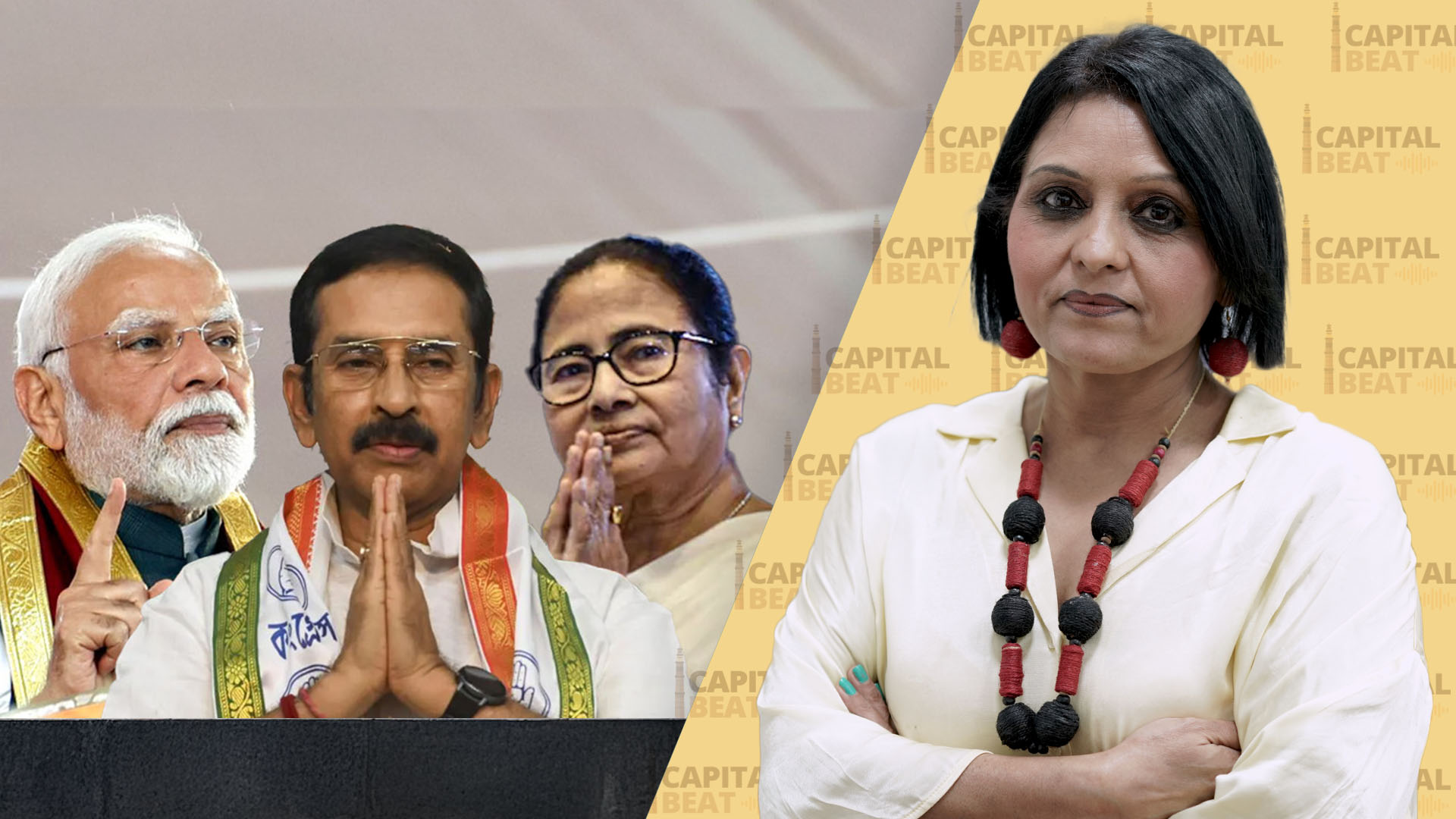

Members from three prominent political parties and a senior journalist came together in the latest episode of Capital Beat to discuss the campaigning for the second phase of the West Bengal Assembly elections that concluded on Monday (April 27). One hundred and forty-two seats in southern Bengal will go to the elections in the phase to be held on Wednesday (April 28).
Also read: How ‘Khela Hobe’ became one of India’s most defining political battle cries
The guests, Shubhankar Bhattacharya, spokesperson of the Trinamool Congress (TMC); Charles Nandi, BJP spokesperson from West Bengal; Chandan Ghosh, the state’s Congress spokesperson; and journalist Shikha Mukerjee, focused on controversies during the campaign, political messaging, and electoral dynamics across South Bengal.
From vulgar poster on Mamata to PM’s confident pitch
The final day of campaigning witnessed a major controversy involving an “obscene vulgar poster” of West Bengal Chief Minister Mamata Banerjee circulating on social media. A complaint was filed seeking details of the user who shared it. The incident triggered sharp reactions across political lines, with accusations and counteraccusations dominating the debate.
Prime Minister Narendra Modi’s campaign remarks also featured prominently. A statement attributed to him was quoted as, “From the mood of Bengal, I sensed I will would come again during the oath-taking ceremony of the BJP government.”
The remark was presented alongside claims that political momentum had shifted in favour of the BJP in Bengal.
Row over poster
The panel highlighted how campaign rhetoric intensified on the final day, with strong reactions to the poster controversy. Bhattacharya described the incident as part of a pattern, saying, “This is not politics. This is a deliberate culture of disrespect and intimidation. Bengal sees through this. It does not accept this.”
Nandi rejected the allegation of BJP involvement, uttering, “I have absolutely no idea whether it is done by BJP because BJP does not believe in this culture.” He added that such actions were not supported by his party.
Also read: After Vande Mataram, it’s Bankim: Electoral politics heats up in Bengal’s Naihati
The exchange also extended to broader political narratives. Nandi described the BJP’s electoral approach in Bengal as a larger ideological effort, stating, “We are fighting a battle for the civilization. To save India, we have to win Bengal.”
The statement drew immediate reactions from other panellists.
High electoral stakes
As nearly 50 per cent of the state’s 294 Assembly constituencies are yet to vote, Mukerjee outlined the regional dynamics, noting the influence of specific communities and past voting trends. She stated: “South Bengal has been the Trinamool stronghold… It is not the BJP stronghold except for that little Matua belt.”
Mukerjee pointed out that electoral outcomes in these constituencies would play a decisive role in determining overall results. She emphasised that both the BJP and the TMC had claimed strong performance in the first phase (held on April 23), making South Bengal crucial.
She also noted the importance of Kolkata in this phase, stating that the BJP needed to establish broader acceptance in urban constituencies: “Calcutta (Kolkata) is still one territory that the BJP needs to capture in order to demonstrate its presence.”
‘Mamata is set to become ex-CM’
The debate featured competing claims of electoral advantage. Nandi asserted that voter sentiment was strongly in favour of the BJP, stating, “Bengal already decided to ensure Mamata Banerjee to become ex-chief minister… her days are numbered.”
In response, the TMC spokesperson questioned the narrative, saying, “I actually didn’t hear any logic. It’s only the narrative, the same narrative, that the BJP is running.” He also alleged that the election environment lacked fairness.
Ghosh addressed the broader political climate, focusing on campaign standards and democratic values. He stated, “How far these parties can really go down in the culture… it is anti-culture, it is anti-democracy.”
Also read: Record turnout in TN, Bengal: What’s behind the surge? | Talking Sense With Srini
He also clarified Congress’s position, saying, “The Congress is not forming the government as it claims… vote for those who are capable.”
The Congress, which has contested in alliance with the TMC in the past, has decided to go alone this time, after a gap of two decades.
Debate over issues dominating campaign
The discussion also covered the themes dominating the election campaign. Bhattacharya criticised what he described as a lack of policy-based campaigning, saying, “You are not bringing in any vision for a change… the discussion should be about development, education.”
He further added, “You cannot demean a woman and say that we are protecting women’s rights.”
Nandi responded by rejecting allegations of religious or caste-based politics, remarking, “The BJP does not believe in religion-based politics… our politics means development.” He also referenced opposition criticism, noting: “Mamata Banerjee only indulged in Hindu-Muslim politics.”
The discussion also touched upon issues such as voter eligibility, demographic concerns, and security arrangements during polling, with differing views on their implementation and impact.
Security, turnout and final campaign push
Security arrangements and voter turnout expectations were highlighted as key factors for the second phase. emphasising the role of election authorities, Nandi said, “This time election would be fear-free, violence-free, intimidation-free.”
He also predicted high participation: “We are going to see huge turnout… more than 93 per cent.” The first phase saw a similarly high turnout.
Concerns were raised regarding the use of central resources during campaigning. Allegations of misuse were countered by claims that measures were necessary to ensure free and fair elections.
Also read: BJP and TMC spar over Mamata’s ‘Chalo Dilli’ remark | Capital Beat
Mukerjee highlighted the complexity of voter sentiment, pointing out that anti-incumbency could affect both state and central governments. She stated: “Anti-incumbency works two ways… it works against Mamata Banerjee as it works against the BJP.”
She also described the phase as highly competitive, “This is the toughest phase for the BJP as it is the most crucial phase for Mamata Banerjee.”
Final remarks
As the campaign period drew to a close, the discussion concluded with a focus on the significance of the upcoming polling day. Mukerjee summarised the electoral contest, stating, “The clash of the titans is going to be the heart of Bengal versus the idea of the BJP.”
Results of Bengal elections will be announced on May 4, along with those held in Assam, Kerala, Tamil Nadu and Puducherry.
The content above has been transcribed from video using a fine-tuned AI model. To ensure accuracy, quality, and editorial integrity, we employ a Human-In-The-Loop (HITL) process. While AI assists in creating the initial draft, our experienced editorial team carefully reviews, edits, and refines the content before publication. At The Federal, we combine the efficiency of AI with the expertise of human editors to deliver reliable and insightful journalism.

Comments are closed.