
Harvard couple wins $3M ‘Oscar of Science’ for first gene therapy to reverse childhood blindness

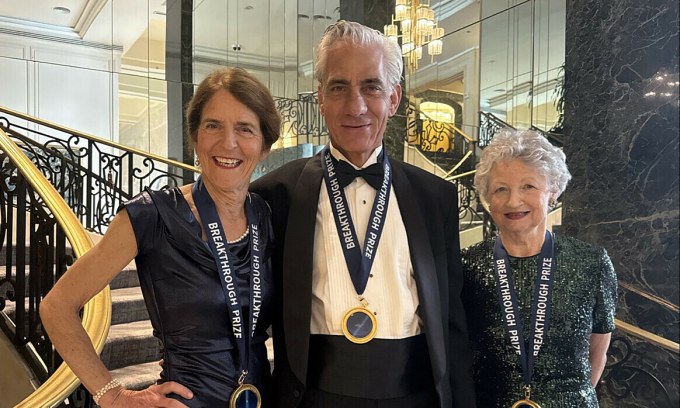
Molecular biologist Jean Bennett, 71, and her husband, ophthalmic surgeon Albert Maguire, 66, both emeritus professors at the University of Pennsylvania, share the US$3 million prize with physician-scientist Katherine High, 74, CEO of RhyGaze, a gene therapy company based in Switzerland and Philadelphia, the Breakthrough Prize Foundation announced.
The prize, dubbed the “Oscars of Science,” is one of the most lucrative cash awards in the field, The Guardian reported.
Approved by the U.S. Food and Drug Administration in 2017, the therapy, Luxturna, is a single-dose treatment for Leber congenital amaurosis, a rare inherited retinal disease that typically causes total blindness by early adulthood.
According to the Breakthrough Prize Foundation, children who would otherwise have lost their sight have been able to attend mainstream schools, play outside at night, and in some cases qualify for driver’s licenses. Patients in clinical trials described seeing their children’s faces, the wood grain of furniture, and tree branches swaying in the wind for the first time.
The therapy works by replacing a faulty version of the RPE65 gene, which normally produces a protein essential for the retina to process light. Without that protein, photoreceptor cells gradually die. The team engineered a hollowed-out virus to ferry a healthy copy of the gene into retinal cells, delivered through a needle as fine as three human hairs.
(From L) Jean Bennett, Al Maguire, and Katherine High at the Breakthrough Prize ceremony. Photo courtesy of Penn Medicine |
The award was presented April 18 at a ceremony in Los Angeles, capping 25 years of work that began with a single question between Bennett and Maguire, who were then paired up to dissect a brain in a lab at Harvard Medical School.
Bennett, who held a Ph.D. in zoology and cell and developmental biology, was already drawn to the then-radical idea of treating disease at its genetic source, a concept no one had yet tested in humans, The Philadelphia Inquirer reported. Maguire had become fascinated with the retina, which he likened to film in a camera, and wondered whether a healthy copy of a defective gene could be inserted into damaged tissue to fix the underlying problem.
“You think we could do it?” Maguire asked Bennett, the Inquirer reported. She said yes.
That was the early 1990s, when only a handful of retinal-disease genes had been identified. The couple spent roughly a decade building the basic science, including how to deliver a gene into a living cell and how to measure whether it was working. They eventually focused on RPE65 mutations, which cause about 5% to 10% of Leber congenital amaurosis cases.
The breakthrough came with dogs. In the late 1990s, collaborators acquired four Swedish Briard puppies carrying the same mutation found in human patients. In July 2000, the team injected the therapy into one eye of three of the dogs, leaving a fourth untreated as a control. Within a week, the collaborators called: the treated dogs were running without bumping into things and even stealing kibble from blind littermates that couldn’t find their food bowls. Bennett described it as a eureka moment, the Inquirer reported.
The path to humans went through crisis. In 1999, just as High’s hemophilia gene therapy work was beginning to show promise, Jesse Gelsinger died in a separate gene therapy trial at Penn, the first known fatality in such a trial. Investors fled the field, and the contract manufacturer producing High’s viral vectors was on the brink of collapse. To save the work, High persuaded Steven Altschuler, then CEO of Children’s Hospital of Philadelphia, to fund vector production in-house, on one condition: she had to expand into other pediatric diseases. She immediately thought of Bennett, a longtime colleague whose children attended the same school as hers, and asked her to bring the dog results into humans.
The first human trials began in 2007, with three adult patients. Promising safety data persuaded regulators to allow children to participate, the first time children without a life-threatening illness were enrolled in a gene therapy trial. By 2012, the team had launched a pivotal phase 3 trial using a custom obstacle course to measure functional vision. Treated patients moved faster, in dimmer light, and held those gains over a year.
The FDA approved the therapy as Luxturna in 2017. Today, most of the roughly 1,000 eligible patients in the U.S. have been treated, and the therapy has expanded into overseas markets.
Despite its scientific success, Luxturna has struggled commercially. Listed at $425,000 per eye, it generated about $50 million in 2025 sales for Roche, the Swiss pharmaceutical company that took ownership after acquiring Spark Therapeutics, a Children’s Hospital of Philadelphia spinout, in 2019, the Inquirer reported. About 15 gene therapies now have FDA approval to treat genetic disease, and dozens of retinal gene therapy trials are underway worldwide.
Now in its 14th year, the Breakthrough Prize was co-founded by Google’s Sergey Brin, Meta CEO Mark Zuckerberg, Priscilla Chan, Julia and Yuri Milner, and 23andMe co-founder Anne Wojcicki.
Six $3 million prizes were awarded across life sciences, mathematics and fundamental physics in 2026, with additional honors for early-career physicists and mathematicians.
Comments are closed.