
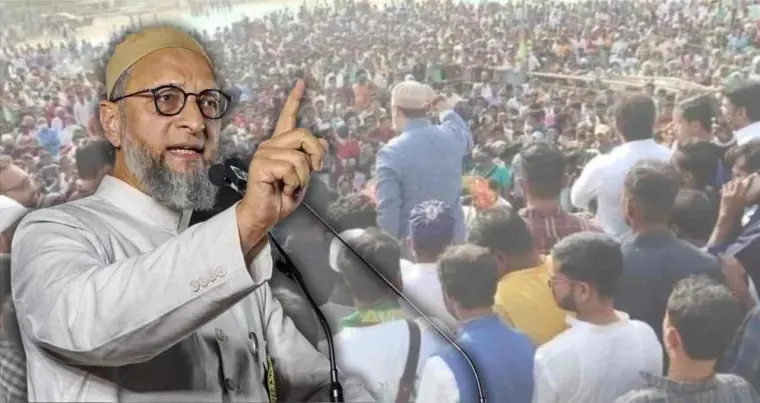

Political and social debate has intensified after the recent decision to create five new districts in Ladakh. While the government is calling the administrative expansion in the Union Territory a step towards development and good governance, some leaders have raised objections about it.
Asaduddin Owaisi: While on one hand there is an atmosphere of happiness among the people regarding the formation of 5 new districts in Ladakh, on the other hand a political controversy has also arisen over this decision. Asaduddin Owaisi has raised questions on this decision and said that it is being seen from a communal perspective and it can affect the unity of the region. He alleged that the purpose of creating new districts was to weaken the social unity of Ladakh.
On social media platform X, he claimed that the less populous Buddhist community was being given more districts, while the more populous Muslim community was getting relatively less representation. Owaisi has also called it an issue related to electoral rights and representation.
5 new districts formed in Ladakh, expansion of administrative structure
Five new districts have been created in Ladakh under administrative reorganization—Nubra, Sham, Changthang, Zanskar and Dras. After this decision, the total number of districts in the Union Territory has now increased from two to seven. This decision was taken by Lieutenant Governor V.K. Saxena, which was already approved by the Home Ministry in August 2024. The government says that this step has been taken to fulfill the long-standing demand of the local people and to ensure better administrative facilities.
Owaisi’s allegation: “Attempt to break unity”
AIMIM chief Asaduddin Owaisi criticized the decision, saying it was an attempt to affect the unity of the Buddhist and Muslim communities of Ladakh. He wrote on social media platform
According to Owaisi, based on 2011 census data, 39.65% of the Buddhist population has been given more districts, while 46.40% of the Muslim population has been given less districts. He termed it as “unbalanced administrative reorganisation”.
Debate over demographic data
The population structure of Ladakh has been a sensitive topic for a long time. According to the 2011 census, Kargil had a majority Muslim population, while the Leh region had a majority Buddhist community. After the formation of new districts, there has now been a re-division of administrative units, in which districts like Leh, Changthang, Nubra, Sham and Zanskar are considered to have Buddhist majority, while Kargil and Dras continue to have Muslim majority.
The office of the Lieutenant Governor of Ladakh says that this step has been taken with the aim of improving regional development, administrative access and service delivery. The government believes that local administration will be more effective from smaller districts and government schemes will be easier to reach remote areas. The administration has described it as part of the “Developed and Prosperous Ladakh” vision.

Comments are closed.