
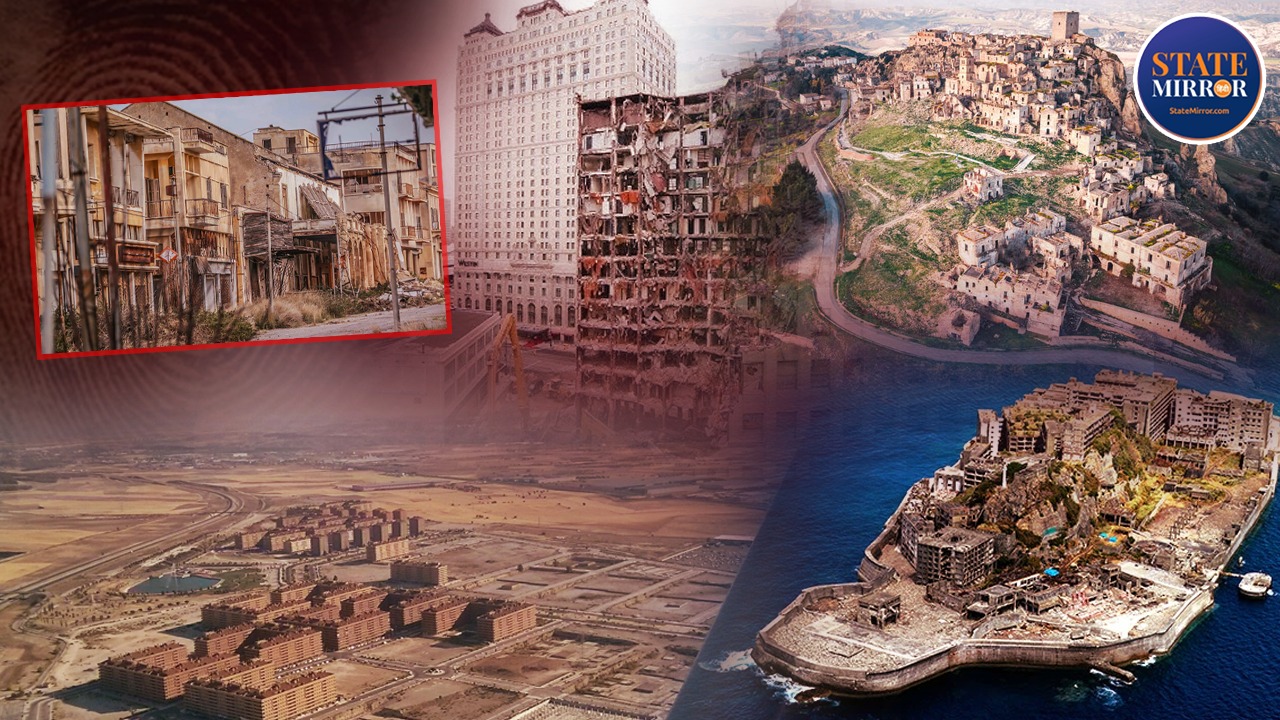

There are cities in the world where there are wide roads, skyscrapers, twinkling lights at night – but there are no people. In the language of common people, these cities are now called ‘ghost cities’. This is not just a story of empty cities, but a serious warning about economic planning, population crisis and changing migration patterns. From China-Japan to Europe and America, this problem has emerged for different reasons, but the signal is the same – how sustainable is future urban development? Will these ghost cities remain scary or will there be a solution to it?
What is Ghost City?
In fact, ‘Ghost City‘There are urban areas where complete infrastructure is present. Like houses, malls, roads and offices and others. But the population is very less or almost non-existent. That is, the city appears to be completely inhabited, but in reality it is empty.
Which countries have the biggest problem?
- In this matter, the most discussed thing is the ghost cities of China, where new cities were built on a large scale, but people did not come to settle there.
- The problem of “Akiya” i.e. empty houses is increasing rapidly in Japan, where villages and small towns are becoming vacant.
- In Spain, after the 2008 economic crisis, many housing projects remained incomplete or empty, while in Italy, cities are becoming empty due to migration from the villages and the government has even introduced a plan to sell houses for €1.
- Such areas have also emerged in countries like America and Cyprus due to different reasons.
What are the reasons for formation of ghost cities?
There are many big reasons behind this problem. The biggest reason is over-construction – especially in China, where more cities were built than the demand. The second major reason is the decline in population, as is being seen in Japan and Europe, where the birth rate is low and the elderly population is high. The third reason is migration pattern. People are leaving small towns and moving towards big metro cities. Apart from this, economic crisis has also been a major reason, like what happened in Spain after 2008.
How serious is the situation in China and Japan?
Many ‘planned cities’ in China such as Ordos Kangbashi and Tianducheng remained vacant for a long time. However, the government is now trying to settle them through industry and policies. At the same time, the situation is different in Japan. There are more than 80 lakh vacant houses (Akiya) here. The government is trying to settle the people by providing free or cheap houses, but the decreasing population remains a big challenge.
Major Ghost Cities of the World
There are many famous ghost cities in the world. Among these, Ordos Kangbashi (China) is the most famous ghost city in the world. Hashima Island (Japan) – once an industrial hub, now empty and deserted. Seseña (Spain) – vacant after the housing boom. Craco (Italy) – now tourist spot. Detroit (America) – Population decreased after the decline of industry. Varosha (Cyprus) – abandoned after the 1974 conflict.
Are these cities a threat to the future?
Ghost cities are not just empty buildings, but it shows that if planning is not proper then resources, money and land can all go waste. This problem may increase further in the future, especially in those countries where either rapid construction is taking place or population is decreasing. This is the real question. Are we building cities of the future or empty structures?
What is the solution to Ghost Cities?
An example of a complete “ghost city” is rare in India, but there are some places which have become examples of partially empty or incomplete urban planning.
Are there ghost cities in India too?
- Most cities in India are not completely empty, but there are some projects and areas where infrastructure was built, but the population did not come as expected. Such as:
- Lavasa (Maharashtra): It was called India’s first planned ‘Hill City’, but due to legal and economic problems it could not be fully settled.
- Dholera Smart City: Planning was done on a large scale, but the population is still very less. It is called “Future City”.
- Amaravati: Due to the stoppage of the Rajdhani project, many areas remained vacant or incomplete.
There are no “ghost cities” in India, but incomplete planning, low population and slow settlement seem to be taking some places in that direction. This shows that just building a city is not enough, settling it is a bigger challenge.

Comments are closed.