
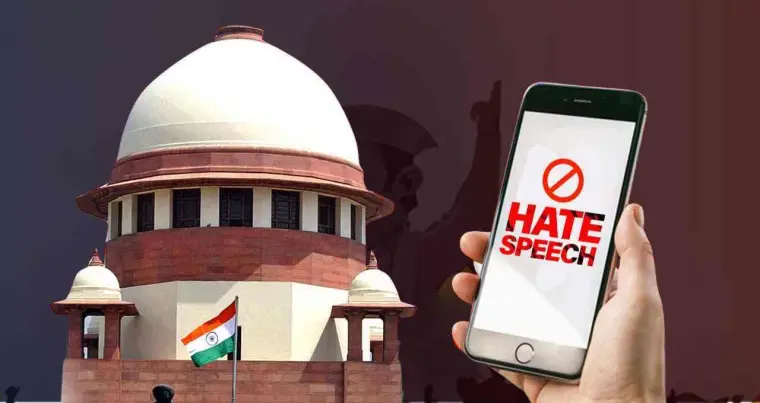

In an important comment, the Supreme Court of India on Wednesday said that the existing laws are sufficient to deal with crimes like hate speech and there is no legal gap in it which would require separate intervention of the court.
New Delhi: The Supreme Court of India, while making an important comment on the matters related to Hate Speech, has clarified that there are already adequate legal provisions in the country to deal with such crimes. The court said that there is no legal deficiency of any kind in this, hence there is no need to issue new guidelines or additional instructions.
This decision was given by the bench of Justice Vikram Nath and Justice Sandeep Mehta on the petitions in which the Supreme Court was demanded to issue detailed guidelines to stop the increasing cases of hate speech.
“It is not the job of the court to create new crimes” – Supreme Court
While delivering the verdict, the court made it clear that deciding the punishment for any crime and defining its scope is the jurisdiction of the legislature and not the judiciary. Justice Vikram Nath said that there is a clear division of powers in the Indian Constitution. The function of the judiciary is to interpret the law and ensure its compliance, not to create new crimes or expand the scope of existing laws. The court also said that interfering in criminal law through judicial directions would be against the constitutional balance.
The Supreme Court also said in its decision that adequate criminal laws already exist in the country to deal with hate speech. The court clarified that the problem is not the lack of law, but its effective implementation. The bench commented that the real concern of the petitioners is not about the absence of law, but about the non-proper implementation of the existing laws.
Full context of hearing on petitions
This decision has come on a group of petitions in which concern was expressed over the increasing incidents of hate speech in the country. The petitioners had requested the Supreme Court to issue strict guidelines on this issue, so that inflammatory speeches spreading on social media and public forums can be banned.
However, the Supreme Court did not accept this demand and clearly said that the existing legal framework is sufficient. The court also mentioned the principle of separation of powers of the Constitution in its decision. The bench said that the roles of the judiciary, legislature and executive are different and they cannot be encroached upon at any level. The Supreme Court reiterated that it is the job of Parliament to make laws, while the function of the courts is only to interpret and enforce those laws.
Comments are closed.