
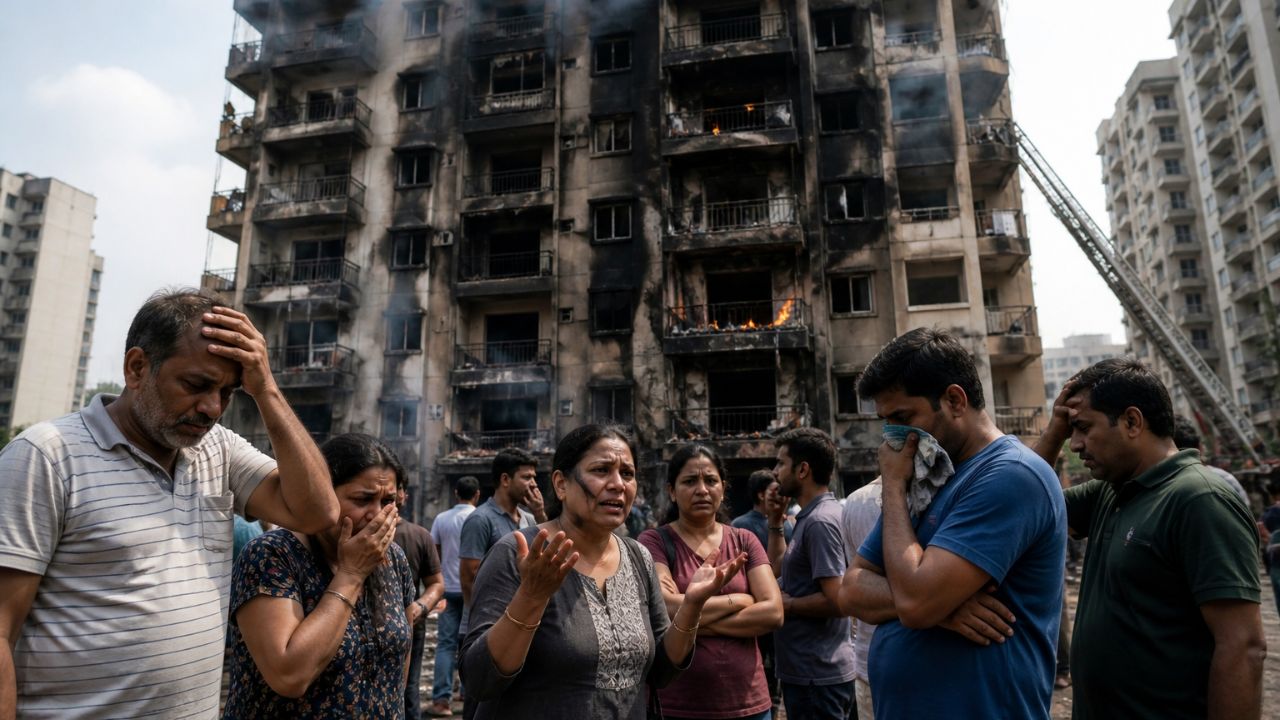

On April 29, a massive fire broke out in the residential flat of Gaur Green Avenue Society in Indirapuram area of Ghaziabad, Uttar Pradesh. Within just an hour this fire caused huge damage to 8 to 12 flats. Goods and household items worth crores were burnt to ashes. The building also suffered considerable damage. This is just an incident in one society but every day we see in the news that a massive fire broke out in a building of a high-rise society. Flames are seen on the TV screen, fire engines are seen and then a flat with everything burnt to ashes. The news ends there but the real struggle begins from there for those families.
A house worth crores, interiors decorated with a lifetime’s earnings, everything turns to ashes in a matter of hours. After this a big question arises that what now? Will the builder provide a new house? Will the society make repairs or is your entire savings lost forever in that fire? Today we will also understand those technical and legal nuances, which are very important to be known by a resident who has invested his entire life’s earnings and has built a house in a township.
understand the rules
To understand who will compensate for the damage caused by fire, especially in high-rise buildings, first you have to know a few things about these residential buildings. The entire process of any residential building, from construction to handing over the keys to the residents, is quite lengthy and technical. In this the builder has to fulfill many legal and security measures. The most important thing in this is – Fire and Water Approvals, what does it contain? Once the building structure is erected, the builder has to obtain certain ‘clearances’ from the local authorities. One of these is- Fire NOC (No Objection Certificate): This is the most important approval.
Also read: Health insurance is important for everyone, understand every detail?
The fire department comes and checks whether the hydrants, sprinklers, fire alarms and smoke detectors in the building are working properly. Without this the building is not considered habitable. When everything is ready as per the standards, then the authority issues OC i.e. Occupancy Certificate. This means that the building is now legally safe to inhabit. Building insurance comes with these certificates. After RERA Act 2017, now insurance of every building is mandatory. Now insurance is necessary but to get insurance, the building has to fulfill certain conditions.
For example, according to law in UP, if any building is more than 15 meters in height, it is mandatory to obtain fire NOC, but who will take this NOC and insurance? Rules for this have also been made in the sections of RERA. Under Section 16 of the Act, it is mandatory for the builder to insure the title of the land and the entire construction and the builder has to pay all the premiums and charges for this insurance before giving possession. However, at the time of possession or formation of an association (RWA), the builder transfers all these insurance documents and benefits to the residents’ association. RWA- Residents Welfare Association is an organization of residents. When the construction of a housing project is completed and people start living there, then by law (under RERA) the builder has to form an association of residents, which is called RWA. What will be the rules in the society, what will be the security, and which vendor will work, all this is now decided by the RWA, not the builder. After formation of RWA, the builder has to hand over all the common areas of the society (park, club house, lift), funds and original documents (like fire NOC, insurance) to the RWA.
Who will be responsible?
Here it is also important to understand that who will be responsible for any untoward incident or maintenance in the building, the builder or the RWA? Also, who has the right to take the maintenance money, the RWA or the builder? The answer to this question depends on which ‘stage’ the society is at. For example: In the beginning, when the building is new and RWA has not been formed, then the builder takes the maintenance money. Usually, at the time of possession, the builder also deposits advance maintenance charges of 1 or 2 years. During this period, the builder is responsible for cleanliness, electricity and water. Once the RWA is formed and the builder completes the ‘handover’ process, it is the members (residents) who collect the maintenance money. The builder has to transfer the remaining maintenance fund (if any) and IFMS (Interest-Free Maintenance Security) money to the bank account of the RWA. After this, every month’s maintenance charge is decided by the RWA and the same is deposited in the society’s bank account.
Also read: Aadhaar app is not necessary in smartphones, government withdrew the proposal
This is where the misunderstanding begins, which residents come to know about when an accident happens to them. Actually, most of the residents are under the misconception that the huge maintenance charges they pay also includes the insurance of their house but the truth is a bit bitter. Generally, the insurance that your Residential Welfare Association (RWA) or housing society takes is only for the structure and common areas of the building.
What is covered: Stairs, lifts, corridors, club houses, basements, shared wiring and external structure of the building (pillars and walls).
What is not covered: Expensive fittings, furniture, electronics, jewellery, clothes and your customized interiors inside your home.
In simple words, RWA insurance is to protect the ‘skeleton’ in which you live but it is your responsibility to protect the ‘world’ you have built within that structure, but who will compensate for it?
What do experts say?
To understand the intricacies of these rules and regulations, we spoke to Neha Gupta, Principal Associate Advocate of Athena Legal. He told that who will compensate for the loss in case of fire depends on these three things:
Liability of builder/developer: If a fire occurs within a specific period of time after getting possession and it is caused by faulty construction or poor electrical work, the builder will be responsible to compensate for the loss.
Responsibility of RWA/Management: It is the responsibility of the RWA to ensure that the wires and cables are in good condition to prevent causes of fire (like short circuit) in the society. If the investigation finds that fire safety norms have been violated, the building management or RWA will be held responsible. They will have to compensate the resident for the loss of property and belongings as well as the mental agony and harassment caused to him. However, for this it is necessary to prove that the accident happened due to negligence of the society management, lack of fire safety equipment or lack of proper insurance of the complex.
Also read: How to book LPG cylinder sitting at home without going to agency? Know the easy way
Insurance coverage: Generally, society insurance only covers structural repairs of common areas. Insurance companies pass the claim only if the cause of the loss is covered under the terms of the policy taken. At the same time, the resident should have his own individual home insurance policy to cover the loss of personal belongings inside the house. Additionally, if the investigation reveals that safety systems were neglected or defective during the fire, insurance companies may deny claims. Also, if a fire starts in one flat and spreads to other flats, the issue of ‘who started the fire’ often arises. In such a situation, if the mistake of one flat owner causes loss to another, then the insurance companies may face legal complications of liability.
Karnataka case will open your eyes
To understand this dilemma of accountability and responsibility of compensation between builder, society and insurance company, look at a case of Karnataka RERA. On November 29, 2025, K-RERA delivered a historic judgment that has become a precedent for such cases to come. What happened? There is an area of Bengaluru – Kanakapura. The construction of a housing project here will be completed only in 2018. After which the builder handed over the maintenance work to the Apartment Owners Association (RWA) on November 2, 2019. There was also a club house in this society. In which there was a sauna bath facility in the ladies washroom. A fire broke out in the same sauna room on January 30, 2024. The fire also caused a lot of damage. Initial investigation revealed that the fire occurred due to overheating of the sauna heater.
Residents raised their voice regarding this. Fought the case himself without any lawyer. He complained under Section 31 of the RERA Act that the builder should get the club house repaired and hand over a copy of the compulsory insurance under Section 16, but the builder flatly refused to pay compensation. The builder said that the maintenance was handed over in 2019 itself, so now he has no responsibility. To strengthen his point, the builder presented a copy of the investigation conducted after the fire. The report claimed that the fire was not due to any construction defect but due to overheating of the heater. Many arguments were presented from both sides. K-RERA heard all the parties and after analysis gave its verdict on November 29, 2025.
The authority said 3 big things in the order:
Relief to builder on maintenance: K-RERA admitted that there was no structural or electrical defect that caused the fire. The maintenance had already been transferred, so the builder is not responsible for the day-to-day maintenance.
Section 16 (Compulsory Insurance) was about: Here the case changed completely. RERA said that Section 16 of the RERA Act imposes a statutory obligation on the builder to get the entire project insured, pay the premium and transfer it to the RWA. This responsibility is completely separate from who is handling the maintenance.
The Final Judgment: The builder could not prove that he had taken insurance or given its papers to the society. Therefore, the court ordered the builder to give a copy of the insurance policy, premium receipt and transfer proof to the association within 30 days. It was also said that if the builder is unable to provide these papers, then the builder himself will have to bear the entire cost of repairing the club house.
Also read: How to charge EV so that it does not catch fire? Note the tips
From this case it became clear that the builder cannot shirk his responsibilities just by giving possession or maintenance. If the project insurance is not done as per the rules or it is not transferred, then the builder will have to compensate for the loss due to any future accident. We also tried to know from Advocate Neha what options the residents have for recovery of loss caused by fire. Do they have any legal recourse? According to Neha – If you suffer loss due to negligence, then you can take these three steps:
Filing an FIR: A resident can file an FIR against a negligent builder, RWA or management company. This can be under sections like damage to property, negligence in building repairs, endangering the life of others and mischief causing harm.
Civil Suit for Compensation: You can file a case for damages and compensation in the civil court. This is against those people whose responsibility was to ensure the safety, security and upkeep of the society but due to their negligence you suffered loss.
Consumer Complaint: You can file complaints in different consumer forums because you provide maintenance and hence you are a consumer. If the management has neglected to provide security and maintenance, then you can claim compensation for the loss of your property and belongings.
The cause of fire is very important
However, here also one thing plays a decisive role – Cause of Fire. Consider the reason for the fire. According to Advocate Neha – If a fire occurs due to one resident’s own fault, for example, he is getting some work done by bypassing the safety measures or he deliberately sets fire to the house and the fire spreads from his flat to another flat or floor, then in such a situation the builder, RWA and other residents can claim the loss against that resident also. The overall thing is that how the fire started is the biggest and decisive question, the answer to which decides who will be responsible for the compensation for the loss.
This is about high rise buildings that are well established and under the maintenance of RWAs, but there is also a strong culture of independent builder flats in metro cities. These are such small buildings, which the builder builds and sells. After the flats are sold, he has no connection with that house or flat. In such a situation, if anything untoward happens in these flats, there is no responsibility of any third party here. Here the owner himself has to bear the entire loss.
Well, the reason behind the fire that broke out in Gaur Green Avenue Society of Ghaziabad is still a matter of investigation. So far, speculations are being made that the cause of the fire is short circuit or renovation work going on in the flat. The investigation is still going on. Only after the administration’s report will it be decided whether the residents will get compensation or not, and if so, who will give it, builder, RWA or insurance company.

Comments are closed.