
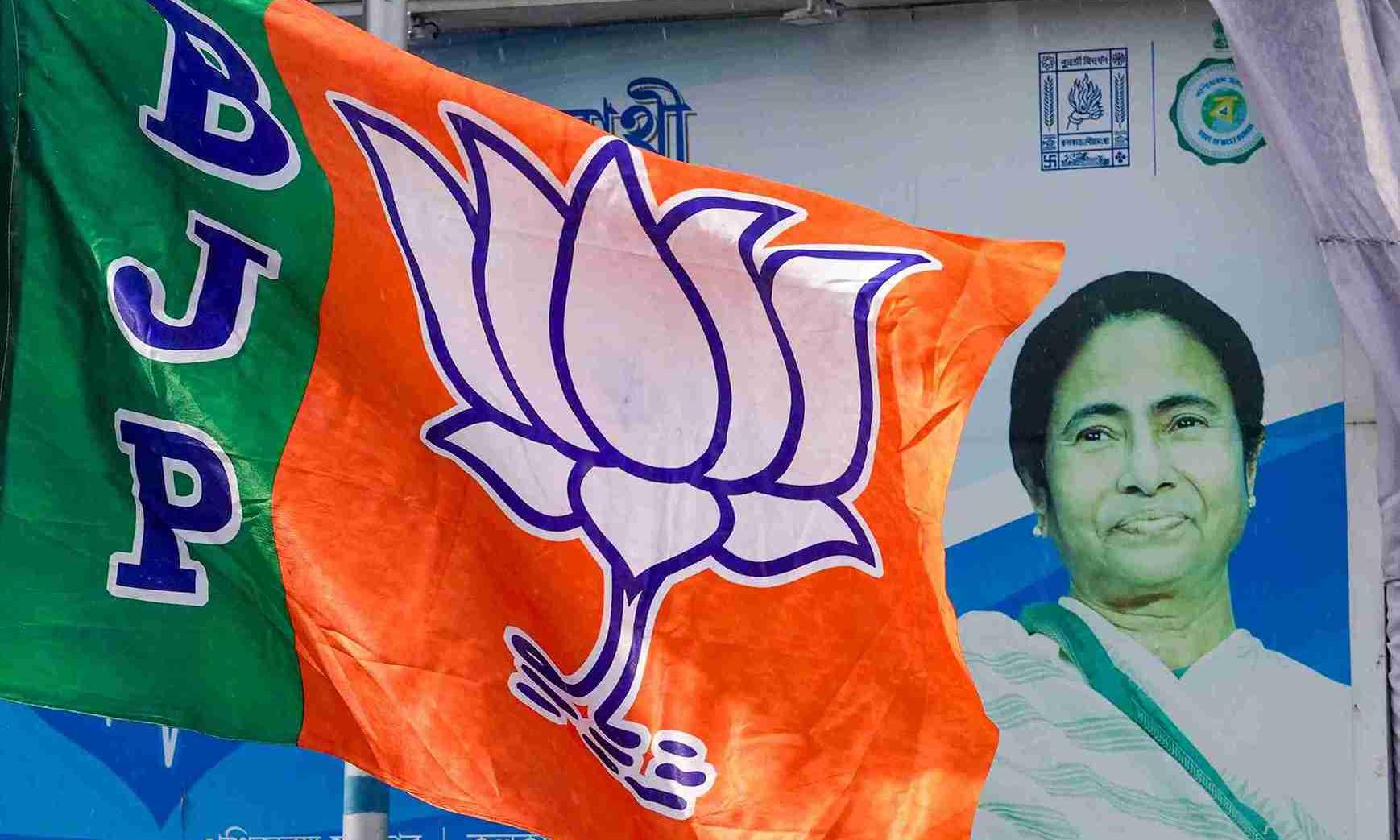

The writing was on the wall. The BJP’s slow and steady progress in West Bengal had become evident in the last two elections, the 2021 assembly and the 2024 Lok Sabha polls. While the party notched up a vote share of 38 per cent in 2021, the figure went up to more than 39 per cent in 2024.
What it failed to do then, it has done this time: Converting those into seats. While it bagged 77 seats in 2021, its leads in the assembly segments sharply went up to 98 in 2024. And as this article is being written, its seat tally in West Bengal stands at a whopping 199, nearly reversing the results vis-à-vis the Trinamool Congress in 2021, with a vote share of more than 45 per cent.
The exit polls made their predictions, which TMC supremo Mamata Banerjee and many an observer dismissed as the BJP’s ploy to demoralise its cadres and reassure the stock market. What they evidently did not have was their ear to the ground.
The illusion of a ‘secular’ state
Even when the TMC swept Bengal in 2011, Mamata Banerjee came to power riding an overwhelming number of women’s and minority votes. A large number of Hindu men, especially in urban areas, remained averse to her. Most of these men were former Left supporters. Surprisingly, turning their ideology on its head, they shifted to backing the right-wing BJP overnight.
Also read: Bengal’s Didi shield cracks: How Mamata Banerjee lost the state she dominated
The Left, with its ageing leadership and its cadres jumping ship to the TMC, played a big role in helping the BJP gain ground in Bengal. And for a party with an organisation as strong as the BJP’s, it did not take much to find its foothold.
In a state ravaged by Partition, communal polarisation always existed. It just did not come out on the surface, thanks to 34 years of Left rule.
Even as the liberals cried themselves hoarse that the “secular” Bengalis with their “syncretic culture” would not vote for the BJP, the truth is slightly different. In a state ravaged by Partition, communal polarisation always existed. It just did not come out on the surface politically, thanks to 34 years of Left rule.
But all one needs to do is scratch the surface, and out comes the divide. That “scratching the surface” is what the BJP has done very effectively over the past years. It is not hard to come across people who staunchly believe that “TMC would have turned Bengal into Bangladesh”.
BJP used the shift Mamata made
If Bengal was never divided along caste or communal lines for decades, unlike many Indian states, the credit largely goes to the Left. But Mamata, even though she largely took over from where they left off, both ideologically and otherwise, shifted from her predecessors in one major department. She banked on caste—wooing the Scheduled Caste Matuas from the very beginning—and Muslim votes to win election after election, effectively alienating Hindu male voters, making them easy pickings for the BJP.
For years, people complained in hushed voices about the administration’s “dual policies” for the Muslim community and the rest. Whether it is real or imaginary is beside the point. The fact is that such an idea gained a firm foothold in Bengal’s psyche, and it did not exist during Left’s 34-year rule.
Also read: Bengal giant killer’s gambit: Suvendu Adhikari and the BJP’s breakthrough
Add to that unabashed hooliganism, complaints of atrocities by the party’s local-level strongmen, allegations of rampant corruption at every level, scams such as Saradha and Narada or the more recent SSC recruitment fiasco, ensured that the people desperately started looking for an alternative.
Aftermath of RG Kar
Then comes the issue of women’s safety. Even though Kolkata repeatedly figures among the safest cities in India, West Bengal does not share that distinction among states. The issue of mass allegations of sexual abuse by TMC’s Sandeshkhali strongman Shahjahan Sheikh rattled the party before the 2024 Lok Sabha elections.
Watch | Like Sheila Dikshit, Mamata pays for horrific rape-murder crime
While it did not pay the price at that time, an even bigger event arrived shortly afterwards, in the shape of the rape and murder of a trainee doctor at the state-run RG Kar Medical College and Hospital in August 2024. And that weakened one of the biggest support systems of the TMC—women voters.
And this is what the Opposition in the state, primarily the BJP and the Left, latched on to. The Mamata government and Kolkata Police faced immense flak for what people felt an alleged attempt to hush up the incident. And no matter how much damage control the party attempted later, the shift in the state’s mood had already begun.
BJP’s bigger and better promises
While urban liberals vowed not to vote for the BJP and decided to go back to Left again, the same cannot be said about the rural areas, where roti-kapda speaks more than ideology. If women voted overwhelmingly for the TMC, it was partly due to schemes such as Lakshmir Bhandar, Kanyashree, Juba Sathi, and Rupashree, involving monthly or one-time allowances and freebies. The BJP, taking a leaf out of Mamata’s book, promised to do the same things, only better.
Also read: West Bengal election 2026: The many firsts emerging from early trends
The BJP Sankalp Patra has promised that every woman will receive a monthly allowance of Rs 3,000, against Rs 1500-1700 of Lakshmir Bhandar. While under Kanyashree, the Mamata government provided a monthly allowance for girl children’s education, the BJP promised a one-time education grant of Rs 50,000 for girl students at the time of admission into graduation courses.
It has also promised financial assistance of Rs 21,000 for pregnant women from financially marginalised families, along with six nutritional kits, plus 33 per cent reservation for women in all state government jobs, including the police force. The party has pledged to create 75 lakh “Lakhpati Didis” (women with an annual income of at least Rs 1 lakh) through self-help groups besides 100 per cent free transportation for women in all state-run buses across West Bengal.
In a state marred by massive unemployment and outmigration, these amounts coming into the hands of women mean a lot.
Coming to women’s safety, the saffron party promised at least one women-only police station in every sub-division, creation of “Durga Suraksha Squads” for patrolling busy public areas, “Nari Sahayata Desks” in every police station, and the formation of two all-women battalions in the State Reserve Police Force.
Anti-incumbency and SIR push
That the TMC faced a massive anti-incumbency sentiment was quite evident. The question was whether those anti-incumbency votes would all go to the BJP or get split with the Left and the Congress too. There was a big buzz among liberal voters that the Left would make a mark again in these polls. As far as the trends show, the Left and the Congress are ahead in only one seat each.
Their respective vote shares have actually dipped since the 2024 Lok Sabha polls, where the Left notched up about 6 per cent votes and the Congress did about 5 per cent. Those figures have now gone down to 4 per cent and 3 per cent, respectively. So, the BJP is likely to have consolidated the anti-incumbency votes as well as the Hindu votes.
Also read: Why 2026 Assembly polls were about Opposition vs BJP plus CEC Gyanesh Kumar
Last but certainly not least was the Special Intensive Revision (SIR) factor. A whopping 91 lakh voters got deleted from the electoral rolls of the state, but disturbingly, 27 lakh of them remained eligible to apply for a relook. The elections came and went but these 27 lakh voters remain clueless about their status. Would their votes have made any difference? Well, history does not care about conjecture.
Today, the BJP will celebrate because it has breached a fortress many thought impregnable, even until yesterday. Whether it can hold on to it is a different story altogether.

Comments are closed.